The Saqqara Bird: Did Ancient Egyptians Understand Flight?
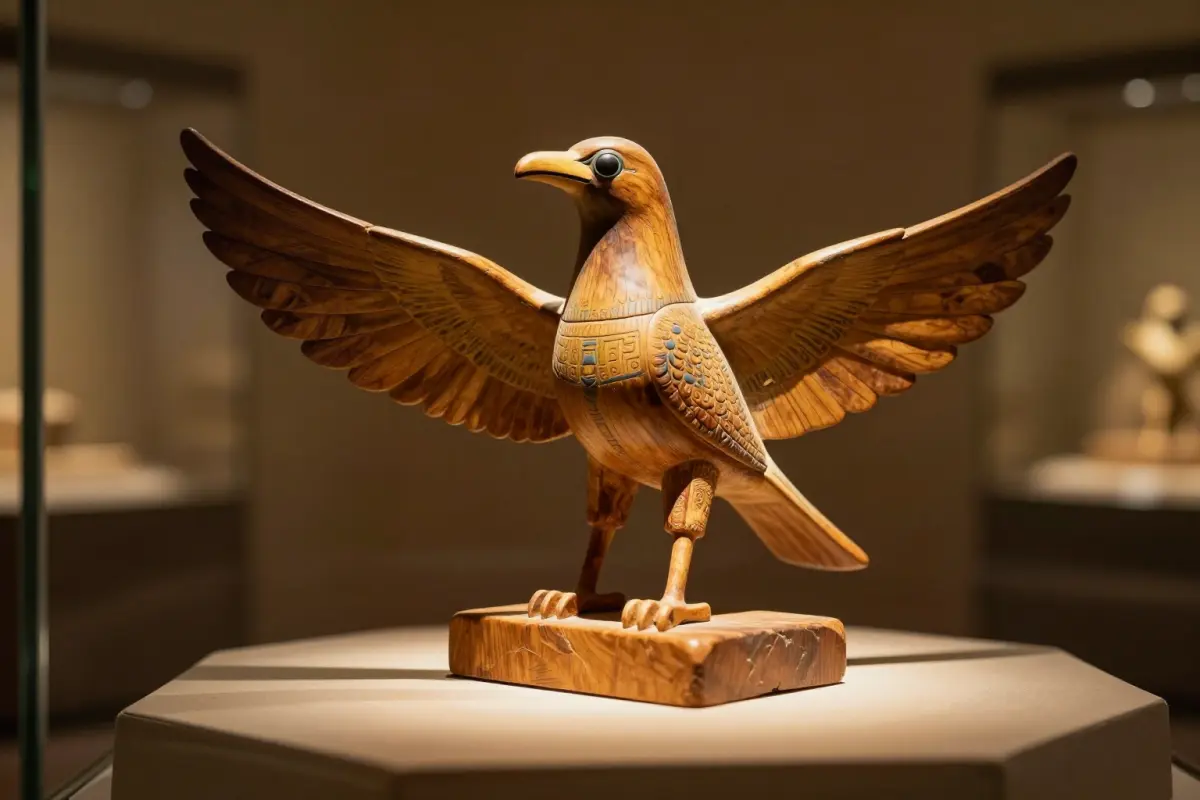
In the Egyptian Museum in Cairo, in a display case surrounded by the gilded treasures of pharaohs and the painted sarcophagi of nobles, sits a small wooden object that has generated one of the most heated debates in the history of archaeology. It is only 18 centimeters long, weighs a mere 39 grams, and was carved from a single piece of sycamore wood more than 2,200 years ago. To the casual observer, it looks like a simple bird figurine — the kind of object that might be found in any ancient tomb. But look more closely, and the Saqqara Bird becomes something far more puzzling. Its wings are straight and sharply angled, not curved like a bird in flight. Its body is sleek and streamlined, tapering to a point. Its tail rises vertically, like the tail fin of a modern aircraft, rather than fanning out horizontally like the tail feathers of any real bird. It has no legs, no feather detail, and no eyes — just a smooth, aerodynamic shape that some researchers have claimed bears an uncanny resemblance to a modern glider. Discovered in 1898 during the excavation of the Pa-di-Imen tomb at Saqqara, the world’s most ancient necropolis, the Saqqara Bird has been dismissed by mainstream Egyptologists as a ritual object, a child’s toy, or a weather vane. But a passionate minority of researchers have argued that this small wooden carving is evidence that the ancient Egyptians understood the principles of aerodynamics and flight centuries before anyone was supposed to.
The Saqqara necropolis is one of the most important archaeological sites in Egypt — a vast burial ground stretching for miles along the western bank of the Nile, south of Cairo. It served as the cemetery for the ancient capital of Memphis for over 3,000 years, from the earliest dynasties through the Ptolemaic period. The site contains the Step Pyramid of Djoser (c. 2670 BCE), the oldest stone pyramid in Egypt, along with dozens of other tombs, temples, and underground galleries. The Pa-di-Imen tomb where the Saqqara Bird was found dates to the Ptolemaic period (roughly 200 BCE), when Egypt was ruled by the Greek descendants of Alexander the Great’s general Ptolemy. The tomb belonged to a man named Pa-di-Imen, which translates to “gift of Amun,” and contained a variety of funerary goods typical of the period. The Saqqara Bird was catalogued as a simple bird figure — catalog number 6347 — and placed in storage, where it remained largely unnoticed for over sixty years.
The artifact is small enough to fit in the palm of a hand. Carved from sycamore wood, it measures approximately 14.2 centimeters (5.6 inches) in length with a wingspan of 18 centimeters (7.1 inches) and weighs only 39.12 grams (1.38 ounces). The bird was apparently designed to be mounted on a stick or pole, as evidenced by a hole in its underside. The wood has darkened with age, and the surface shows the patina of millennia, but the carving is precise and deliberate, suggesting the work of a skilled craftsman. For over sixty years, the Saqqara Bird sat in its case in Cairo, visited by thousands of tourists and scholars who passed it without a second glance.
That changed in the late 1960s, when Dr. Khalil Messiha, an Egyptian physician and amateur archaeologist with a keen interest in aerodynamics, visited the Egyptian Museum in Cairo and examined the artifact closely. What he saw convinced him that this was no ordinary bird figure — it was, he believed, a scale model of a glider. Messiha noted several features that distinguished the Saqqara Bird from typical Egyptian bird representations. The wings are straight and angled downward (a feature known as dihedral in aviation terminology), rather than curved as one would expect in a naturalistic bird carving. The tail fin rises vertically, perpendicular to the body — a configuration found in modern aircraft, not in any known species of bird. The object has no legs, no feather detail, no eyes, and no other ornithomorphic features. It is, Messiha argued, a purely aerodynamic shape. He went further, claiming that the Saqqara Bird’s proportions — its fuselage-to-wingspan ratio, its center of gravity, its vertical stabilizer — all corresponded to modern aircraft design principles. His claims attracted significant attention, particularly when the Saqqara Bird was featured in books and documentaries about ancient mysteries.
In 1991, the British researcher Martin Gregorie conducted a detailed study of the Saqqara Bird. Gregorie built several replicas and tested them as gliders. His findings were unequivocal: the Saqqara Bird, in its original form, cannot fly. Without the addition of a horizontal tailplane — a feature the original artifact entirely lacks — the model is aerodynamically unstable and would pitch forward and crash immediately. Only when Gregorie added a modern horizontal stabilizer (something not present on the original carving) did the model achieve any kind of stable flight, and even then, it performed poorly compared to purpose-built gliders.
In 2023, researchers at the Institute of Aerospace Technology Bremen conducted the most rigorous scientific analysis of the Saqqara Bird to date. Using computational fluid dynamics (CFD) simulations based on a precise 3D scan of the artifact, the team modeled the Saqqara Bird’s aerodynamic behavior with modern engineering tools. Their results were published in a peer-reviewed study and thoroughly debunked the ancient aircraft hypothesis. The analysis revealed multiple fundamental problems with the claim that the Saqqara Bird represents a functional aircraft. The artifact’s maximum glide ratio was found to be extremely low. More critically, the center of mass is located near the trailing edge of the wing, behind the neutral point, rendering the object unstable in pitch — it would nose-dive uncontrollably if launched from any height. The CFD simulation also showed an asymmetric lift distribution across the wingspan, which would cause it to roll uncontrollably during flight. The researchers concluded that their results are “not consistent with the suggestion that the Saqqara Bird demonstrates ancient knowledge of aerodynamics.”
If the Saqqara Bird is not a model aircraft, then what is it? The most widely accepted interpretation is that it was a ceremonial or votive object representing a falcon — the bird form most sacred in Egyptian religion. The falcon was the physical manifestation of Horus, one of the most important deities in the Egyptian pantheon, associated with kingship, the sky, and divine protection. Falcon figures are among the most common religious artifacts found in Egyptian tombs. Another compelling hypothesis is that the Saqqara Bird served as a weather vane or masthead ornament for sacred boats used during religious festivals. Reliefs in the Temple of Khonsu at Karnak, dating to the late New Kingdom, show ceremonial boats with bird-shaped ornaments mounted on their masts. The hole in the underside of the Saqqara Bird, designed to mount it on a stick or pole, is consistent with this function.
The Saqqara Bird’s fame extends far beyond Egyptological circles, largely thanks to the Swiss author Erich von Däniken, whose 1968 bestseller Chariots of the Gods? popularized the ancient astronaut hypothesis. Von Däniken cited the Saqqara Bird as evidence that extraterrestrial beings had visited ancient Egypt and shared advanced knowledge, including the principles of flight, with early civilizations. In the decades since, the Saqqara Bird has appeared in countless documentaries and books promoting alternative theories about ancient technology. However, this narrative has been consistently challenged by the scientific community. There are no ancient Egyptian texts describing flight, no depictions of aircraft in tomb paintings, and no other artifacts suggesting aerodynamic knowledge. The Egyptians were masterful engineers — they built the pyramids — but there is no evidence they ever attempted to build flying machines.
The real history of human flight begins much later. Abbas ibn Firnas, a 9th-century Andalusian polymath, is credited with one of the earliest recorded attempts at manned flight. In approximately 875 CE, ibn Firnas constructed a glider-like device and launched himself from a height, reportedly staying airborne for several moments before crashing. The scientific understanding of flight had to wait until Sir George Cayley, the English engineer sometimes called the “father of aviation,” who identified the four fundamental forces of flight — weight, lift, drag, and thrust — in the early 1800s. The first powered, controlled flight was achieved by Orville and Wilbur Wright at Kitty Hawk, North Carolina, in 1903.
The Saqqara Bird remains one of those artifacts that captures the imagination precisely because it resists easy categorization. What makes it genuinely interesting is not the claim that it proves ancient flight, but rather what it reveals about the sophistication of ancient Egyptian craftsmanship. The object is carved from a single piece of sycamore wood with remarkable precision. Its smooth, streamlined form demonstrates an intuitive aesthetic appreciation for aerodynamic shapes, even if its creator had no formal understanding of the physics involved. The Saqqara Bird also serves as a valuable case study in the difference between resemblance and evidence. The fact that an ancient artifact looks like a modern technology does not mean it functioned as one. Scientific analysis — from Gregorie’s replica tests to the 2023 CFD study — has repeatedly demonstrated that the Saqqara Bird cannot fly. Today, the Saqqara Bird remains in the Egyptian Museum in Cairo, catalog number 6347, where it continues to draw visitors fascinated by its enigmatic form — a small wooden carving that has achieved a kind of immortality its maker could never have imagined.
References & Further Reading
Wikipedia: Horus — The falcon-headed Egyptian god most likely represented by the Saqqara Bird
Editorial note: the Saqqara Bird is documented in the Egyptian Museum in Cairo (catalog number 6347). Key sources include Khalil Messiha’s published paper, Martin Gregorie’s 2003 aerodynamic analysis, and the extensive archaeological record of the Saqqara necropolis. See our Editorial Policy.