The Lost City of Heracleion: An Ancient Egyptian Metropolis Hidden Beneath the Sea for 1,200 Years
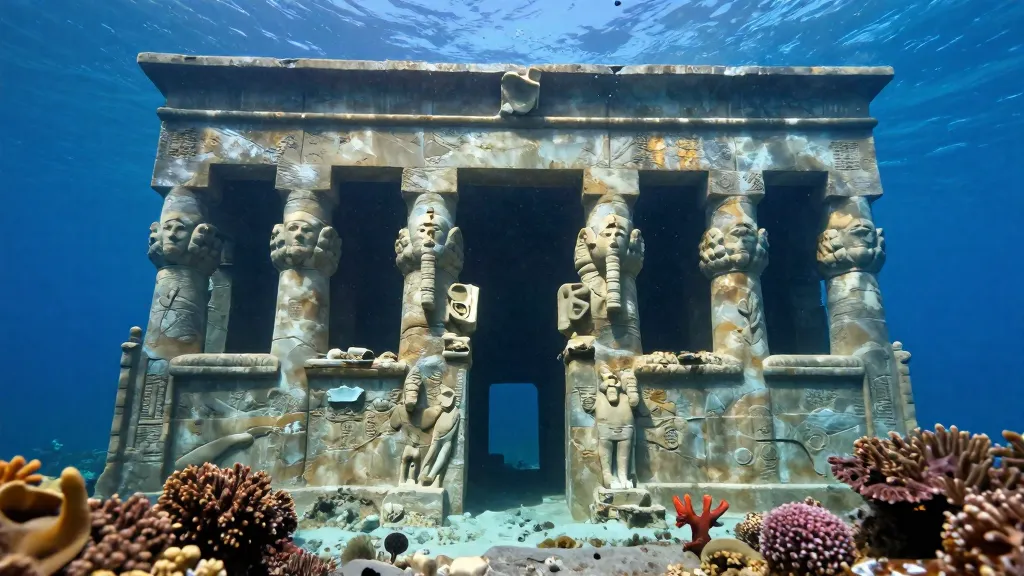
For over a thousand years, it existed only as a whisper in ancient texts — a magnificent port city at the mouth of the Nile, mentioned by Herodotus in the fifth century BCE and described by the geographer Strabo four centuries later, but never found. No ruins. No traces. No evidence that it had ever existed at all. Scholars began to wonder if Thonis-Heracleion — the city the Egyptians called Thonis and the Greeks called Heracleion — was merely a legend, a poetic invention of ancient historians. Then, in 2000, French underwater archaeologist Franck Goddio and his team at the European Institute for Underwater Archaeology (IEASM), working in cooperation with the Egyptian Supreme Council of Antiquities, made one of the most extraordinary archaeological discoveries of the modern era. Lying beneath approximately 6.5 kilometers of Mediterranean seabed off the coast of Abu Qir Bay, near Alexandria, at a depth of roughly 10 meters, were the ruins of an entire ancient city — temples, harbors, statues, ships, and thousands of artifacts, preserved in the silt of the Nile delta for over twelve centuries. The lost city of Heracleion was real. And it was spectacular.
The significance of the discovery cannot be overstated. Before the founding of Alexandria in 331 BCE by Alexander the Great, Thonis-Heracleion was Egypt’s primary port on the Mediterranean — the obligatory point of entry for all ships arriving from the Greek world. It was a thriving, cosmopolitan city where Egyptian and Greek cultures met, mingled, and exchanged goods, ideas, and religious practices. Founded probably around the 8th century BCE, the city flourished for centuries as a center of trade and religious ceremony. Its Temple of Amun-Gereb was one of the most important religious sanctuaries in late-period Egypt, playing a central role in the pharaonic rites of dynastic succession. The city’s legendary origins were attributed to Heracles (Hercules) himself, who was said to have first set foot on Egyptian soil at this very spot. According to Herodotus, Helen of Troy and her lover Paris visited Heracleion before the Trojan War, taking refuge in the temple during a storm. The city was not merely a trading post — it was a sacred landscape, a gateway between the civilizations of the Mediterranean and the ancient kingdom of the pharaohs.
The search for Thonis-Heracleion began in 1996, when Franck Goddio and his team at IEASM began a systematic survey of the western part of Abu Qir Bay, northeast of Alexandria. Goddio, a former financial executive who had left the business world to pursue underwater archaeology, had already made a name for himself with discoveries of sunken ships and submerged landscapes in the Philippines and elsewhere. The Abu Qir Bay project was his most ambitious undertaking: an attempt to map and explore a vast underwater area covering approximately 11 by 15 kilometers of seabed, using the most sophisticated survey technology available, including side-scan sonar, magnetometers, sub-bottom profilers, and nuclear magnetic resonance magnetometers. The team surveyed the seabed methodically, building a detailed topographic map of the underwater landscape. For four years, the work was painstaking and often frustrating — the seabed was covered in centuries of accumulated sediment, and the ruins lay hidden beneath layers of clay and sand.
The breakthrough came in 2000. As the team refined their surveys and began targeted excavations, they started finding unmistakable evidence of an ancient city. First came fragments of pottery and building materials, then larger structures — the foundations of buildings, sections of walls, and eventually, the massive stone blocks of a great temple. The scale of the discovery was breathtaking. Among the most dramatic early finds was a colossal red granite statue of the god Hapy, the Egyptian deity of the Nile’s annual flood, standing approximately 5.4 meters (over 17 feet) tall — a monument of pharaonic grandeur that had lain unseen on the seabed for over a millennium. The discovery of a black granite stele bearing a bilingual inscription in Egyptian hieroglyphs and Greek text confirmed the city’s identity beyond doubt: this was Thonis-Heracleion. Another significant find was a massive stele of pharaoh Nectanebo I (c. 378–362 BCE), perfectly preserved, which referred to the settlement by both its Egyptian name, Thonis, and its Greek name, Heracleion — the definitive proof that the legendary city of the ancient texts and the underwater ruins were one and the same.
Thonis-Heracleion was not a small coastal village — it was a major port city and trading emporium that for centuries served as Egypt’s primary gateway to the Mediterranean. Built on a network of adjoining islands in the Nile Delta, the city was intersected by canals and waterways, with numerous harbors and anchorages. Its wharves, temples, and tower-houses were linked by ferries, bridges, and pontoons, creating a watery urban landscape somewhat reminiscent of medieval Venice. At the heart of the city stood the great temple of Amun-Gereb, the supreme god of the Egyptians during the Late Period. This massive temple complex, which King Nectanebo I expanded with numerous additions in the fourth century BCE, was surrounded by subsidiary sanctuaries dedicated to Osiris, Khonsu (known to the Greeks as Herakles, giving the city its Greek name), and other deities. Archaeological evidence shows that the sanctuaries at Heracleion were famous throughout the ancient world for miraculous healing, attracting pilgrims from across the Mediterranean.
One of the most remarkable discoveries at Thonis-Heracleion was evidence of the annual celebration of the Mysteries of Osiris, one of the most important religious festivals in ancient Egypt. Each year during the month of Khoiak (roughly October–November), the god Osiris, placed in a ceremonial barque, was carried in a grand procession from the temple of Amun at Heracleion to his shrine at Canopus. This ritual reenacted the myth of Osiris’s death and resurrection and was believed to ensure the annual flooding of the Nile and the fertility of the land. Archaeologists found elaborate model barques — miniature ceremonial boats made of lead, copper alloy, and wood, featuring intricate decoration — that had been deposited as votive offerings during these processions. Greek mercenaries were employed to defend the city as early as the Twenty-sixth Dynasty, and recent archaeological findings suggest that Greeks had started to take root in the city well before the Ptolemaic period. The city served as a cultural bridge between Egyptian and Greek civilization, with temples and rituals blending elements of both traditions.
The disappearance of Thonis-Heracleion is one of the most dramatic examples of urban destruction by natural forces in the ancient world. The city did not collapse overnight but was gradually destroyed by a combination of earthquakes, tsunamis, rising sea levels, and soil liquefaction over several centuries. The critical event occurred around 101 BCE, when a severe flood — likely triggered by an earthquake — caused the ground beneath the city’s central island to undergo soil liquefaction. The hard clay on which Heracleion was built suddenly turned into liquid, and the buildings, temples, and monuments collapsed into the water. Before this catastrophe, the city had already been in decline. The rise of Alexandria, founded by Alexander the Great in 331 BCE and situated about 15 miles to the southwest, had gradually eclipsed Heracleion as Egypt’s primary port. By the second century BCE, most international trade had shifted to Alexandria, and Heracleion’s economic importance was fading. A few residents clung to the remnants of the city during the Roman era and the beginning of Arab rule, but by the end of the eighth century CE, what remained of Thonis-Heracleion had sunk permanently beneath the Mediterranean.
The underwater excavations have produced an astonishing array of artifacts. Colossal stone statues of pharaohs, queens, and gods, some standing over 5 meters tall, remarkably preserved beneath the sea floor, testify to the monumental scale of the city’s religious architecture. Gold jewelry and precious objects — rings, earrings, and pendants of exquisite craftsmanship — suggest the wealth of the city’s inhabitants and the luxury goods that passed through its ports. Hundreds of stone anchors of various sizes and designs correspond to Egyptian, Greek, and Phoenician vessels, providing physical evidence of the diverse trading networks that converged at Heracleion. Perhaps most astonishingly, seventy-two ancient shipwrecks have been discovered in the harbor area, making this one of the largest concentrations of ancient vessels ever found. The ships carried amphorae from across the Mediterranean — Greek wine jars, Phoenician storage vessels, Egyptian containers — painting a vivid picture of a thriving international port.
The ancient Greek historians who wrote about Thonis-Heracleion wove the city into some of the most famous legends of the ancient world. Herodotus told the story of Paris and Helen of Troy seeking refuge at the Canopic mouth of the Nile, where Paris’s servants fled to a nearby temple and the watchman Thonis captured their ships. Diodorus Siculus connected the city to the legend of Heracles himself, claiming the hero had tamed a catastrophic flood of the Nile and restored the river to its proper course. These legends, once dismissed as pure mythology, gained new significance after the city’s discovery. The existence of a major port at the Canopic mouth of the Nile, with temples to Heracles and other Greek deities, provided a plausible historical foundation for stories that had been passed down for millennia.
Today, the excavation of Thonis-Heracleion continues. Only a fraction of the site has been fully explored, and each diving season brings new revelations. Many of the most spectacular artifacts have been displayed in major museum exhibitions worldwide, including the British Museum in London and the Institut du Monde Arabe in Paris. The sand and debris that covered the ruins for over a millennium actually preserved them remarkably well, protecting the site from looters and the destructive effects of exposure. The story of Heracleion is a reminder that the Mediterranean seabed still holds extraordinary secrets — and that sometimes, the most spectacular archaeological discoveries are not made on land, but beneath the waves. A city that was lost for 1,200 years is finally telling its story, and we are only beginning to listen.
References & Further Reading
Wikipedia: Franck Goddio — Biography of the underwater archaeologist who discovered Heracleion
Wikipedia: Canopus, Egypt — The nearby ancient city that was also partially submerged
Wikipedia: Abu Qir Bay — The body of water where both Heracleion and Canopus were discovered
Editorial note: archaeological research at Thonis-Heracleion is ongoing, and new finds continue to expand our understanding of the site. See our Editorial Policy.