Göbekli Tepe: The World's Oldest Temple and the Mystery of Who Built It
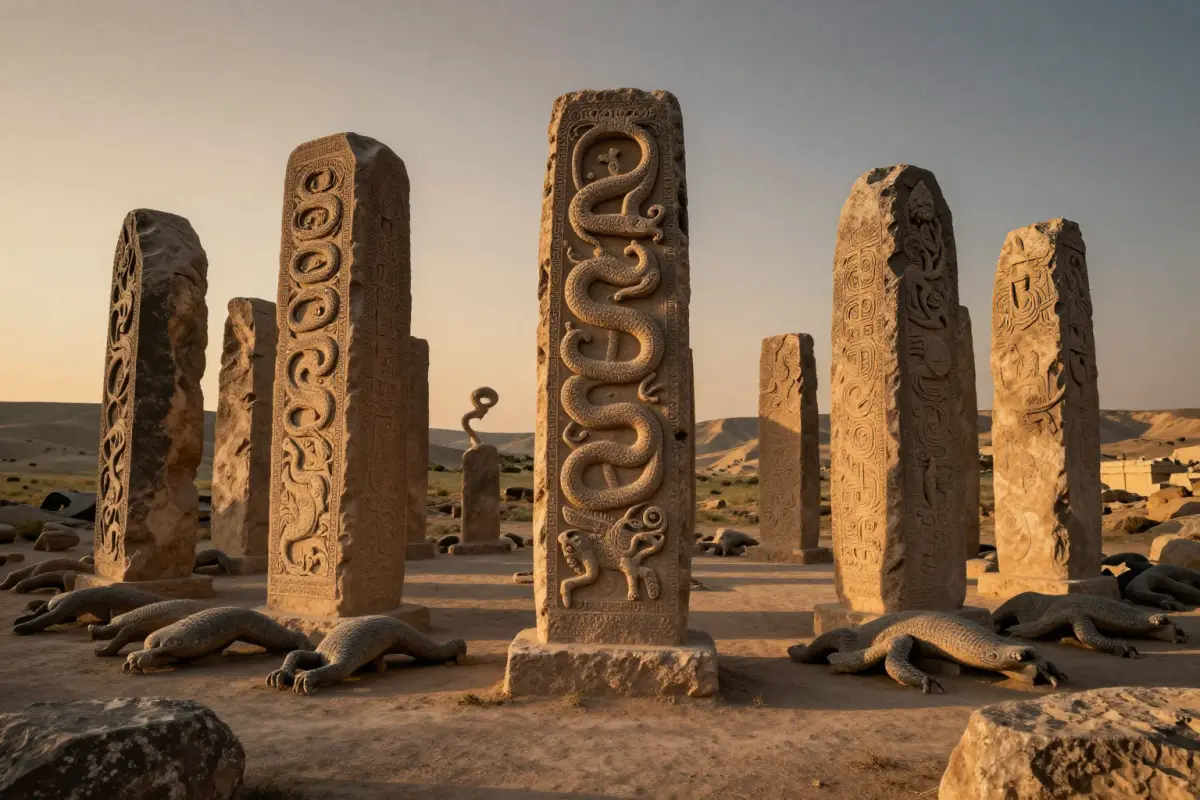
In the rolling limestone hills of southeastern Turkey, roughly twelve kilometers northeast of the city of Şanlıurfa, there lies a low, rounded mound that looks, to the untrained eye, like nothing more than an unremarkable bump in the landscape. Beneath that mound, however, lies one of the most extraordinary archaeological discoveries in human history — a vast complex of monumental stone enclosures built approximately 11,600 years ago, around 9600 BCE, during the Pre-Pottery Neolithic A period. This is Göbekli Tepe — the oldest known temple in the world. Its massive T-shaped limestone pillars, some standing over 5.5 meters tall and weighing up to ten metric tons, are arranged in great circular enclosures and carved with elaborate reliefs of animals: foxes, boars, snakes, scorpions, vultures, lions, and gazelles. The site predates Stonehenge by roughly six thousand years and the Egyptian pyramids by approximately seven thousand years. It was built, used, and then deliberately buried by people who had not yet invented agriculture, pottery, metalworking, or the wheel — communities of hunter-gatherers who somehow organized themselves to quarry, transport, carve, and erect monumental stone architecture on a scale that would not be seen again for millennia. The discovery of Göbekli Tepe has fundamentally rewritten our understanding of human prehistory, overturning the long-held assumption that organized religion and monumental architecture were products of settled agricultural societies. At Göbekli Tepe, it appears, religion came first — and agriculture may have followed.
The implications of Göbekli Tepe are staggering. Before its discovery, the dominant narrative of human civilization held that the Neolithic Revolution — the transition from hunting and gathering to agriculture and permanent settlement — was the prerequisite for everything that followed: cities, temples, writing, kings, and organized religion. The logic seemed sound: only settled agricultural communities with food surpluses could afford to support specialized workers who did not produce food. Göbekli Tepe shattered this narrative. Here was a monumental ceremonial complex built by people who had not yet domesticated a single plant or animal. The site’s discoverer, the German archaeologist Klaus Schmidt (1953–2014), proposed a radical inversion of the traditional model: perhaps it was not agriculture that enabled organized religion, but organized religion that drove the development of agriculture. The need to feed large numbers of people gathered for communal construction and religious ceremonies at Göbekli Tepe may have provided the impetus for the deliberate cultivation of wild cereals — the first steps toward the agricultural revolution that would transform humanity.
Göbekli Tepe’s story as an archaeological site began in 1963, when a joint survey team from the University of Chicago and Istanbul University conducting a reconnaissance of sites in southeastern Turkey noted the mound and recorded it in their survey records. However, the team dismissed the site as a medieval cemetery, noting the presence of broken limestone fragments on the surface but failing to recognize their true significance. The mound sat undisturbed for another three decades. In 1994, Klaus Schmidt, an archaeologist affiliated with the German Archaeological Institute (DAI), was examining the old Chicago survey records as part of a broader study of prehistoric sites in the region. Schmidt had recently completed work at the nearby Neolithic site of Nevalı Çori, where T-shaped limestone pillars had been discovered in the 1980s — the first such pillars ever found. When Schmidt read the survey description of Göbekli Tepe and saw the note about limestone fragments on the surface, he immediately suspected that the site might contain similar architecture. He traveled to the mound, examined the surface finds, and recognized within minutes that the flint tools and limestone fragments dated not to the medieval period but to the Pre-Pottery Neolithic — thousands of years earlier than anyone had imagined possible for such monumental construction.
Schmidt began systematic excavations in 1995, working with a team from the German Archaeological Institute and Turkish archaeologists. What they uncovered over the following years exceeded his wildest expectations. Beneath the mound lay a series of large circular enclosures, each defined by a ring of massive T-shaped limestone pillars set into stone walls. The enclosures were carefully constructed, with the largest pillars positioned in pairs at the center and smaller pillars arranged around the perimeter. The pillars were elaborately carved with relief sculptures of animals, abstract symbols, and, in some cases, what appear to be stylized human features — arms, hands, belts, and loincloths. The workmanship was extraordinary, especially given that the carvers used only stone tools. No metal tools existed at this time. Schmidt and his team eventually identified four main enclosures, designated Enclosures A through D, with geophysical surveys suggesting that as many as twenty additional enclosures might lie buried beneath the unexcavated portions of the mound. The site covers approximately nine hectares (about 22 acres), making it a substantial ceremonial complex. Schmidt would devote the rest of his life to Göbekli Tepe, leading excavations until his death in 2014. His work earned the site recognition as a UNESCO World Heritage Site in 2018.
At the heart of Göbekli Tepe are its monumental circular enclosures, each consisting of a ring of massive T-shaped pillars surrounding two even larger central pillars. To date, archaeologists have identified at least twenty enclosures through geophysical surveys, though only about ten percent of the site has been excavated. Enclosure D, the largest and most impressive, contains two central pillars each approximately 5.5 meters tall. These pillars are adorned with detailed carvings: one features a fox, the other a boar, and both show stylized human arms and hands extending along their sides, as if the pillars themselves are abstract human figures. The surrounding ring pillars are similarly decorated with a menagerie of animals. The craftsmanship is extraordinary — the reliefs are crisp, detailed, and executed with a level of skill that suggests the carvers were experienced artisans. The enclosures were roofed, according to recent archaeological analysis, with evidence suggesting they were covered by timber and earth structures. The floors were made of polished terrazzo-like limestone, a remarkably advanced flooring technique for a society that had not yet invented pottery.
The carved reliefs on Göbekli Tepe’s pillars constitute one of the earliest known bodies of figurative art in human history. The animals depicted are exclusively wild species: foxes, wild boars, lions, leopards, snakes, scorpions, vultures, cranes, ducks, spiders, and bulls. Notably absent are any domesticated animals — no sheep, goats, cattle, or dogs — consistent with the Pre-Pottery Neolithic date, before the advent of animal husbandry. The choice of animals and their arrangement on specific pillars appears deliberate and meaningful. Some scholars have suggested that the animal reliefs represent clan totems or spirit animals, with different groups contributing pillars decorated with their particular symbolic creature. Others have interpreted the carvings as part of a shamanic cosmology, with dangerous animals like snakes and scorpions representing the underworld, soaring birds like vultures representing the sky, and powerful predators like lions representing the earth. The vulture carvings have attracted particular attention: on one pillar in Enclosure D, a vulture is depicted with its wings spread wide, alongside what appears to be a headless human figure. Some researchers have connected this imagery to excarnation — the practice of exposing human corpses to be defleshed by scavenging birds, a funerary practice documented in several ancient cultures. If this interpretation is correct, Göbekli Tepe may have been associated with cult of the dead rituals.
Göbekli Tepe’s most profound contribution to archaeology may be its impact on our understanding of the Neolithic Revolution — the transition from hunter-gatherer societies to agricultural civilizations. The conventional narrative held that agriculture provided the food surplus necessary to support large settled communities, which in turn developed monumental architecture, specialized labor, and complex social hierarchies. But Göbekli Tepe turns this sequence on its head. Here we have monumental architecture built before agriculture, before permanent settlements, and before any of the social structures traditionally assumed to be prerequisites for such projects. Schmidt argued that the need to feed the large workforce required to build and maintain Göbekli Tepe may have driven the intentional cultivation of wild cereals. The site is surrounded by the wild ancestors of modern wheat — particularly einkorn wheat, which genetic studies have traced to the Karacadağ mountains, just thirty kilometers from Göbekli Tepe. The massive organizational demands of construction may have pushed hunter-gatherers to develop more intensive methods of food production, eventually leading to full-scale agriculture. In this interpretation, Göbekli Tepe did not result from civilization — it caused civilization.
Recent discoveries have complicated this picture somewhat. Excavations since 2016 have uncovered domestic structures, extensive cereal processing evidence, a sophisticated water supply system, and tools associated with daily life at the site. This suggests that Göbekli Tepe may have been more of a permanent settlement than previously thought, not purely a ceremonial site visited by nomadic pilgrims. The water system, which included carved channels feeding rock-cut cisterns capable of holding at least 150 cubic meters of water, indicates advanced planning and long-term occupation. The enclosures also appear to have been regularly buried deliberately — filled in with soil, stone, and organic material before new enclosures were built on top. This practice of ritual burial may explain why the site was preserved so well over thousands of years, though the reasons for it remain debated. Possibilities include ritual decommissioning, the desire to preserve the sacred space, or a shift in religious practices that required the old temples to be hidden before new ones could be constructed.
The T-shaped pillars are the defining feature of Göbekli Tepe, and their meaning remains one of the site’s most debated questions. Approximately two hundred pillars have been identified through excavation and geophysical survey, ranging from small examples of about three meters to giants exceeding 5.5 meters in height. The anthropomorphic interpretation — that the pillars represent stylized human figures — is supported by several lines of evidence. Many pillars have carved arms and hands extending down their sides, with fingers clearly delineated. Some feature what appear to be belts, loincloths, and animal-skin garments. The T-top may represent a head, rendered in abstract form. If this interpretation is correct, the enclosures can be understood as gatherings of stone ancestors or supernatural beings, with the central pair representing the most important figures and the surrounding ring representing lesser entities. The T-shape is found at other contemporary sites in the region, including Karahan Tepe and Nevalı Çori, part of a broader cultural complex known as the Taş Tepeler (“Stone Hills”). Alternative interpretations include the idea that the pillars represent world pillars or axis mundi symbols — cosmic supports connecting the earth to the sky, a motif found in many ancient mythologies.
Only about ten percent of Göbekli Tepe has been excavated. Geophysical surveys suggest that the vast majority of the site — including perhaps dozens more enclosures — still lies buried beneath the mound, waiting to be uncovered. Each new excavation season brings fresh surprises and new questions. The Turkish government has embraced Göbekli Tepe as a national treasure, investing heavily in site preservation and a state-of-the-art visitor center that opened in 2019, allowing tourists to view the excavated enclosures from elevated walkways. The site is located about fifteen kilometers northeast of Şanlıurfa, which can be reached by domestic flights from Istanbul and other Turkish cities. What Göbekli Tepe ultimately means for human history is still being written. The site demonstrates that hunter-gatherer societies were capable of complex organization, specialized labor, and sophisticated artistic expression thousands of years before the invention of farming. It suggests that the drive to build monuments may have been one of the forces that spurred the development of agriculture, rather than the other way around — a revolutionary idea that continues to reshape our understanding of where we came from and what our ancestors were capable of achieving.
References & Further Reading
Wikipedia: Karahan Tepe — The nearby T-pillar site that may be even older than Göbekli Tepe
Editorial note: Archaeological understanding of Göbekli Tepe continues to evolve rapidly as new excavations and analytical techniques yield fresh insights. See our Editorial Policy.