Thutmose II Tomb: The Lost Pharaoh Found
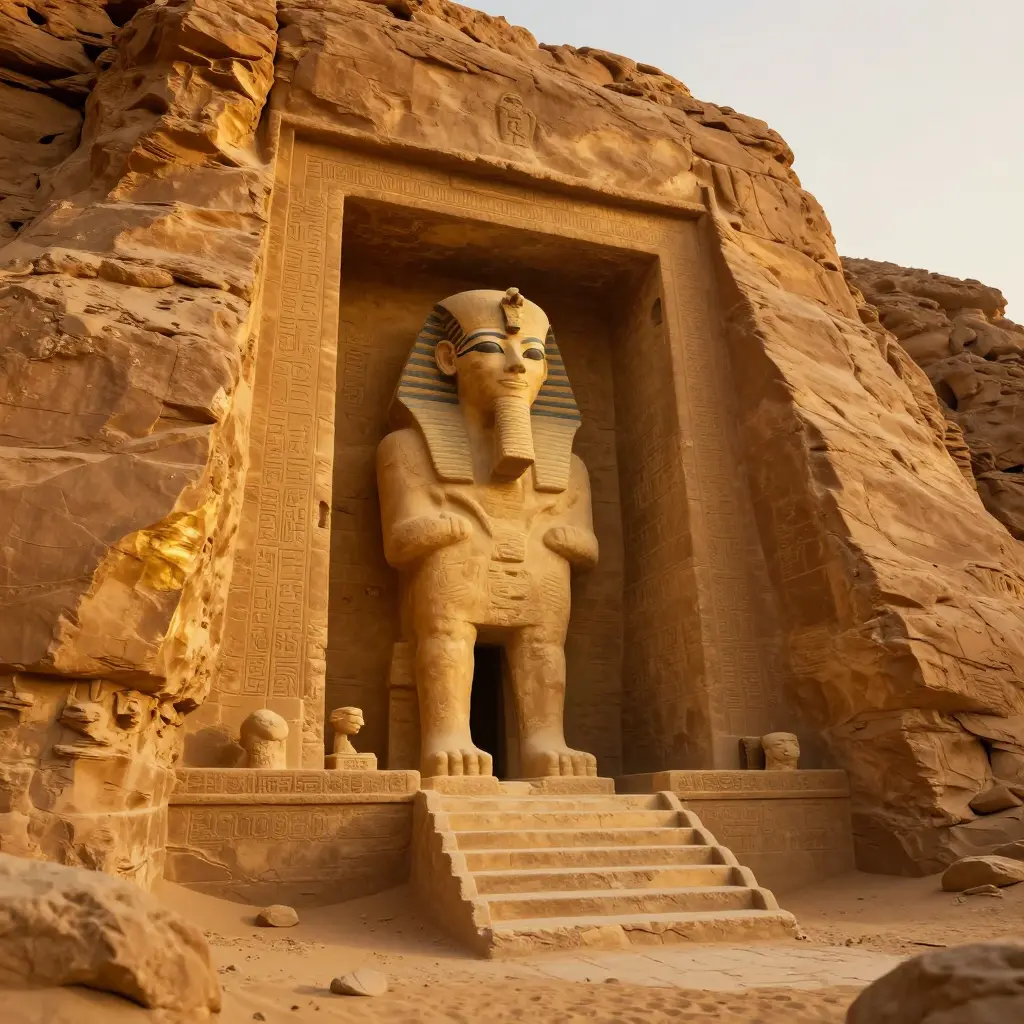
In February 2025, the Egyptian Ministry of Tourism and Antiquities made an announcement that sent shockwaves through the archaeological world: the long-lost tomb of Pharaoh Thutmose II, ruler of Egypt during the 18th Dynasty (circa 1493–1479 BCE), had been found. The discovery was extraordinary not merely because Thutmose II was a pharaoh — Egypt is, after all, a land of pharaohs — but because his tomb was the first royal Egyptian tomb discovered since Howard Carter found Tutankhamun’s in 1922. That is a gap of over one hundred years. In that century, humanity split the atom, walked on the Moon, mapped the human genome, and connected the world through the internet — and yet, despite all of our technology and all of our accumulated knowledge, the burial place of a king who ruled three and a half thousand years ago had remained hidden beneath the desert sands.
The tomb was located not in the famous Valley of the Kings, where most 18th Dynasty pharaohs were buried, but in a remote, rugged area called the Western Wadis, approximately 2.45 kilometers from the Valley of the Kings, in a location known as Wadi Gabbanat el-Qurud. The joint Egyptian-British archaeological mission was led by Dr. Piers Litherland, an honorary research associate at the University of Cambridge’s archaeology department, working under the auspices of the New Kingdom Research Foundation. What they found was a tomb that had been devastated by ancient flooding, its contents scattered, its decorations fragmentary — but unmistakably royal. When Litherland first entered the burial chamber and saw a section of intact ceiling painted blue with yellow stars, he knew immediately what he was looking at. Blue-painted ceilings with yellow stars are only found in kings’ tombs. He emerged from the tomb, saw his wife waiting outside, and, as he later recalled: “The only thing I could do was burst into tears.”
The significance of the discovery extends far beyond a single pharaoh’s resting place. Thutmose II was one of the most important transitional figures of the early New Kingdom. He was the husband of Hatshepsut, one of Egypt’s most powerful and famous female pharaohs, who assumed the throne after his death. He was the father of Thutmose III, the military genius known as the “Napoleon of Ancient Egypt,” who led 17 military campaigns and expanded Egypt’s empire to its greatest extent. The tomb fills a critical gap in our understanding of early 18th Dynasty royal burial practices — the period when the tradition of burying pharaohs in the Theban Necropolis was still evolving. It also raises new questions: Why was Thutmose II buried so far from the Valley of the Kings? What happened to the tomb’s contents? And what can the surviving fragments tell us about a reign that has been largely overshadowed by those of his wife and son?
Thutmose II (sometimes spelled Thutmosis or Tuthmosis) was the fourth pharaoh of the 18th Dynasty, ruling Egypt for approximately thirteen years, from about 1493 to 1479 BCE. He was the son of Thutmose I, a powerful warrior-pharaoh who campaigned in Nubia and Syria, and a secondary wife named Mutnofret. He inherited a vast and wealthy kingdom from his father, but his reign is generally considered modest in comparison to those of his predecessors and successors. He conducted at least one military campaign in Nubia and may have led expeditions in the Levant, but the surviving records suggest he was not the military dynamo his father and son would become. He was, however, a builder: he added to the temple complex at Karnak and commissioned construction projects throughout Egypt.
Thutmose II’s personal life was deeply intertwined with the politics of royal succession. He married his half-sister Hatshepsut, the daughter of Thutmose I and his Great Royal Wife Ahmose — a common practice in the Egyptian royal family, designed to consolidate power and maintain the purity of the royal bloodline. With Hatshepsut, Thutmose II fathered a daughter, Neferure, but no surviving male heir. He also fathered a son, Thutmose III, with a secondary wife named Isis. When Thutmose II died, probably in his thirties, Thutmose III was still a young child. Hatshepsut initially served as regent for her stepson but eventually assumed the full title of pharaoh, becoming one of the most remarkable rulers in Egyptian history. The mummy attributed to Thutmose II, found in the Deir el-Bahari cache (DB320) in 1881, shows signs of poor health, including skin diseases and a weakened constitution, which may explain his relatively short life and undistinguished reign.
The story of the tomb’s discovery is a testament to patience, persistence, and the careful methodology of modern archaeology. The joint Egyptian-British mission had been conducting broader archaeological work across the Western Wadis — a rugged, remote area west of Luxor that had received far less archaeological attention than the nearby Valley of the Kings. The team was not specifically looking for Thutmose II’s tomb; they were conducting clearance work and searching for foundation deposits — ritual offerings placed by ancient builders at the foundations of tombs and temples. The Western Wadis had long been associated with the burials of royal women, including queens and princesses of the 18th Dynasty, which made the area archaeologically interesting but not necessarily a place where one would expect to find a pharaoh’s tomb.
The breakthrough came on October 31, 2022, when team members Ashraf Omar Ali and Heraji Sayed Ahmed noticed a softness in the ground surface — a subtle depression that suggested something lay beneath. Excavation revealed the entrance to a previously unknown tomb, designated Wadi C-4. The tomb had been sealed since the Third Intermediate Period (circa 1069–664 BCE), and its main axis was filled with densely packed debris that had been deposited by repeated flooding and had hardened to a concrete-like consistency. The flooding had also compromised the structural integrity of the tomb’s ceilings, causing partial collapses that made the excavation slow, dangerous, and painstaking. Litherland and his team spent months carefully removing the debris, documenting every fragment and every piece of evidence. A preliminary report was published in Egyptian Archaeology magazine, Issue 63, in 2023, in which Litherland posed the tantalizing question: “Has the Tomb of Thutmose II been found?” The official announcement by the Egyptian Ministry of Tourism and Antiquities came in February 2025, confirming the identification.
The critical evidence that identified the tomb as royal was architectural. When the team reached the burial chamber, they found that part of the ceiling was still intact: a blue-painted ceiling with yellow stars. This is a distinctive decorative feature found exclusively in pharaonic tombs. No private individual, no matter how wealthy or powerful, was permitted to have a star-painted ceiling in their tomb. The blue-and-yellow starry ceiling was a royal prerogative, representing the night sky and the pharaoh’s journey through the underworld to join the circumpolar stars — the “imperishable ones” that never set below the horizon. Additionally, the team found traces of a khekher frieze — a decorative motif of stylized flowers that was another hallmark of royal tombs. Small fragments of plaster bearing sections of the Amduat (“What is in the Netherworld”) were also recovered. The Amduat was a funerary text that described the sun god Ra’s journey through the twelve hours of the night, and its presence in a tomb was reserved for royalty. Together, these features left no doubt: this was the tomb of a pharaoh.
The tomb of Thutmose II, designated Wadi C-4, is a rock-cut tomb carved into the limestone cliffs of the Wadi Gabbanat el-Qurud. Its layout comprises two corridors and four roughly rectangular chambers of varying sizes. The tomb is “bent to the left” — meaning that the axis of the tomb turns to the left, a feature characteristic of early 18th Dynasty royal tombs. The floor of the corridor was coated in white plaster, a relatively simple finish compared to the elaborate painted decorations found in later royal tombs. The overall design is less complex and less elaborate than the tombs of later 18th Dynasty pharaohs like Thutmose III or Amenhotep III, suggesting that the tradition of royal tomb-building in this area was still in its formative stages.
The tomb’s location is one of its most puzzling aspects. Why was Thutmose II buried in the Western Wadis, rather than in the Valley of the Kings, where his father Thutmose I and later 18th Dynasty pharaohs were interred? The answer may lie in the evolving understanding of royal tomb placement during the early New Kingdom. The Valley of the Kings was not yet the established burial ground it would become; the early 18th Dynasty pharaohs appear to have experimented with different locations. Thutmose II’s tomb may represent an intermediate stage between the burial practices of the Middle Kingdom and the fully developed Valley of the Kings tradition. Its location in an area associated with royal women — near the tombs of three queens identified as the wives of Thutmose III — may also suggest a deliberate connection to the female members of the royal family, particularly his powerful wife Hatshepsut, whose famous mortuary temple at Deir el-Bahari lies nearby.
What the archaeologists found inside the tomb was, by any measure, heartbreaking. The tomb had been devastated by repeated flooding over the millennia, which filled the main axis with densely packed debris and caused the ceiling to partially collapse. The flooding was so severe that the debris hardened to a concrete-like consistency, making excavation extraordinarily difficult. Most of the tomb’s original contents were gone, likely removed in antiquity during the reburial operations that moved many royal mummies to the Deir el-Bahari cache. What remained were fragments: sherds of pottery, fragments of funerary equipment, pieces of painted plaster bearing scenes from the Amduat, and the tantalizing traces of the blue starry ceiling. The damage was so extensive that some sections of the tomb were completely destroyed, and the surviving fragments represented only a small fraction of the tomb’s original splendor. And yet, even in its ruined state, the tomb yielded invaluable information about early 18th Dynasty burial practices, architectural development, and the evolving theology of the afterlife.
The tomb of Thutmose II was found empty — the pharaoh’s mummy was not there. This was expected. Thutmose II’s mummified remains were discovered in 1881, in the famous Deir el-Bahari Royal Cache (DB320), a hidden tomb where ancient priests had relocated the mummies of numerous pharaohs to protect them from tomb robbers. The cache contained the remains of some of the most famous rulers of the New Kingdom, including Ramesses II, Ramesses III, Seti I, Thutmose III, and Thutmose II himself. The mummies had been stripped of their original grave goods and re-wrapped in simple linens, their gilded coffins replaced with plain wooden ones — a humbling fate for kings who had once been considered gods on Earth. However, the identity of the mummy attributed to Thutmose II has been the subject of some scholarly debate. The body was labeled as Thutmose II on its wrappings, but physical examination has raised questions. The mummy shows signs of poor health consistent with the historical record, but some Egyptologists have noted discrepancies between the mummy’s physical characteristics and what might be expected for a member of the Thutmosid royal family. The discovery of the original tomb may eventually provide new evidence that helps resolve this question. For now, the mummy in the National Museum of Egyptian Civilization in Cairo is generally accepted as Thutmose II, but the tomb discovery has reignited scholarly interest in verifying this identification.
The discovery of Thutmose II’s tomb is significant for several reasons that go far beyond the mere identification of a pharaoh’s burial place. First, it solves one of the long-standing mysteries of Egyptian archaeology: where were the early 18th Dynasty pharaohs buried? The Valley of the Kings contains tombs from most 18th Dynasty rulers, but the tombs of several early pharaohs — including Thutmose I, Thutmose II, and possibly Amenhotep I — had never been definitively located. The discovery of Thutmose II’s tomb in the Western Wadis suggests that the early 18th Dynasty kings may have been buried in a different area entirely, and that the Valley of the Kings became the primary royal burial ground only later in the dynasty. Second, the tomb provides invaluable evidence about early 18th Dynasty burial practices. The relatively simple layout, the white plaster floors, the Amduat decorations, and the left-bent axis all represent an early stage in the development of royal tomb architecture — a stage that had been largely theoretical, based on inferences from later, more elaborate tombs. Third, the tomb’s location near the tombs of royal women provides new evidence about the relationship between pharaonic burials and the burials of queens and princesses, particularly in the context of Hatshepsut’s powerful role in the early 18th Dynasty.
The discovery of Thutmose II’s tomb is a reminder that the sands of Egypt have not yet surrendered all their secrets. After more than a century without a new royal tomb discovery, after decades of speculation about where the missing pharaohs might be buried, a team of patient, dedicated archaeologists found one — not by accident, but by methodical investigation of an overlooked area. The tomb is not intact like Tutankhamun’s; it has been stripped and devastated by time. But it is royal, it is authentic, and it is real. Dr. Piers Litherland described the moment of realization as one of “extraordinary bewilderment” — the overwhelming emotion of confronting something you have spent years searching for and never truly expected to find. The pharaohs are not done surprising us yet.
References & Further Reading
Wikipedia: Valley of the Kings — The broader context of royal burials in the Theban Necropolis
📚 Recommended Reading: The Complete Valley of the Kings: Tombs and Treasures of Egypt's Greatest Pharaohs (on Amazon) — As an Amazon Associate, we earn from qualifying purchases.
Editorial note: archaeological interpretations are continuously revised as new evidence emerges from ongoing excavation. See our Editorial Policy.