Derinkuyu Underground City: 20,000 People Lived Beneath Turkey!
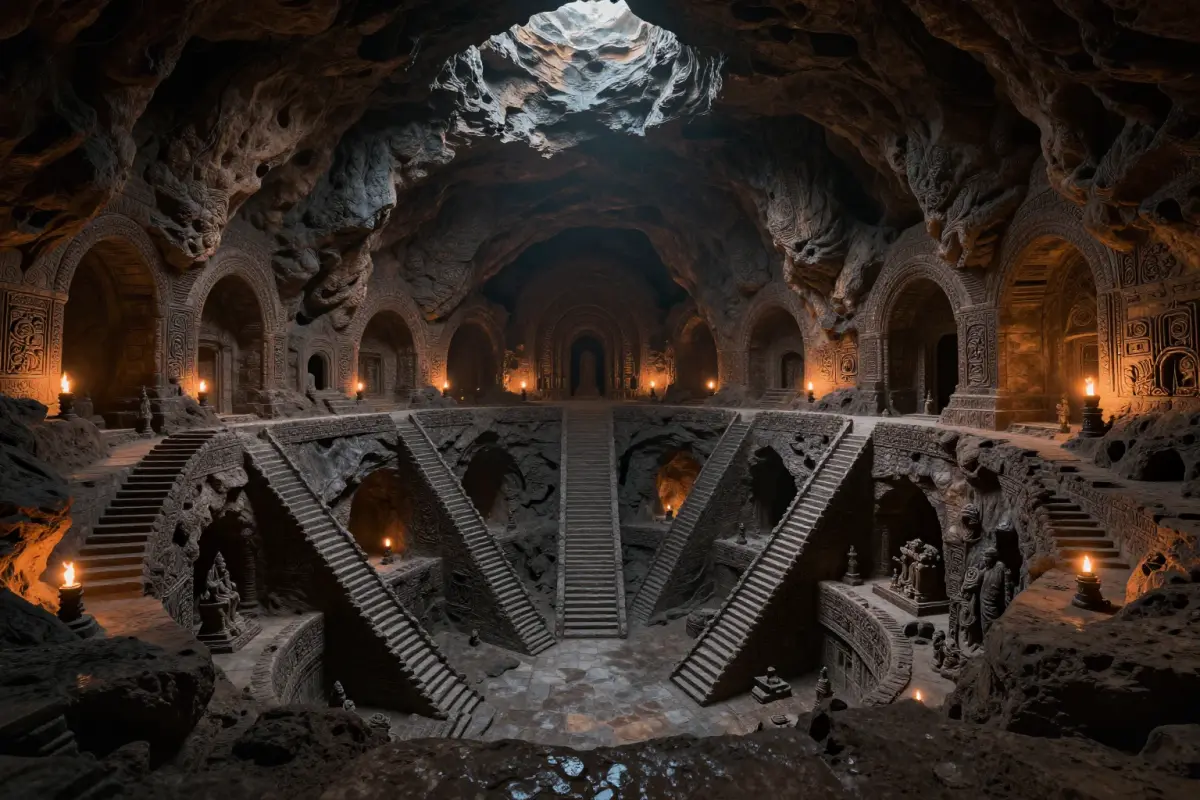
In 1963, a resident of the small town of Derinkuyu in central Turkey was renovating his home when he knocked down a wall and discovered something that would rewrite our understanding of ancient engineering. Behind the wall was not another room, not a storage closet, not a forgotten cellar — but a dark, twisting passageway that plunged deep into the earth. According to local accounts, the man had noticed his chickens disappearing through a crevasse that had opened up during the renovation work, never to be seen again. Curious about where the chickens were going, he investigated the crevasse and found a dark passageway leading into the earth. The passage led to the first level of what turned out to be an 18-level underground city extending approximately 85 meters (279 feet) below the surface — a subterranean metropolis large enough to shelter 20,000 people along with their livestock, food stores, wine presses, churches, schools, and oil presses. The city, known in ancient times as Elengubu, had been carved from the soft volcanic rock of the Cappadocia region over the course of nearly three thousand years, used and expanded by successive civilizations from the Phrygians to the Persians to the Christians of the Byzantine era, before being finally abandoned in the 1920s by Cappadocian Greeks fleeing the Greco-Turkish War. It had lain hidden and forgotten beneath the homes, streets, and fields of the modern town for decades — an entire civilization buried under the feet of people who had no idea it was there.
The Derinkuyu underground city is located in the Cappadocia region of central Anatolia, a vast plateau sitting at an elevation of approximately 1,000 meters (3,300 feet) above sea level. Cappadocia is one of the most geologically distinctive landscapes on Earth, famous for its cone-shaped rock formations known as “fairy chimneys,” its hot air balloon-filled skies, and its extraordinary network of underground cities, cave dwellings, and rock-cut churches. The entire region sits atop layer upon layer of volcanic tuff — compacted ash deposited by ancient eruptions of nearby volcanoes including Mount Hasan and Mount Erciyes. This soft, porous rock is easy to carve when freshly exposed but gradually hardens on contact with air, making it an ideal medium for creating underground structures. The Cappadocians exploited this property for millennia, carving homes, stables, churches, and entire cities into the living rock. Today, the region is home to at least 36 known underground cities, with some estimates placing the number at over 200, many connected by networks of tunnels stretching for miles. In 1985, the Goreme National Park and the Rock Sites of Cappadocia were designated a UNESCO World Heritage Site, recognizing the unique cultural and geological significance of this extraordinary landscape.
The scale of Derinkuyu is difficult to comprehend until you stand inside it. The city extends 85 meters (279 feet) below ground — roughly the height of a 25-story building — and contains 18 levels of tunnels, chambers, staircases, and halls, though only 8 levels are currently open to the public. The total excavated area encompasses approximately 445,000 square feet (41,350 square meters), though some estimates based on unexcavated sections suggest the true extent may be considerably larger. The city’s layout is a masterpiece of underground urban planning. The upper levels contain living quarters, kitchens, storage rooms, and stables for livestock. The middle levels housed communal spaces, refectories (dining halls), wine presses, and oil presses — evidence that the city was designed for long-term habitation, not merely temporary refuge during emergencies. A missionary school with study rooms was identified on the second level, complete with what appear to be classrooms and a barrel-vaulted ceiling. The deepest accessible levels contain a cruciform church carved into the rock, tombs, and a massive ventilation shaft that serves as the city’s primary air supply.
One of the most remarkable features of Derinkuyu is its water supply system. The city had its own deep wells that extended below the level of the underground complex, drawing from the water table in a way that could not be compromised by enemies on the surface. The wells were carefully positioned so that they could not be poisoned or blocked from outside — a critical defensive consideration. The city also featured an extensive storage system capable of holding vast quantities of dried food, grain, wine, and olive oil, enough to sustain the estimated 20,000 inhabitants for months at a time. The wine and oil presses are particularly significant: they indicate that the underground city was not merely a temporary bunker but a fully functioning community where people lived, worked, worshipped, and educated their children for extended periods — possibly years at a time during periods of conflict or persecution.
The statistics of Derinkuyu are staggering. The city contains over 600 known entrances, most hidden inside private homes on the surface. The ventilation system includes more than 15,000 air ducts, with the deepest ventilation shaft reaching 55 meters (180 feet) down. The massive rolling stone doors that seal each level weigh approximately 500 kg (1,100 lbs) each. The temperature inside remains a constant 13°C (55°F) year-round, regardless of the scorching summers and freezing winters on the surface. Derinkuyu is connected to the nearby Kaymakli Underground City via a tunnel approximately 8–9 km (5–6 miles) long. The city was opened to tourists in 1969 and now receives hundreds of thousands of visitors annually.
Perhaps the most impressive engineering achievement at Derinkuyu is the ventilation system — a feat so sophisticated that it has been compared to modern HVAC design. Sustaining 20,000 people and their animals in an enclosed underground environment requires an enormous and constant supply of fresh air. Without adequate ventilation, the inhabitants would have quickly suffocated from carbon dioxide buildup, and the fires used for cooking, heating, and light would have consumed the limited oxygen. The Derinkuyu engineers solved this problem with a system of over 15,000 air ducts — small shafts and channels carved through the volcanic rock that connect every level of the city to the surface. The largest and most important ventilation shaft descends 55 meters (180 feet) from the surface to the deepest levels, providing a steady flow of fresh air throughout the complex.
The ventilation system was designed with a remarkable understanding of air pressure differentials and natural convection. The shafts were positioned and sized to create a continuous airflow driven by the temperature difference between the warm interior of the city (heated by human bodies, animal metabolism, and cooking fires) and the cooler surface air. Warm air from inside the city rose through the shafts and exited near the surface, drawing fresh air in through other shafts and entrances lower down. This created a self-sustaining circulation system that required no mechanical fans or blowers — a form of passive ventilation that modern architects still study with admiration. The engineers also designed the system so that each level could be sealed off independently without compromising the airflow to the rest of the complex, an important feature given that the stone doors were designed to isolate levels during attacks. Even with a level sealed, the air ducts continued to function, ensuring that defenders could breathe even while under siege.
Security at Derinkuyu was provided by a series of massive rolling stone doors — circular boulders carved from the volcanic rock, each weighing approximately 500 kg (1,100 lbs), that could be rolled into place to seal the entrances to each level from the inside. The doors were shaped like wheels and fit into carved slots in the walls and floor, allowing them to be rolled smoothly into position. Critically, the doors could only be operated from the inside — there were no handles, grips, or mechanisms on the exterior side. Once a door was rolled into place, it was virtually impossible for an attacker on the surface to open it, as the stone filled the entire passageway and could not be gripped from the outside. The doors were designed to protect against the most common threats of the ancient world: invading armies, raiders, and persecutors. Each level of the city could be independently sealed, meaning that even if an enemy penetrated the upper levels, the defenders could retreat to the lower levels and seal the connecting passages behind them. The stone doors represented a level of defensive sophistication that is remarkable for any period, let alone for structures carved from rock over two thousand years ago.
The question of who built Derinkuyu is complicated by the fact that the city was not constructed by a single civilization in a single period but was expanded and modified over the course of nearly three thousand years. The earliest construction is attributed to the Phrygians, an ancient Indo-European people who established a powerful kingdom in central Anatolia during the 8th–7th centuries BCE. The Phrygians were among the foremost architects of the Iron Age and are known for engaging in complex mega-construction projects. According to archaeologists at the Turkish Department of Culture, the first galleries at Derinkuyu were carved during this period, using the soft volcanic tuff that could be excavated with simple tools. However, some scholars have argued that the earliest levels may predate the Phrygians and could have been begun by the Hittites, who dominated Anatolia during the 15th–12th centuries BCE, or even by earlier cultures.
One of the earliest written accounts that may describe Derinkuyu comes from the Greek historian Xenophon of Athens, who wrote around 370 BCE in his work Anabasis that the people of Anatolia had excavated their homes underground, with dwellings large enough for a family, domestic animals, and stored food supplies. Over the centuries that followed, the city was expanded by successive waves of inhabitants. During the Byzantine period (5th–10th centuries CE), the underground city reached its greatest extent as Christians used it as a refuge during periods of persecution — first during Roman persecutions of early Christians, and later during Arab raids that swept through Anatolia in the 7th–10th centuries. The cruciform church on the deepest accessible level, the missionary school on the second level, and many of the storage facilities date from this period. The city was also used by local populations as recently as the early 20th century, when Cappadocian Greeks sheltered in the underground network during the upheavals of the Greco-Turkish War (1919–1922). The final abandonment came in the 1920s, when the Cappadocian Greeks were expelled from Turkey under the 1923 population exchange between Greece and Turkey, leaving Derinkuyu empty for the first time in millennia.
Derinkuyu was not an isolated outpost but part of a vast underground network that extends throughout the Cappadocia region. The city is connected to the nearby Kaymakli Underground City via a tunnel approximately 8–9 km (5–6 miles) long — wide enough for people to walk through but narrow enough to be easily defended against pursuers. This tunnel connection meant that inhabitants of one underground city could evacuate to another if their own city was compromised, or that communities in different cities could communicate and support each other during extended sieges. The broader Cappadocian underground network contains at least 36 known underground cities, with some estimates placing the number at over 200, ranging from small, single-level refuges to massive multi-level complexes like Derinkuyu and Kaymakli. In 2014, Turkish archaeologists announced the discovery of a previously unknown underground city near the city of Nevsehir that is believed to be even larger than Derinkuyu, with preliminary estimates suggesting it may contain as many as 5 million square feet of space and extend to depths comparable to or greater than Derinkuyu. If confirmed, this would make the Nevsehir site the largest known underground city in the world — suggesting that the full extent of the Cappadocian underground network remains to be discovered.
Derinkuyu was not a crude cave but a fully self-contained underground community. Wine presses carved into the rock floor indicate that inhabitants produced wine underground, using grapes presumably grown on the surface during safe periods and brought below for processing. Olive oil presses served a similar function for oil production. Stables on multiple levels housed livestock — including cattle, sheep, and goats — providing meat, milk, and wool. A missionary school on the second level, complete with study rooms and a barrel-vaulted ceiling, suggests that education continued even during extended periods underground. A cruciform church on the deepest accessible level provided a space for worship. The constant temperature of 13°C (55°F) year-round actually offered advantages over surface living: food stored underground spoiled more slowly, and inhabitants were protected from the extreme temperature swings of the Anatolian plateau, where summer temperatures can exceed 35°C (95°F) and winter temperatures can drop well below freezing.
Derinkuyu remains one of the most extraordinary archaeological sites on Earth — a city that was continuously inhabited, expanded, and refined for nearly three thousand years, from the Phrygian era through the Byzantine period to the early 20th century. Its 18 levels, extending 85 meters below ground, represent a feat of engineering that is remarkable by any standard: a self-sustaining underground community with its own ventilation, water supply, food storage, religious spaces, educational facilities, and defensive systems, all carved from soft volcanic rock with simple tools. The discovery of Derinkuyu in 1963 — and the subsequent recognition that the entire Cappadocia region is honeycombed with underground cities connected by miles of tunnels — has transformed our understanding of ancient capabilities. These were not crude caves but sophisticated urban environments, designed and maintained by people who understood engineering principles that would not be formally codified for centuries. The fact that Derinkuyu remained hidden beneath a modern town for decades before its accidental discovery raises a tantalizing question: what else lies beneath our feet, waiting to be found?
References & Further Reading
Editorial note: Derinkuyu is documented through archaeological research, the Turkish Department of Culture, UNESCO World Heritage records, and historical accounts including Xenophon’s Anabasis. See our Editorial Policy.