Cleopatra's Lost Tomb: Where Is Egypt's Last Queen Buried?
On August 12, 30 BC, the last pharaoh of Egypt drew her final breath. Cleopatra VII, the brilliant, multilingual queen who had captivated Julius Caesar and Mark Antony, who had ruled Egypt for twenty-one years, who had styled herself as the living incarnation of the goddess Isis, was dead — by her own hand, according to the ancient sources, though the exact method remains debated to this day. Her Roman conqueror, the man who would soon rename himself Augustus, had promised to allow her to be buried with dignity. The Greek historian Plutarch, writing a little over a century after her death, recorded that Octavian “gave orders that her body should be buried with that of Antony in regal and splendid fashion.” The Roman historian Suetonius confirmed the account, noting that Augustus “allowed them both the honour of burial, and gave orders that their tomb should be made and finished.” The queen and her lover were laid to rest together, as they had wished, in a magnificent tomb somewhere in or near the city of Alexandria — the gleaming Mediterranean capital that had been the center of the Greek-speaking world for three centuries. And then, at some point in the centuries that followed, the tomb vanished. No trace of it has ever been found. No ancient traveler recorded visiting it after the first century. No medieval pilgrim left a description of its location. The burial place of two of the most famous people in the ancient world — a queen whose name remains synonymous with beauty, power, and tragedy, and a Roman general who once controlled half the known world — has been lost for over two thousand years.
The mystery of Cleopatra’s lost tomb is not merely a matter of a missing grave. It is a window into the destruction and disappearance of one of the greatest cities of the ancient world. Alexandria, the city that Cleopatra ruled, was a marvel of Hellenistic civilization — home to the legendary Library of Alexandria, the towering Pharos Lighthouse (one of the Seven Wonders of the Ancient World), and a royal quarter of palaces, temples, and monuments that rivaled anything in Rome or Athens. But Alexandria was built on the unstable sediment of the Nile delta, and over the centuries, a combination of earthquakes, tsunamis, and subsidence caused entire sections of the ancient city to sink beneath the Mediterranean Sea. The royal quarter, including Cleopatra’s palace on the island of Antirhodos, now lies beneath approximately 16 feet of water and another 16 feet or more of sediment, as documented by the underwater archaeologist Franck Goddio, who has spent over 25 years surveying the bay of Alexandria. The same forces that destroyed the royal quarter may have destroyed or buried Cleopatra’s tomb. But the possibility remains — tantalizing, maddening, irresistible — that the tomb is still out there, waiting to be discovered. The search for Cleopatra’s final resting place has become one of the most passionate and controversial quests in the history of archaeology, producing dramatic underwater discoveries, bitter scholarly disputes, and a Dominican lawyer-turned-archaeologist named Kathleen Martinez who has bet her career on a theory that most mainstream Egyptologists reject.
To understand why Cleopatra’s tomb matters, it is necessary to understand the extraordinary life and death of the woman who occupies it. Cleopatra VII Philopator (69–30 BC) was the last active ruler of the Ptolemaic Kingdom of Egypt, a dynasty founded by one of Alexander the Great’s generals after Alexander’s death in 323 BC. The Ptolemies were ethnically Greek, and for nearly three centuries they had ruled Egypt from Alexandria, maintaining Greek as the language of the court while the native Egyptian population spoke their own language. Cleopatra was remarkable even by the standards of this cosmopolitan dynasty: she was the first Ptolemaic ruler to learn the Egyptian language, and she styled herself as the reincarnation of the goddess Isis, the Egyptian mother goddess associated with magic, fertility, and resurrection. She was, by all accounts, extraordinarily intelligent — she spoke at least nine languages, was well-versed in mathematics, philosophy, and astronomy, and was a shrewd political operator who navigated the treacherous waters of Roman politics with consummate skill.
Her alliance with Mark Antony, one of the three most powerful men in Rome, was both a love story and a political partnership that threatened the Roman Republic. Together, they controlled the eastern half of the Mediterranean — Antony with his Roman legions and Cleopatra with her enormous wealth and the resources of Egypt, the breadbasket of the ancient world. But their ambitions brought them into direct conflict with Antony’s rival Octavian, Julius Caesar’s adopted heir, who controlled the western half of the Roman world. The final confrontation came at the Battle of Actium on September 2, 31 BC, when Octavian’s fleet, commanded by his general Agrippa, defeated the combined fleets of Antony and Cleopatra off the western coast of Greece. The defeat was decisive. Antony and Cleopatra fled to Alexandria. Over the following months, as Octavian’s forces closed in, their world collapsed. Antony, receiving a false report that Cleopatra was dead, fell on his sword. Cleopatra, according to the most famous version of the story, allowed herself to be bitten by an asp (Egyptian cobra) — a symbol of divine royalty — and died. The ancient sources differ on the exact method of her death: some say asp bite, others say poison, others say a combination. What is clear is that Cleopatra chose death over the humiliation of being paraded through Rome in Octavian’s triumph — a fate she had meticulously planned to avoid.
The manner of Cleopatra’s death has been debated for over two thousand years. The most famous account, given by Plutarch, holds that Cleopatra had an Egyptian cobra (asp) smuggled into her chamber in a basket of figs, and allowed it to bite her. The cobra was sacred to the goddess Wadjet and was a symbol of Egyptian divine royalty — by dying from its bite, Cleopatra would have been claiming the status of a goddess in death. However, modern toxicologists have questioned this account: cobra venom causes a painful, drawn-out death involving paralysis and respiratory failure over hours, which does not match the ancient descriptions of Cleopatra dying quickly and peacefully. The Roman historian Cassius Dio suggests she may have used a fast-acting poison, possibly applied with a hairpin or a poisoned comb. Some scholars have proposed that she may have drunk a lethal cocktail. The truth may never be known — Octavian’s agents found her already dead, with two small puncture marks on her arm, but no snake was found in the chamber. Whether asp or poison, Cleopatra’s death was a carefully staged final act by a queen who understood the power of symbolism and narrative. She died as she had lived — on her own terms.
Our knowledge of Cleopatra’s tomb comes almost entirely from a handful of ancient written sources, none of which provide a precise location. The most important account is from Plutarch’s “Life of Antony”, written around AD 75 (approximately 105 years after the events). Plutarch describes Cleopatra constructing a “lofty and beautiful” monument or tomb near a temple of Isis, and records that in her final days, she moved between her palace and the unfinished mausoleum, bringing “her most valuable treasures” — gold, silver, emeralds, pearls, and ivory — to the tomb. Plutarch states that Octavian, after her death, ordered the tomb to be completed and allowed Cleopatra and Antony to be buried together “in regal and splendid fashion.” The Roman historian Suetonius, in his “Life of Augustus,” confirms this account, writing that Augustus “allowed them both the honour of burial” and gave orders for their tomb to be completed. Cassius Dio, writing in the early third century AD, provides additional detail, noting that the tomb’s “upper part next to the roof was not yet fully completed” at the time of Cleopatra’s death and that both were “embalmed in the same fashion and buried in the same tomb.”
The geographer Strabo, who visited Alexandria around 25 BC — just five years after Cleopatra’s death — places her palace on the island of Antirhodos in Alexandria’s eastern harbor, and mentions the monument but does not specify its exact location. John, Bishop of Nikiu, writing in the seventh century AD, also places the palace on Antirhodos. These sources collectively suggest that the tomb was located in or near the royal quarter of Alexandria, close to Cleopatra’s palace and the harbor. The reference to a “temple of Isis” is particularly intriguing, because Cleopatra identified herself closely with Isis, and a tomb near an Isis temple would be consistent with her religious self-presentation. However, none of these sources gives coordinates, street names, or other precise locational details — and the Alexandria they describe no longer exists in any recognizable form. The royal quarter, the palace, the temples, the harbors — all have been destroyed, rebuilt, submerged, or buried under the modern city of Alexandria, a teeming metropolis of over five million people that sits atop the ruins of the ancient capital like a layer cake of history.
The most dramatic evidence of what happened to ancient Alexandria has come from Franck Goddio, the French underwater archaeologist who has conducted a geophysical survey of Alexandria’s eastern harbor since 1994. Goddio and his team at the European Institute for Underwater Archaeology (IEASM) have mapped and excavated the submerged ruins of the royal quarter, including the island of Antirhodos where Cleopatra’s palace stood. Their discoveries are extraordinary: massive stone columns, pavements, statues, and building foundations lying on the seabed beneath 16 to 30 feet of water and sediment, preserved in remarkable condition. Among the finds are the remains of a structure that may be the Timonium — a retreat that Mark Antony built for himself near the harbor, named after the Greek misanthrope Timon of Athens. The discovery of the Timonium suggests that the royal quarter, including the area around Cleopatra’s palace, is largely intact on the seabed — raising the tantalizing possibility that the tomb, if it was located in this area, may also survive underwater.
The French archaeologist Jean-Yves Empereur, working independently of Goddio, has also made significant discoveries in Alexandria’s waters, including the massive stone blocks of the Pharos Lighthouse and hundreds of architectural fragments from the Ptolemaic period. However, neither Goddio nor Empereur has found any evidence of Cleopatra’s tomb in the underwater ruins. The challenge is enormous: the harbor is vast, the sediment layers are deep, and a tomb — which would be an underground structure — would be particularly difficult to detect beneath the seabed. The search for the tomb in Alexandria’s harbor is complicated by the fact that the modern city of Alexandria is built directly on top of the ancient one, making land-based excavation in the areas that have not subsided extremely difficult. Much of what was once the ancient city is now buried beneath streets, buildings, and the accumulated debris of two millennia of continuous occupation.
The destruction of ancient Alexandria is one of the most dramatic examples of urban submersion in history. The city was built on a narrow peninsula between the Mediterranean and Lake Mariout (Mareotis), with the royal quarter positioned along the eastern harbor. Over the centuries, a series of earthquakes and tsunamis — including devastating events in AD 365, 796, and 1303 — caused the land to subside and the sea to encroach. The island of Antirhodos, where Cleopatra’s palace stood, sank beneath the waves. By the time Goddio began his surveys in 1994, the royal quarter lay hidden beneath 16 to 30 feet of water and an additional layer of sediment. Goddio’s team has mapped an area covering over 2.5 hectares of submerged ruins, identifying palace foundations, harbor installations, and hundreds of artifacts from the Ptolemaic and Roman periods. The discoveries confirm that Cleopatra’s Alexandria — the city of palaces and libraries and lighthouses — was not merely destroyed but literally swallowed by the sea. The fate of Cleopatra’s tomb may be the same: if it was located in the royal quarter, it could now be beneath the Mediterranean, preserved in the silt but invisible to conventional archaeological methods.
While the underwater search in Alexandria’s harbor has produced spectacular discoveries, the most controversial and sustained effort to locate Cleopatra’s tomb has been conducted on land, at a site called Taposiris Magna, approximately 45 kilometers (30 miles) west of Alexandria. The driving force behind this search is Dr. Kathleen Martinez, a Dominican archaeologist and criminal lawyer who gave up a successful legal career to pursue what she calls “the case of her life.” Martinez, affiliated with the Universidad Nacional Pedro Henríquez Ureña in the Dominican Republic, first proposed the theory that Cleopatra’s tomb might be located at Taposiris Magna in 2005. Her reasoning was forensic rather than archaeological: she studied the ancient sources, analyzed Cleopatra’s personality and strategic thinking, and concluded that a queen who “always had a Plan A and a Plan B” would not have buried herself in the vulnerable royal quarter of Alexandria, where her enemies could desecrate her remains.
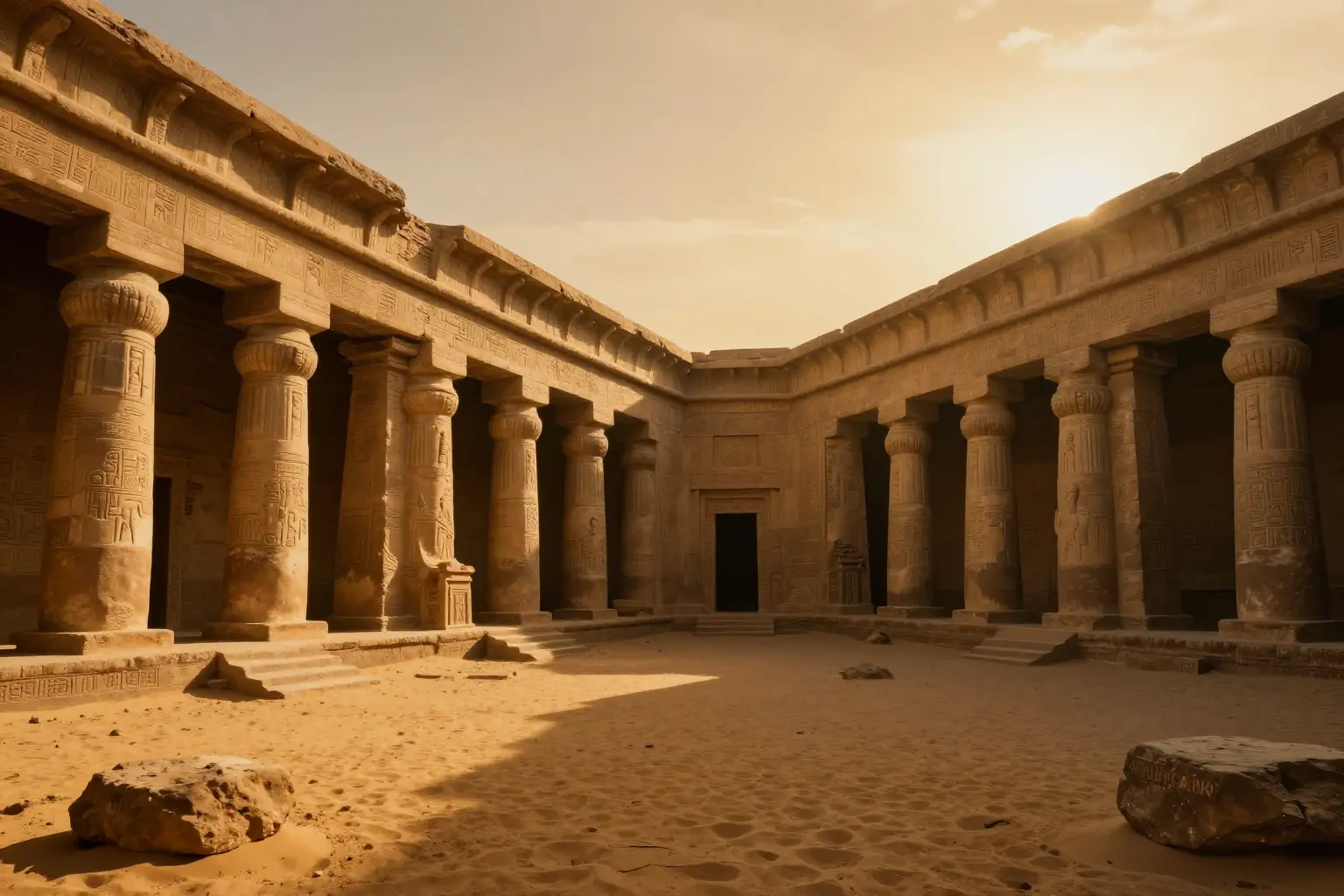
Taposiris Magna — whose name means “Great Tomb of Osiris” — is a temple complex built during the reign of Ptolemy II Philadelphus (circa 280–270 BC), dedicated to the gods Osiris and Isis. The choice of deities is significant: Osiris was the god of death and resurrection, and Isis was his wife and the goddess with whom Cleopatra identified herself. Plutarch recorded that Cleopatra built her tomb near a “temple of Isis” — and Taposiris Magna was one of the most important Isis temples in the region. Martinez’s theory proposes that Cleopatra, anticipating her defeat, arranged for her body to be transported through secret tunnels to a hidden burial chamber within or beneath the temple, where she and Antony would lie together for eternity in a place sacred to the gods she worshipped.
Since beginning excavations in 2005, Martinez and her team have made a series of discoveries that have kept the theory alive, even as mainstream Egyptologists have expressed deep skepticism. In 2008, the team discovered a tunnel carved 35 meters deep into the rock beneath the temple. In 2010, they uncovered a large necropolis containing at least ten mummies, some gilded, along with coins bearing Cleopatra’s image. In 2022, they announced the discovery of a 1,305-meter (4,300-foot) tunnel — partially submerged and heading seaward — carved deep into the rock beneath the temple, containing jars and ceramics dating to the Ptolemaic period. And in 2025, working with Robert Ballard (the discoverer of the Titanic) and a team using advanced sonar technology, Martinez announced the discovery of a submerged ancient port approximately 2.5 miles from the present coast, directly aligned with the tunnel — evidence that Taposiris Magna was once connected to the Mediterranean by an integrated network of tunnels and harbors that could have been used to transport a queen’s body in secret.
Despite the dramatic discoveries at Taposiris Magna, the majority of Egyptologists and archaeologists remain skeptical that Cleopatra’s tomb is located at the site. The most prominent critic is Zahi Hawass, the former Egyptian Minister of State for Antiquities Affairs and one of the most influential archaeologists in the world. Hawass has stated publicly that there is no proof connecting Taposiris Magna to Cleopatra’s burial and has questioned Martinez’s credentials and methodology. Other scholars have pointed out that the coins bearing Cleopatra’s image found at the site are not unusual — Cleopatra’s coins circulated widely throughout Egypt during her reign and for decades afterward, and their presence at any Ptolemaic site is not evidence of a personal connection. The mummies, while intriguing, are not royal burials — they appear to be the remains of upper-class citizens or priests, not pharaohs or queens. No inscription, no papyrus, no physical evidence has been found at Taposiris Magna that directly references Cleopatra, Antony, or their burial. The tunnels, while impressive engineering, may have served practical purposes — water supply, storage, or temple rituals — rather than funerary ones. Most mainstream archaeologists believe that Cleopatra was buried in Alexandria, in or near the royal quarter, as the ancient sources suggest, and that the tomb was destroyed or submerged by the same seismic events that destroyed the royal palace and the lighthouse.
Cleopatra’s lost tomb is not the only great burial mystery of Alexandria. The city was also the final resting place of Alexander the Great himself, whose body was brought to Egypt after his death in 323 BC and interred in a magnificent mausoleum that became one of the most famous pilgrimage sites in the ancient world. Roman emperors, including Augustus, Caligula, and Caracalla, are recorded as visiting Alexander’s tomb. The Ptolemaic rulers built their own tombs in the same royal necropolis, creating a funerary landscape of extraordinary grandeur. But by the late Roman or early Islamic period, the location of Alexander’s tomb was lost. Medieval travelers claimed to have visited it, but their accounts are contradictory and unverifiable. Today, no one knows where Alexander the Great is buried — and the same forces that erased his tomb from history may have erased Cleopatra’s as well. The parallel is sobering: if the tomb of the most famous conqueror in history can disappear in Alexandria, it is not surprising that the tomb of a queen has done the same.
The search for Cleopatra’s lost tomb is one of the most compelling archaeological quests of our time — a mystery that combines the grandeur of ancient history with the cutting-edge technology of modern underwater exploration. The ancient sources tell us that Cleopatra and Mark Antony were buried together in a magnificent tomb near a temple of Isis, in or near the royal quarter of Alexandria. But the Alexandria they knew has largely vanished — sunk beneath the Mediterranean, buried under the modern city, or destroyed by earthquakes and tsunamis. Franck Goddio’s discoveries in Alexandria’s harbor have revealed a sunken world of palaces and temples, demonstrating that the royal quarter survives beneath the waves, even as Kathleen Martinez’s excavations at Taposiris Magna have produced tunnels, mummies, coins, and a submerged port that keep her controversial theory alive. Neither approach has yet produced the definitive evidence that would end the debate. The tomb may lie beneath the Mediterranean silt in Alexandria’s eastern harbor, invisible to current technology. It may lie hidden in a secret chamber beneath the Osiris temple at Taposiris Magna, waiting for the right tunnel to be explored. It may have been destroyed centuries ago, its stones scavenged for later construction, its treasures looted, its occupants’ bones scattered. Or it may be discovered tomorrow, by a team of divers or a ground-penetrating radar survey or a lucky accident, in a find that would rank among the greatest archaeological discoveries of all time. Until that day, the tomb of Cleopatra remains where it has been for over two thousand years: lost, silent, and waiting.
References & Further Reading
Wikipedia: Cleopatra — Comprehensive biography covering her life, reign, relationships, and death
Wikipedia: Alexandria — The ancient city's history, destruction, and archaeological remains
📚 Recommended Reading: Searching for the Lost Tombs of Egypt by Chris Naunton (on Amazon) — As an Amazon Associate, we earn from qualifying purchases.
Editorial note: The search for Cleopatra's tomb is ongoing, with new discoveries at Taposiris Magna announced as recently as 2025. See our Editorial Policy.