Sacsayhuamán: The Inca Fortress Built With Impossible Stones
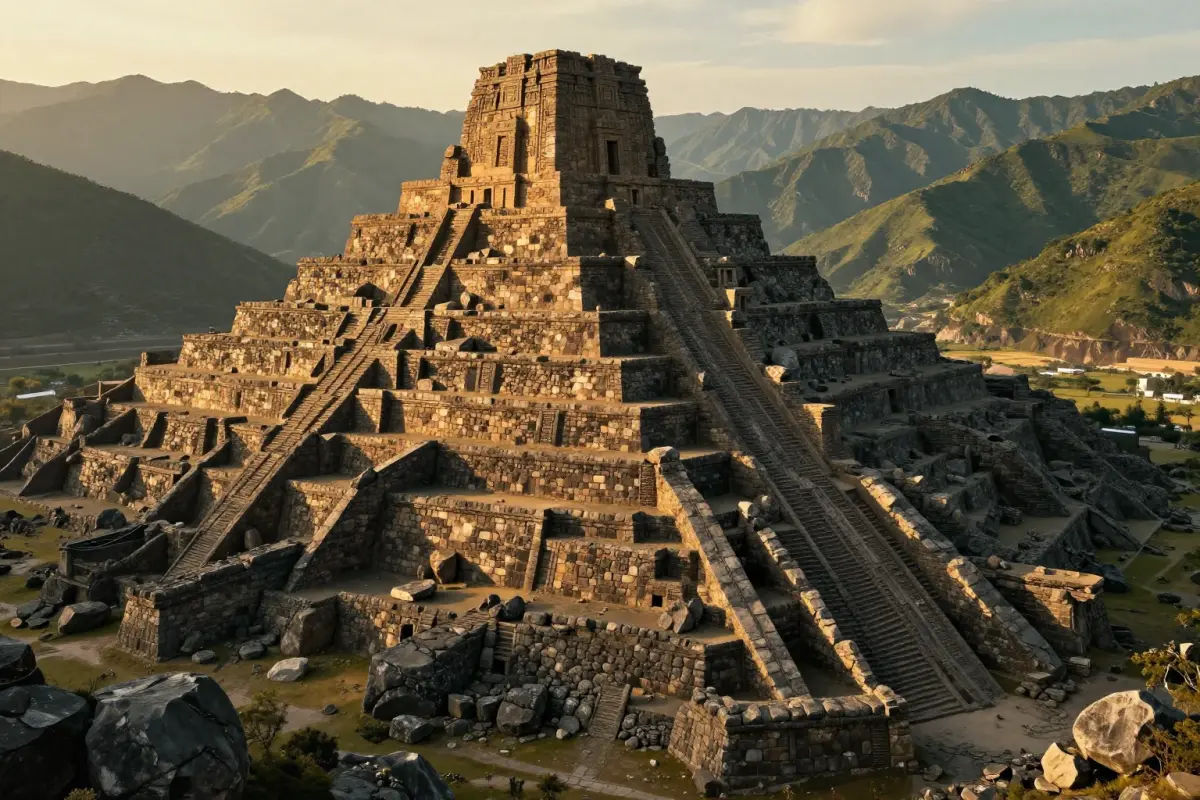
High above the ancient city of Cusco, Peru, at an altitude of 3,701 meters (12,142 feet) above sea level, stand walls so extraordinary that they have challenged our understanding of ancient engineering for over five hundred years. The fortress of Sacsayhuaman (pronounced SACK-sy-wuh-mun; Quechua: Saqsaywaman, meaning “fortress of the royal falcon”) is a citadel built from stones so massive, so precisely fitted, and so impossibly engineered that the first Spanish conquistadors to see them could not believe they had been made by human hands. The three great zigzagging terrace walls that form the fortress’s defenses contain stones weighing up to an estimated 200 tons — as heavy as a blue whale — transported from quarries located 20 to 35 kilometers away across rugged mountain terrain, and fitted together without a single drop of mortar so tightly that a razor blade cannot be inserted between them. The Inca builders had no wheels, no iron tools, no written language, and no draft animals capable of moving such weights — the llama, the largest domesticated animal in the Andes, can carry only about 45 kilograms (100 pounds). And yet somehow, working at an altitude where the air is thin enough to make a modern tourist gasp, they assembled one of the most impressive megalithic structures on Earth.
The Sacsayhuaman complex sits on a steep hill on the northern outskirts of Cusco, approximately 2 kilometers from the city’s central plaza. Cusco was the capital of the Inca Empire — the Tawantinsuyu, or “Realm of the Four Parts” — the largest empire in pre-Columbian America, stretching from modern-day Colombia to Chile at its height. According to Spanish chroniclers who recorded Inca oral traditions, construction began during the reign of Pachacuti Inca Yupanqui (ruled 1438–1471), the visionary emperor who transformed the Inca from a small regional kingdom into a vast empire, and continued under his successors Topa Inca Yupanqui and Huayna Capac. Some estimates suggest the construction took over 70 years, spanning multiple reigns and requiring the labor of thousands of workers drafted from across the empire. The site covers approximately 3,093 hectares (7,643 acres) and includes not only the famous zigzag walls but also temples, storage buildings, aqueducts, and other structures. In 1983, Sacsayhuaman was designated a UNESCO World Heritage Site as part of the City of Cusco listing.
The most striking feature of Sacsayhuaman is its three great parallel terrace walls, arranged in a dramatic zigzag pattern with 22 salient angles along the outer face. The longest wall extends approximately 400 meters (1,312 feet) in length, and the walls rise up to 6 meters (20 feet) tall in places. The zigzag design is unique — no other Inca site features walls with this configuration — and its purpose has been debated for centuries. The most common explanation is that the zigzag pattern served a defensive function, allowing defenders on the walls to fire upon attackers from multiple angles, exposing the flanks of anyone attempting to storm the fortifications. However, the design also has remarkable seismic properties: the interlocking angles distribute the forces of earthquakes more effectively than straight walls, and some researchers have suggested that the zigzag pattern was at least partly an engineering response to the earthquake-prone Andean environment.
What truly sets Sacsayhuaman apart is the masonry. The walls are built using a technique known as polygonal stonework, in which each stone is carved into a unique, irregular shape that interlocks precisely with its neighbors. Unlike the coursed, rectangular masonry found at other Inca sites, the stones at Sacsayhuaman are enormous, multi-sided blocks — some with 10, 12, or even more sides — that fit together like pieces of a three-dimensional jigsaw puzzle. The joints are so tight and so precise that even after more than 500 years, including multiple devastating earthquakes, you cannot insert a sheet of paper between them. The largest stones are truly megalithic: estimates place the heaviest blocks at 100 to 200 tons, with some individual stones measuring 5 meters (16 feet) or more in their longest dimension. These are among the largest stones ever moved and fitted in the Western Hemisphere.
The question that has haunted archaeologists and engineers for centuries is deceptively simple: how did the Inca move and place stones weighing 100 to 200 tons without wheels, iron tools, or heavy machinery? The Inca did not use the wheel for transportation, and the largest domesticated animal available was the llama, which can carry a maximum of about 45 kilograms — utterly useless for moving a 200-ton stone block. The most widely accepted theory, supported by the Spanish chronicler Garcilaso de la Vega (1539–1616), an Inca-Spanish historian who recorded Inca oral traditions in his Royal Commentaries of the Incas (1609), is that the stones were moved using massive human labor forces. Garcilaso wrote that 20,000 men were involved in transporting a single large stone, dragging it on rollers and earthen ramps with ropes made of plant fiber and leather. While this number may be exaggerated, the general approach is consistent with what is known about Inca labor organization. The Inca Empire maintained a system of corvee labor called the mita, under which subjects were required to provide a certain amount of labor to the state each year. Additional techniques may have included earthen ramps built up to the level of the wall as construction progressed, log rollers placed beneath the stones, lever systems using wooden beams, and inclined planes and slipways — smooth, lubricated channels cut into the earth that would have reduced the friction involved in sliding the stones.
In the 1980s and 1990s, Jean-Pierre Protzen, a professor of architecture at the University of California, Berkeley, conducted pioneering studies of Inca stonework that shed significant light on how the seemingly impossible fits at Sacsayhuaman were achieved. Protzen demonstrated through experiments that Inca stone-cutting techniques could produce the precise joints observed at the site using an iterative process of shaping and fitting. The method involved placing a stone in roughly the right position, marking the contact points where it touched its neighbors, removing it, grinding down the high spots with hammer stones (harder rocks used as percussive tools), and then replacing it to check the fit. This process was repeated — sometimes dozens of times — until the stone seated perfectly. Protzen’s work demonstrated that the “impossible” fits, while remarkable, did not require any technology unknown to the Inca — only patience, skill, and an enormous investment of human labor.
One of the most remarkable properties of Sacsayhuaman’s walls is their extraordinary resilience. Over the past five centuries, the Cusco region has experienced several devastating earthquakes, including major events in 1650, 1950, and 1986. In each case, the Spanish colonial buildings in Cusco — built with conventional mortar and brick or stone construction — suffered severe damage or collapsed entirely. The Inca walls at Sacsayhuaman survived virtually intact. The reason lies in the dry-stone masonry technique employed by the Inca builders. Because the stones are fitted so precisely and held in place by their own weight without mortar, the walls can flex and shift slightly during an earthquake, absorbing and distributing the seismic energy rather than cracking under the stress. The polygonal shapes of the individual stones also contribute to seismic resistance: the irregular joints create an interlocking structure that resists lateral forces far more effectively than straight, mortared joints.
Sacsayhuaman also played a pivotal role in one of the most dramatic episodes of the Spanish conquest of Peru. In 1536, three years after the Spanish capture of Cusco, the Inca emperor Manco Inca Yupanqui launched a massive revolt against Spanish rule, laying siege to Cusco with an army estimated at tens of thousands of warriors. The Battle of Sacsayhuaman was a key engagement in this siege, as Inca forces used the fortress as a stronghold and base of operations. The Spanish, led by the brothers of Francisco Pizarro, mounted a desperate assault on the fortress. During the battle, Juan Pizarro was killed while leading an attack on the walls — one of the highest-profile Spanish casualties of the entire conquest. The Spanish eventually captured Sacsayhuaman after a ferocious fight, but at significant cost. In the aftermath, the Spanish systematically dismantled much of the fortress, using its stones as building material for colonial Cusco. They destroyed the upper portions of the walls, which were made of smaller, more manageable stones. The massive megalithic blocks at the base, however, were too large to move — and it is only because of their immovable size that these extraordinary walls survive today.
The question of what Sacsayhuaman was actually built for — fortress, ceremonial center, or both — has never been fully resolved. Some scholars have noted that when viewed from above, the city of Cusco appears to have been laid out in the shape of a puma (mountain lion), with Sacsayhuaman forming the head of the animal. This interpretation is supported by the zigzag walls, which some researchers believe represent the teeth of the puma. The puma was a sacred animal in Inca cosmology, representing power and the earthly realm. If this interpretation is correct, Sacsayhuaman was not merely a military installation but a cosmological statement — a physical expression of the Inca worldview carved into the landscape of their capital. The site also features excellent acoustic properties, with the terraced walls creating a natural amphitheater effect that could have been used for ceremonies and public gatherings. Today, the site hosts the annual Inti Raymi (Festival of the Sun) celebration on June 24, attracting approximately 50,000 spectators each year to recreate the Inca sun festival that was the most important ceremony in the imperial calendar.
Sacsayhuaman stands as one of the most impressive and mysterious archaeological sites in the world — a testament to the engineering genius, organizational capability, and artistic vision of the Inca civilization. The megalithic walls, with their 200-ton stones fitted together without mortar, represent a level of craftsmanship that has not been surpassed in the five centuries since they were built. While modern research, particularly the work of Jean-Pierre Protzen, has demonstrated that the Inca possessed the technical means to achieve these extraordinary fits, the sheer scale of the labor, the logistics of transporting massive stones across mountains at extreme altitude, and the organizational sophistication required to coordinate such a project remain deeply impressive. The stones of Sacsayhuaman have survived earthquakes, wars, conquest, and the systematic dismantling of the site by the Spanish — and they will likely be standing long after the buildings of our own civilization have crumbled to dust.
References & Further Reading
Wikipedia: Inti Raymi — The Festival of the Sun celebrated annually at Sacsayhuaman on June 24
Editorial note: Sacsayhuaman is documented through Spanish colonial chronicles (Garcilaso de la Vega, Pedro Cieza de Leon), archaeological research (Jean-Pierre Protzen, UC Berkeley), and UNESCO World Heritage records. See our Editorial Policy.