The Great Molasses Flood: The Day a Deadly Wave of Syrup Destroyed Boston
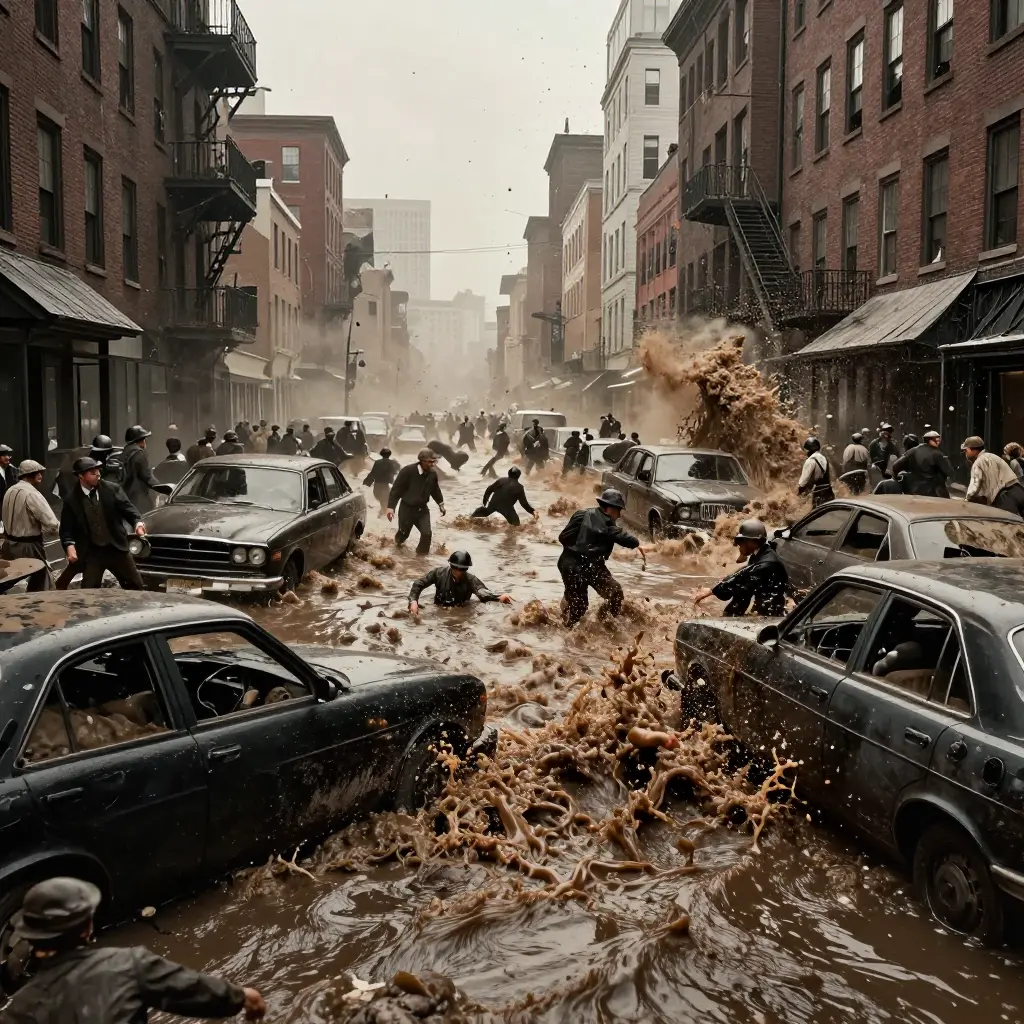
On January 15, 1919, at approximately 12:30 in the afternoon, the residents and workers of Boston’s North End heard a low, grinding rumble that many mistook for an approaching train on the Boston Elevated Railway. Within seconds, the sound escalated into a deafening roar, and a wall of dark, viscous liquid — 2.3 million gallons of molasses weighing approximately 13,000 tons — burst from a massive storage tank on 529 Commercial Street and surged through the crowded neighborhood at an estimated 35 miles per hour. The wave was 25 feet high and 160 feet wide at its peak, a churning tsunami of syrup that smashed buildings, overturned horse-drawn wagons and motor vehicles, crushed freight cars, and trapped men, women, and children in a sticky, suffocating embrace. When the molasses finally stopped moving, 21 people were dead and 150 more were injured. Entire buildings had been swept from their foundations. The firehouse of Engine 31 was demolished, crushing several firefighters beneath tons of brick and timber. A section of the Boston Elevated Railway tracks had collapsed. Horses, wagons, dogs, and people were encased in the thick, brown liquid, some alive and struggling, others beyond rescue. The disaster was not an act of God, an earthquake, or a terrorist attack — it was a catastrophic engineering failure caused by a storage tank that should never have been built, overseen by a man with no engineering qualifications, filled to capacity without ever having been properly tested.
The disaster occurred at the facility of the Purity Distilling Company, a subsidiary of the United States Industrial Alcohol Company (USIA), located on Commercial Street near Keany Square in the North End of Boston. The North End was — and remains — one of the oldest neighborhoods in Boston, a densely populated area of narrow streets, tenement buildings, and small businesses that had been home to successive waves of immigrants. In 1919, it was predominantly Italian-American, a community of working-class families who lived in the shadow of the industrial waterfront. The Purity Distilling Company had built its massive molasses storage tank on the waterfront in 1915, at the height of World War I, when demand for industrial alcohol — produced by fermenting molasses — was enormous. Molasses was fermented to produce ethanol, which was used both in alcoholic beverages and, critically, in the manufacture of munitions and explosives for the war effort. The tank was a business asset in a time of war, and its construction was rushed, its oversight negligent, and its operation reckless. The neighborhood around it was treated as an afterthought — until the tank failed, and the neighborhood paid the price.
The story of the Great Molasses Flood begins with a man named Arthur P. Jell, the treasurer of the Purity Distilling Company, who oversaw the construction of the molasses tank in 1915. Jell was a businessman, not an engineer. He had no training in structural engineering, no expertise in tank design, and no experience in industrial construction. Despite this, he was placed in charge of one of the largest liquid storage facilities in Boston — a tank that stood 50 feet tall, measured 90 feet in diameter, and had a capacity of 2.3 million gallons. The tank was built on a three-foot-thick concrete foundation by the Hugh Nawn Construction Company, with the steel shell erected by the Hammond Iron Works. The construction was completed in 1915, and within two days, the first shipment of molasses was being pumped into the tank.
From the very beginning, the tank was problematic. Almost immediately after it was filled, local residents noticed molasses seeping from the seams and rivets of the steel structure. The leaks were so persistent that North End children would gather at the base of the tank with pails and buckets to collect the free molasses that oozed from the joints. When residents complained about the visible leaks, the company’s response was not to repair the tank or investigate the structural integrity of the rivets — it was to paint the tank brown, so that the oozing molasses would be less visible against the tank’s exterior. This breathtakingly cynical response was characteristic of the company’s approach to safety. The tank was never subjected to a hydrostatic test — the standard engineering procedure of filling a new tank with water to test its structural integrity before filling it with the intended contents. No independent engineer inspected the tank. No stress calculations were performed to verify that the steel walls and rivets were adequate for the enormous weight of the molasses. Modern forensic analysis, conducted decades later, confirmed what should have been obvious at the time: the steel walls were too thin, the rivets were insufficient, and the design was fundamentally inadequate for the loads it was expected to bear.
The massive demand for molasses in 1915 through 1919 was driven by World War I. Molasses can be fermented to produce ethanol, which was a critical ingredient in the manufacture of munitions and explosives, including TNT and smokeless powder. The United States Industrial Alcohol Company was a major supplier of industrial alcohol to the war effort. When the United States entered the war in 1917, demand surged even further. The molasses stored in the North End tank was shipped from Cuba, Puerto Rico, and the West Indies, stored in the tank, and then transferred by rail to distilleries for conversion to alcohol. The enormous profits to be made from wartime molasses processing created a powerful incentive to cut corners on safety and construction — an incentive that had deadly consequences. Ironically, the war had ended just two months before the disaster, on November 11, 1918, but the tank was still full because the company was stockpiling molasses in anticipation of Prohibition, which would take effect in January 1920 and would drive up the price of industrial alcohol even further.
The weather on January 15, 1919, played a critical role in the disaster. The previous week had seen a severe cold snap, with temperatures dropping well below freezing. On January 15, the temperature rose dramatically to an unseasonably warm 40 degrees Fahrenheit — a swing of more than 40 degrees from the recent cold. This rapid temperature change had two critical effects on the molasses in the tank. First, the existing molasses, which had been cold and viscous, began to warm and expand. Second, a new shipment of warm molasses had recently been delivered from a tanker ship and pumped into the tank, further raising the temperature and volume of the contents. The combination of thermal expansion and additional volume placed enormous stress on the already-weak tank walls and rivets. At approximately 12:30 PM, the structural failure occurred. Witnesses reported hearing a sound like machine-gun fire or the ripping of cloth — the sound of rivets popping out of the steel plates one after another, in rapid succession, as the tank’s walls gave way.
The collapse was catastrophic and nearly instantaneous. The tank ruptured, releasing a wall of 2.3 million gallons of molasses that surged outward in a wave estimated at 25 feet high, 160 feet wide, and moving at 35 miles per hour. The physics of molasses made the wave particularly deadly: molasses is approximately 1.4 times denser than water and vastly more viscous, meaning that a wave of molasses carries far more destructive force than a wave of water of the same dimensions, and it does not drain away — it engulfs and entraps everything in its path. The wave demolished the Engine 31 firehouse, crushing the building and trapping several firefighters inside. It smashed into the Boston Elevated Railway tracks, collapsing a section of the elevated structure. It swept away horse-drawn wagons, motor trucks, and automobiles, carrying them blocks from their original positions. It flooded homes and businesses to a depth of two to three feet, trapping residents in their kitchens and living rooms. People who were caught in the wave were unable to move in the thick, sticky liquid — those who fell were often unable to stand again, and many drowned in molasses, a mode of death that is as horrifying as it is improbable.
The 21 victims of the Great Molasses Flood ranged in age from a 10-year-old schoolboy to a 76-year-old man. Many were Italian immigrants living in the densely populated tenements near the tank. Among the dead were several longshoremen and warehouse workers who had been eating lunch near the waterfront, a firefighter from Engine 31 who was crushed when the firehouse collapsed, and a young girl who had been walking home from school. Some victims were killed instantly by the force of the wave or by collapsing buildings. Others were trapped in the molasses and suffocated — unable to breathe as the thick liquid filled their noses and mouths. The 150 injured survivors suffered from broken bones, crush injuries, hypothermia from immersion in the cold molasses, and infections from wounds contaminated by the sticky, bacteria-laden liquid. Rescue efforts were conducted by the Boston Police Department, the U.S. Navy, the Red Cross, and hundreds of volunteers who waded into the molasses to pull survivors from the wreckage. The rescue and recovery operation continued for several days, as workers searched collapsed buildings and drained molasses from basements and cellars.
In the immediate aftermath of the disaster, the United States Industrial Alcohol Company launched a vigorous public relations campaign to deflect blame. The company claimed that the tank had been bombed by anarchists — a not-implausible theory in the political climate of 1919, when a series of anarchist bombings had shaken American cities. The Italian immigrant community of the North End was viewed with suspicion by many native-born Americans, and the anarchist narrative played on existing prejudices. The company pointed to recent bomb threats against industrial facilities and argued that no properly constructed tank could have failed spontaneously. The strategy was to shift the narrative from corporate negligence to foreign terrorism, exploiting the xenophobia of the era to avoid liability.
The families of the victims rejected the anarchist theory and filed three separate lawsuits against USIA, which were eventually consolidated into a single massive legal proceeding that became the longest trial in Massachusetts history at that time. The court appointed Hugh W. Ogden, a respected attorney and former judge, as a special court-appointed auditor to investigate the disaster. Ogden conducted a painstaking investigation that lasted from 1919 to 1925, examining the wreckage of the tank, interviewing witnesses and engineers, reviewing construction records, and commissioning independent structural analyses. His report, issued in 1925, was devastating. Ogden found that the tank had been poorly designed, inadequately constructed, and never tested. The steel walls were too thin — significantly below the thickness required by engineering standards for a tank of that size. The rivets were insufficient in number and quality. The man who oversaw construction, Arthur Jell, had no engineering qualifications. The tank had never been subjected to a hydrostatic test. The company had ignored the persistent leaks and had chosen to paint the tank brown rather than repair it. Ogden’s conclusion was clear: the disaster was caused by corporate negligence, not by anarchists or saboteurs.
The Great Molasses Flood had a profound and lasting impact on engineering standards and building codes in the United States. Before 1919, there were virtually no regulations governing the construction and inspection of large industrial storage tanks in most American cities. Tanks were built at the discretion of their owners, with no requirement for independent engineering review, safety testing, or ongoing inspection. The disaster exposed the fatal consequences of this laissez-faire approach. In the wake of the flood and the Ogden report, Massachusetts and other states enacted laws requiring engineering certification and regular inspection of large storage tanks and industrial structures. The American Society of Civil Engineers (ASCE) updated its standards for tank design and construction, requiring rigorous stress calculations, material testing, and hydrostatic testing before a tank could be placed in service. These standards, which can trace their origins directly to the molasses flood, are still in effect today and govern the construction of everything from water towers to chemical storage facilities across the country. The settlements paid to the victims’ families — approximately $7,000 per victim (equivalent to about $115,000 in 2024 dollars) — were modest by modern standards but represented a significant acknowledgment of corporate responsibility.
One of the most enduring legends of the Great Molasses Flood is that, on hot summer days, the North End of Boston still smells of molasses. According to local folklore, decades of molasses seeping into the soil, the cobblestones, and the foundations of buildings left a residual scent that re-emerges when the summer heat warms the ground. Residents reported smelling molasses in the area for decades after the disaster, and the story has been repeated in countless articles, books, and documentaries. Whether the smell is real or a product of collective memory and suggestion is debatable — the area has been extensively redeveloped since 1919, and the original buildings, streets, and soil have long since been replaced. The site of the tank is now Langone Park and Puopolo Sports Field, a small waterfront park with a memorial plaque commemorating the disaster. But the legend persists, and it serves as a powerful metaphor for the way that disasters — even strange, absurd disasters — leave lasting marks on the communities they strike.
The Great Boston Molasses Flood of 1919 is often remembered as a curiosity — a bizarre footnote in history, a story so strange that it sounds like an urban legend. But it was real, and it was deadly. Twenty-one people lost their lives because a corporation cut corners on construction, ignored warning signs, and prioritized profits over safety. The disaster was not an act of God or an unpredictable accident — it was the entirely foreseeable result of negligence, incompetence, and greed. The six-year legal battle that followed, culminating in Hugh Ogden’s landmark report, established important precedents for corporate accountability and engineering regulation that are still with us today. The molasses flood taught America that industrial facilities must be designed by qualified engineers, tested before use, and inspected regularly — lessons that seem obvious now but were not standard practice before January 15, 1919. The victims of the flood — the Italian immigrants, the firefighters, the longshoremen, the children walking home from school — deserve to be remembered not as characters in a quirky anecdote but as victims of a preventable tragedy. The sweet smell of molasses, lingering over a century later, is not a joke — it is a warning.
References & Further Reading
Wikipedia: Purity Distilling Company — The company that owned and operated the failed molasses tank
Wikipedia: North End, Boston — The neighborhood devastated by the molasses flood
📚 Recommended Reading: Dark Tide by Stephen Puleo (on Amazon) — As an Amazon Associate, we earn from qualifying purchases.
Editorial note: the Great Molasses Flood remains one of the most thoroughly documented industrial disasters in American history, with extensive court records and engineering analyses available. See our Editorial Policy.