The Roman Dodecahedron: Ancient Mystery That Still Baffles Experts
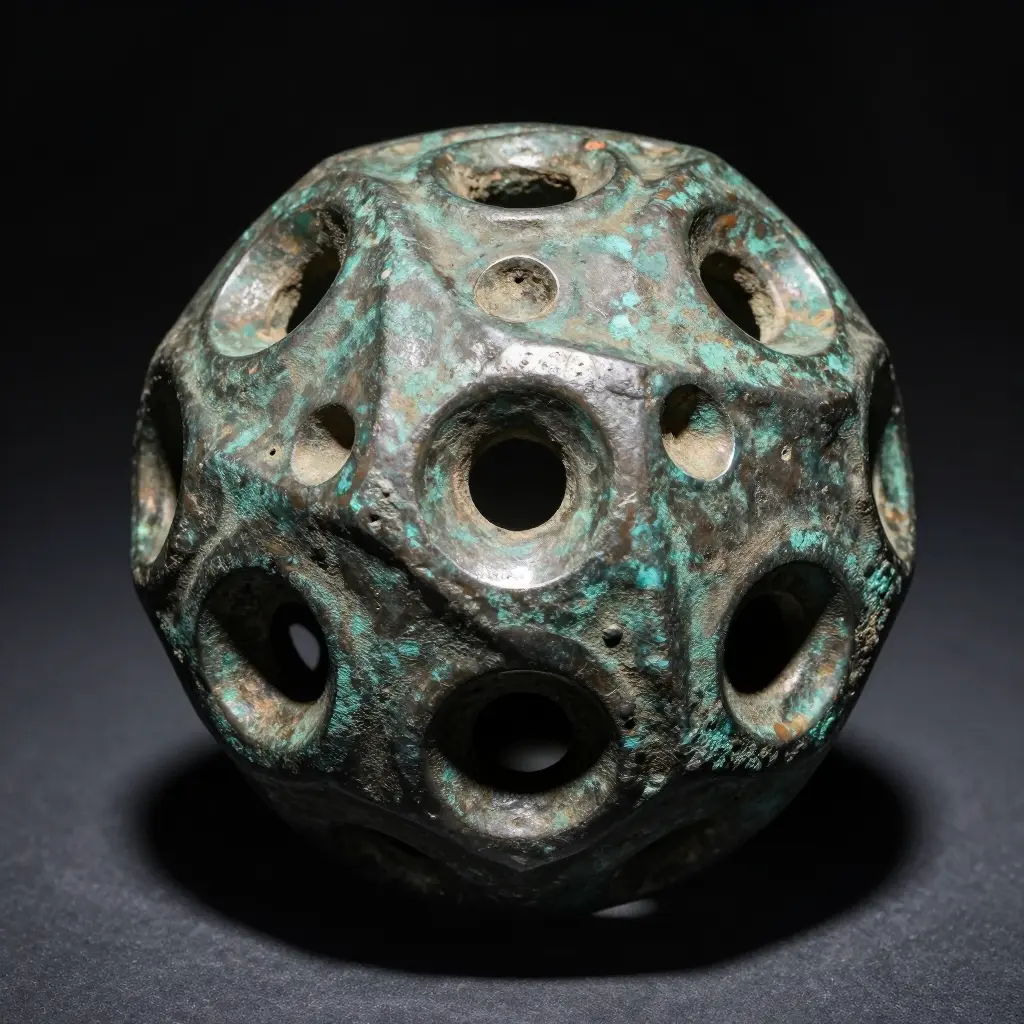
In 1739, a farmer in Aston, Hertfordshire, England, was plowing his field when his plow struck something hard. He dug it out and found a strange object he had never seen before: a small, hollow, twelve-sided bronze shape, about the size of a cricket ball, with a circular hole of different sizes in each of its pentagonal faces and small rounded knobs protruding from every corner. It was clearly ancient — the patina of age covered its surface — and it was clearly deliberate: the geometric precision of its form ruled out any natural origin. The farmer brought it to the Society of Antiquaries in London, where the learned gentlemen examined it with bewilderment. They had no idea what it was. No inscription, no text, no historical record offered any clue. Over the next 285 years, more than 130 similar objects have been discovered across the former Roman Empire — in England, France, Belgium, Germany, the Netherlands, Luxembourg, Austria, Switzerland, and Hungary. They range from 4 to 11 centimeters in diameter, from 35 grams to 1 kilogram in weight. They are all made of copper alloy, all cast using the lost-wax technique, all feature twelve pentagonal faces with circular holes of varying sizes, and all have small knobs at their vertices. And no one has ever definitively explained what they were used for.
The Roman dodecahedron is one of the most enduring mysteries of classical archaeology — not because it is exotic or fantastical, but precisely because it is so ordinary. These are bronze objects, mass-produced by skilled metalworkers, distributed across a specific geographic region of the Roman Empire over a period of roughly three centuries. Someone made them. Someone used them. Someone valued them enough to bury them with their dead or place them in temples and homes. And yet the entire Roman civilization — a culture obsessed with writing, record-keeping, and bureaucratic documentation — left not a single word about what these objects were for. The dodecahedrons sit in museum cases from Tongeren to Bonn to London, silent and inscrutable, daring two and a half millennia of scholars to crack their secret.
Every Roman dodecahedron shares the same basic form: a regular dodecahedron — a three-dimensional shape with twelve flat pentagonal faces, each face a perfect (or near-perfect) pentagon. Each face has a circular hole cut into its center, and the holes connect to the hollow interior of the object. At each of the twenty vertices, a small spherical knob protrudes outward. The result is an object of striking geometric beauty: a twelve-sided form that seems to belong more to the realm of mathematics than to the ancient world. The dodecahedron is one of the five Platonic solids — the regular polyhedra described by the Greek philosopher Plato in his dialogue Timaeus (circa 360 BCE), where he associated the dodecahedron with the cosmos itself, writing that “God used it for arranging the constellations on the whole heaven.”
The physical details of the dodecahedrons are remarkably consistent, yet each one is subtly unique. They range in size from 4 centimeters to 11 centimeters. The circular holes in their faces vary in diameter from 6 millimeters to 40 millimeters, and — crucially — no two dodecahedrons have the same arrangement of hole sizes. Each object has a unique pattern of larger and smaller holes, a fact that has fueled endless speculation about their purpose. The knobs at the vertices are not perfectly regular, suggesting they were shaped by hand rather than cast in a mold. The exteriors are well-finished and were probably polished in antiquity, while the interior surfaces are left rough and unfinished — a detail that has been interpreted as evidence that the interior was not meant to be seen. Remarkably, no dodecahedron has ever been found with letters, numbers, or any form of writing on it. They rarely show signs of wear, suggesting they were not subjected to heavy use or abrasion.
One of the most baffling aspects of the mystery is their geographic distribution. Over 130 examples have been found across a wide swath of the former Roman Empire — in England, France, Belgium, Germany, the Netherlands, Luxembourg, Austria, Switzerland, and Hungary. They have been found in civilian settlements, temples, villas, and graves. And yet, despite this broad distribution across the northwestern provinces, not a single dodecahedron has ever been found in Italy — not in Rome, not in Pompeii, not in Ostia, not in any of the Italian provinces that formed the heart of the Roman world. They have also never been found in the eastern provinces — not in Greece, not in Turkey, not in Syria, not in Egypt. This distribution pattern is extraordinary and immediately rules out several possible explanations. If they were standard Roman military equipment, we would expect to find them across the entire Empire. If they were standard religious implements, we would expect to find them in temples everywhere. The fact that they are found only in the northwestern provinces — and primarily in areas associated with Gallo-Roman culture — strongly suggests that they served a purpose specific to the Celtic and Germanic peoples who lived in these regions, or at least to the unique cultural mix that developed when Roman and Celtic cultures interacted.
The highest concentration of finds comes from Gaul (modern France and Belgium) and Britannia (modern England). Significant finds have been made at Avenches, Switzerland (the Roman city of Aventicum); Tongeren, Belgium (where the Gallo-Roman Museum houses one of the finest collections); and numerous sites in Germany along the Rhine frontier. Most were found in civilian contexts — homes, workshops, and temples — rather than in military installations. Many were found associated with coins and pottery, suggesting they were valued personal possessions. Some were found in graves, indicating they were considered important enough to accompany the dead into the afterlife. The dating of the objects — primarily 2nd to 4th century CE — places them in the period when Gallo-Roman culture was at its peak.
Over the past three centuries, scholars have proposed dozens of theories. The most commonly discussed include candleholders or lamp stands — though no dodecahedron has ever been found with wax residue, and the varying hole sizes make little sense for a candleholder. Surveying or range-finding instruments, proposed by G.M. de Croot in 1991, suggest the varying-sized holes were used as peepholes for estimating distances, though this fails to explain why each dodecahedron has a unique pattern. Religious or cult objects are supported by the dodecahedron’s association with the cosmos via Plato and by the fact that many were found in or near temples, though no known Roman or Celtic religious practice involves twelve-sided objects. Gaming dice have been suggested — the dodecahedron can be rolled — but no game using dodecahedral dice is known from the Roman world, and the knobs would make for an irregular roll. Astronomical calculators using the varying hole sizes to represent different angles for sighting the sun or stars is an appealing theory that connects to Plato’s cosmic association, but it lacks concrete evidence.
In recent years, the knitting nancy or finger-ring-making theory has emerged as perhaps the most compelling explanation. The theory proposes that the dodecahedrons were used to create bronze wire finger rings — a common type of jewelry in the Roman world, particularly in the northwestern provinces. Wire would be fed through one of the holes and wrapped around the knobs in a spiral pattern, creating a coiled ring. The varying sizes of the holes would correspond to different wire gauges, and the different sizes of the dodecahedrons would produce rings of different diameters. Experiments by modern craftspeople have demonstrated that this technique works, producing attractive and wearable rings. However, critics point out that not all dodecahedrons are well-suited for this purpose — some have holes that are too small for practical wire-working — and the theory does not explain why the objects are found in such a wide range of contexts, including temples and graves.
Perhaps the most frustrating aspect of the mystery is the complete absence of written evidence. The Romans were prolific writers. They wrote legal codes, military reports, engineering manuals, religious texts, personal letters, graffiti, and shopping lists. And yet, in the entire surviving corpus of Roman literature, not a single word describes or mentions a dodecahedral object. The silence is absolute and baffling. Several explanations have been proposed: the dodecahedrons may have been so common and mundane that no one thought to write about them. The knowledge of their purpose may have been oral and specialized, passed down through apprenticeship. The objects may have had a secret or sacred purpose deliberately kept out of written records. Or the relevant texts may have existed but been lost — the vast majority of Roman writings have not survived.
In 2023, researchers at Amsterdam University began using 3D scanning technology to create detailed digital models of Roman dodecahedrons from museum collections across Europe. The project, led by the 4D Research Lab, used structured-light scanning to create sub-millimeter-accurate models that could be compared and analyzed computationally. The scans revealed that the objects are less perfectly regular than they appear — the knobs are slightly irregular, the holes are not perfectly centered, and the faces are not perfectly flat, suggesting each was made individually by hand. The scans also revealed evidence of repair and modification on some examples, suggesting the objects were valuable enough to be maintained over long periods rather than discarded and replaced.
The Roman dodecahedron is a humbling reminder that the past is not a puzzle to be solved but a landscape to be explored. We have over 130 of these objects, spanning three centuries and nine countries. We have precise measurements, chemical analyses, 3D scans, and decades of scholarly debate. And yet, the fundamental question — “What is it for?” — remains unanswered. The dodecahedrons were made by people who lived and worked and loved and died in the Roman provinces of Gaul and Britannia. They used these objects for purposes that were obvious to them — so obvious that no one bothered to write them down. The knowledge was passed from hand to hand, generation to generation, until it wasn’t. And now we are left with the objects themselves: beautiful, enigmatic, silent. Perhaps the dodecahedrons’ greatest gift is not the answer they withhold, but the curiosity they inspire — the reminder that even in an age of satellites and supercomputers, the ancient world can still make us say: “We don’t know.”
References & Further Reading
Live Science: Roman Dodecahedron — Overview of the mystery and the leading theories about purpose
Wikipedia: Platonic Solid — The mathematical and philosophical context of the dodecahedron shape
Editorial note: archaeological interpretations are continuously revised as new discoveries and analytical techniques emerge. See our Editorial Policy.