The Great Emu War: When Australia's Military Lost to 20,000 Birds
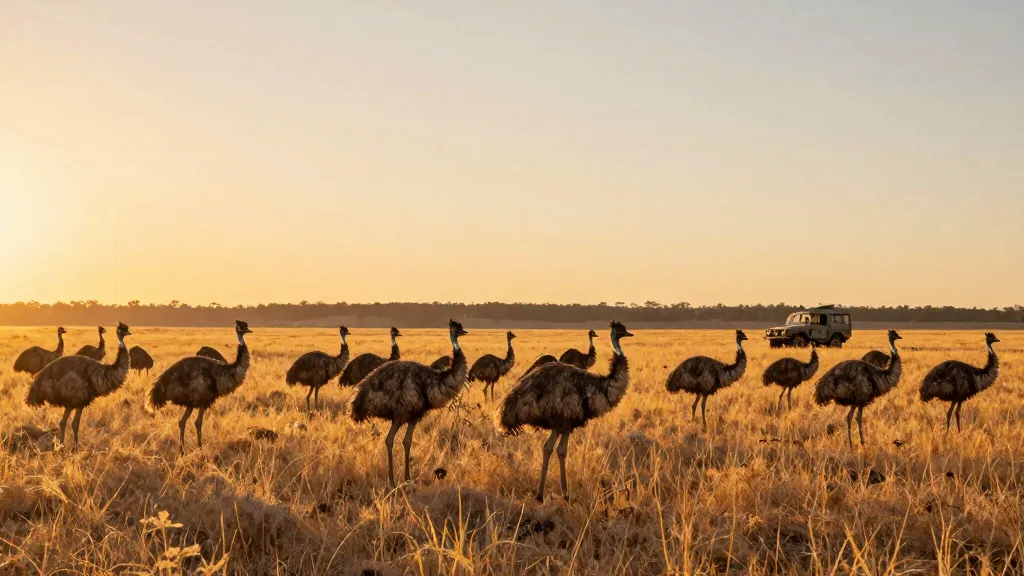
In November 1932, the nation of Australia did something no country had done before or since: it deployed its military against birds. Not enemy aircraft. Not hostile drones. Emus. Large, flightless, surprisingly fast birds indigenous to the Australian continent that had the audacity to wander into wheat fields in the Campion district of Western Australia and eat the crops. The Australian government, under the direction of Minister of Defence Sir George Pearce, sent soldiers of the Royal Australian Artillery, armed with Lewis machine guns capable of firing 500 to 600 rounds per minute, to deal with an estimated 20,000 emus that had migrated into the farming district and were devastating the wheat crops of struggling ex-soldier settlers. What followed was one of the most absurd military campaigns in human history — a month-long operation in which highly trained soldiers with automatic weapons proved spectacularly ineffective against large, fast-moving birds with a remarkable talent for evasion. By the time the military withdrew on December 10, 1932, the official tally was 986 emus killed out of an estimated population of 20,000, at a cost of approximately 10,000 rounds of ammunition. The operation was widely mocked in the press, debated in Parliament, and ultimately abandoned in favor of a simple bounty system that proved far more effective.
The roots of the Great Emu War lie in the aftermath of World War I. After the war ended in 1918, the Australian government faced the challenge of reintegrating thousands of discharged veterans into civilian life. The solution was the Soldier Settlement Scheme, a program that granted returned soldiers parcels of land in agricultural areas — often in marginal farming country that experienced farmers would have avoided. In Western Australia, large areas of the Wheatbelt region, including the Campion district near the town of Walgoolan, were allocated to veteran farmers who were instructed to grow wheat. The government promised subsidies, agricultural support, and — critically — fences to protect the crops. The subsidies were slow to arrive. The agricultural support was minimal. The fences were never built. The veterans, many of whom had no farming experience, found themselves struggling to coax wheat from dry, marginal soil in the midst of the Great Depression, which had begun in 1929 and had driven wheat prices to historic lows. They were barely scraping by when the emus arrived.
The emu (Dromaius novaehollandiae) is the second-largest living bird by height, after the ostrich, and is endemic to Australia. Adult emus can reach heights of up to 6.2 feet and weigh up to 130 pounds. They are flightless, but they are far from helpless: emus can run at sustained speeds of up to 30 miles per hour, can sprint even faster in short bursts, and are remarkably agile for their size. They are also extraordinarily hardy, capable of surviving in the harsh Australian outback by going weeks without food or water, and they have a temperament that can charitably be described as “unbothered.” When confronted with danger, emus do not typically stand and fight — they scatter, running in multiple directions at high speed, making them extremely difficult targets for hunters or, as the Australian Army would discover, machine-gun crews.
In late 1932, a migration of approximately 20,000 emus moved inland from the coastal regions of Western Australia, following their traditional seasonal patterns in search of food and water. The long, dry summer had reduced their usual food sources, and the emus discovered something far better: the wheat fields of the Campion district, filled with ripe, nutritious grain and plenty of water from the farmers’ irrigation systems. The birds descended on the crops in enormous flocks, eating the wheat, trampling the young plants, and — perhaps most damaging of all — destroying the rabbit-proof fences that farmers had painstakingly erected to protect their fields. The damaged fences allowed rabbits to pour into the farmland, compounding the destruction. For the veteran farmers, many of whom had survived the horrors of the Western Front only to face financial ruin at the hands of giant birds, the emu invasion was the last straw.
The irony of the situation was deepened by the fact that the emu appears on the Australian coat of arms, alongside the kangaroo. Both animals were chosen because they are native to Australia and because, according to popular belief, neither can walk backward — symbolizing a nation that only moves forward. The coat of arms was granted by King George V in 1912, twenty years before the government sent soldiers to shoot the bird that represents the nation.
The farmers’ complaints reached Sir George Pearce, the Australian Minister of Defence, who approved a military operation to deal with the emu problem. The decision was influenced by the political reality that the veteran farmers were a sympathetic constituency — men who had served their country in war and were now being driven to ruin by birds — and by the agricultural lobby’s pressure for government action. Pearce authorized the deployment of soldiers from the Royal Australian Artillery, under the command of Major G.P.W. Meredith. The soldiers were armed with Lewis Guns, light machine guns that had been used extensively in World War I. The Lewis Gun had a rate of fire of 500 to 600 rounds per minute and was typically fed from a 47-round drum magazine. It was an effective weapon against infantry. Against emus, it proved far less successful than anticipated.
The first engagement took place on November 2, 1932, in the Campion district. Meredith and his men positioned themselves near a group of emus and opened fire. The results were underwhelming. The emus, startled by the noise, scattered almost immediately, breaking into small groups and running at high speed across the open terrain. The soldiers, accustomed to fighting human enemies who tended to take cover rather than sprint away at 30 miles per hour, struggled to track and hit the fast-moving birds. Many rounds were fired; few emus were killed. The Lewis Guns jammed frequently in the dusty conditions, and during each jam, the surviving emus simply ran out of range. Major Meredith, who appears to have been a professional soldier with a wry sense of humor, later delivered one of the most memorable assessments in Australian military history: “If we had a military division with the bullet-carrying capacity of these birds it would face any army in the world... They can face machine guns with the invulnerability of tanks.”
After the initial failures, Major Meredith adapted his tactics. On November 4, 1932, he attempted a mass engagement near a local dam where an estimated 1,000 emus had gathered. The plan was to ambush the birds at close range and use the concentrated firepower of the Lewis Guns to bring down large numbers. But the emus once again confounded the soldiers. As soon as firing began, the birds scattered in every direction, and the Lewis Guns jammed repeatedly. During one particularly frustrating episode, a gun was mounted on a truck in an attempt to pursue the fleeing emus — but the truck could not keep up with the birds over the rough, uneven terrain, and the vibration of the vehicle made accurate aiming impossible. The idea of a motorized emu hunt was quickly abandoned. By the end of the November 4 engagement, approximately 2,500 rounds of ammunition had been expended for relatively few confirmed kills. The operation was suspended on November 8 while Meredith reported back to his superiors.
The Great Emu War was a public relations disaster for the Australian government. The media had a field day with the story, dubbing it “The Great Emu War” and running headlines that mocked the military’s inability to defeat a flock of birds. Australian newspapers published cartoons of emus dodging machine-gun fire and soldiers fleeing from enormous birds. In Parliament, the operation was debated with a mixture of outrage and hilarity. Sir George Pearce, who had approved the deployment, was subjected to pointed questioning about the wisdom of sending the army to fight birds. One parliamentarian reportedly asked whether a “war medal” would be issued for the campaign. Another suggested that the soldiers should be sent back with “greater firepower” — presumably a joke, though the line between joke and policy in the Emu War was always thin.
After the military withdrawal on December 10, 1932, the government provided farmers with ammunition — reportedly 500,000 rounds — and encouraged them to shoot the emus themselves. More importantly, the government strengthened the existing bounty system, which had been established in 1923 and paid farmers a fixed amount per emu scalp. The bounty system proved dramatically more effective than the military operation, for a simple reason: individual farmers, hunting alone or in small groups, could approach emus quietly and shoot them at close range with rifles — a method far better suited to the terrain and the behavior of the birds than noisy, conspicuous machine-gun ambushes. Between 1945 and 1960, the bounty system resulted in the collection of 284,794 emu scalps in Western Australia, a figure that dwarfs the military’s tally of 986 birds. The lesson was clear: when it comes to managing wildlife, patient hunters with rifles are more effective than soldiers with machine guns.
The Great Emu War faded into relative obscurity for several decades, remembered primarily as a quirky anecdote in Australian history. In the 2010s, however, the story experienced a remarkable resurgence as an internet meme. The image of soldiers with machine guns fighting — and losing to — giant flightless birds proved irresistible to online communities, and the Emu War became a staple of history memes, Reddit threads, YouTube videos, and social media posts. Ornithologist Dominic Serventy, one of Australia’s leading bird scientists, helped explain the emus’ remarkable evasion tactics, noting that the birds’ natural response to threats — scattering at high speed in multiple directions — made them nearly impossible targets for a coordinated military engagement. The Emu War has since been referenced in video games, television shows, and comedy routines, and is regularly cited as one of the most entertaining examples of human-wildlife conflict in history.
The Great Emu War of 1932 is, at its core, a story about the limits of human power. The Australian government sent trained soldiers with automatic weapons to fight a flock of flightless birds, and the birds won. Not through courage or strategy or intelligence — the emus simply did what emus do. They ran. They scattered. They absorbed bullets and kept going. They proved that a determined animal with strong legs and no concept of military hierarchy is remarkably difficult to exterminate with a machine gun. The Emu War is funny — it is impossible not to laugh at the image of soldiers crouching behind Lewis Guns, waiting in ambush for a flock of giant birds, only to watch the birds sprint away at 30 miles per hour while the guns jam. But it is also a reminder that human beings are not always the masters of the natural world that we imagine ourselves to be. The farmers of the Campion district eventually found a solution — the bounty system worked where the military did not — and the emu population was gradually brought under control through patient, sustained effort rather than dramatic military operations. The Emu War teaches us that nature is not an enemy to be defeated but a force to be managed with respect, patience, and a healthy dose of humility.
References & Further Reading
Wikipedia: Emu — Biology, behavior, and conservation status of the emu (Dromaius novaehollandiae)
Wikipedia: Lewis Gun — The light machine gun used by Australian soldiers during the Emu War
📚 Recommended Reading: The Great Emu War by C.J. Dennis (on Amazon) — As an Amazon Associate, we earn from qualifying purchases.
Editorial note: The Great Emu War is one of the best-documented human-wildlife conflicts in Australian history, with extensive records in the Australian National Archives and contemporary newspaper accounts. See our Editorial Policy.