The Ghost Army: How Fake Tanks and Sound Effects Helped Win WWII
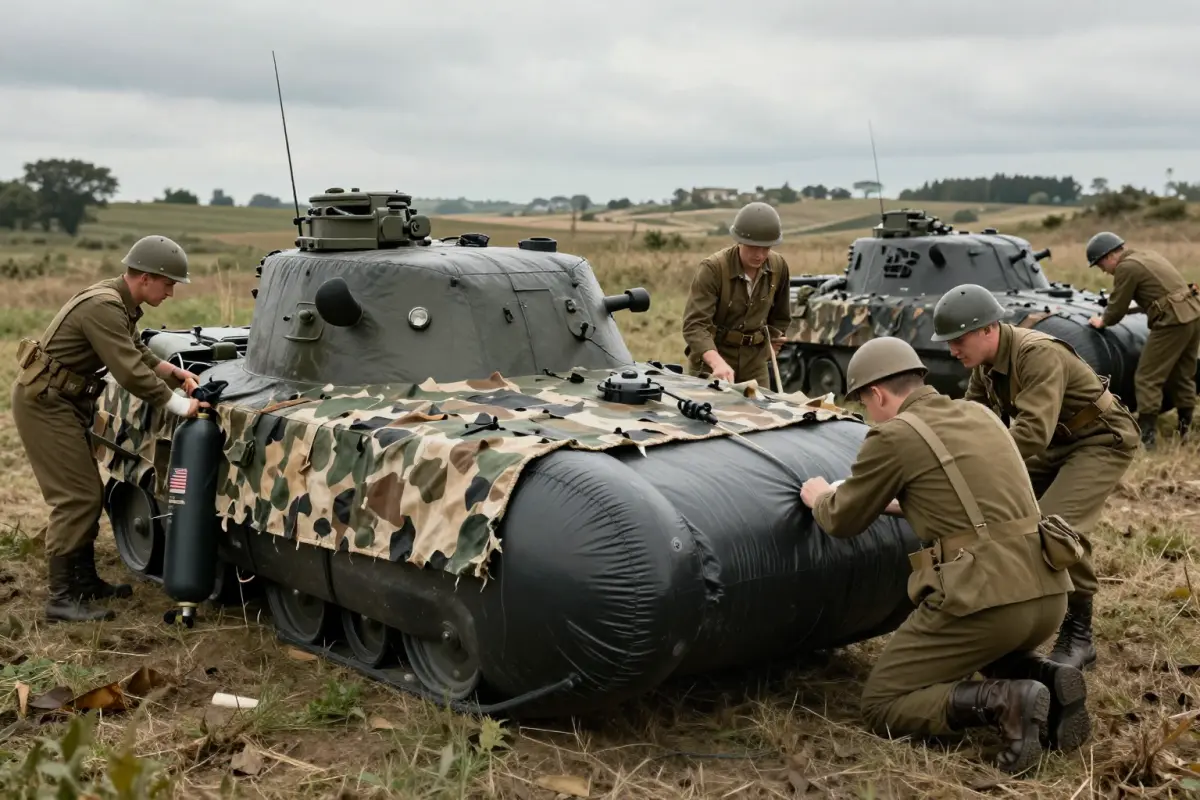
In the final year of World War II, as Allied forces fought their way across Europe against a determined and deeply entrenched enemy, the United States Army deployed a weapon so unusual, so brilliantly absurd, and so profoundly creative that its story remained classified for over fifty years. This weapon had no guns, no armor, and no explosive force. It could not destroy a bridge or capture a hill. And yet it is credited with saving the lives of an estimated 15,000 to 30,000 American soldiers. The weapon was the 23rd Headquarters Special Troops — better known as the Ghost Army. Activated on January 20, 1944, this secret unit of approximately 1,100 men was unlike anything the United States military had ever assembled. Its ranks were filled not with hardened combat veterans but with artists, designers, actors, sound engineers, architects, and advertising professionals — creative minds recruited from art schools, Madison Avenue agencies, and Hollywood studios, men whose job was not to fight the enemy but to fool him. Armed with inflatable tanks that could be unpacked and inflated in hours, powerful loudspeakers mounted on half-tracks that could broadcast the sounds of an entire armored division across miles of countryside, and radio operators who transmitted carefully crafted fake communications to deceive German signals intelligence, the Ghost Army staged a traveling road show of deception that stretched from the beaches of Normandy to the banks of the Rhine River.
The Ghost Army was the brainchild of Ralph Ingersoll, a journalist and publisher who had co-founded PM, a liberal New York newspaper, and Billy Harris, a U.S. Army planner who recognized the potential of large-scale tactical deception. Inspiration came from the British, who had honed the art of military deception in the North African desert under the brilliant Dudley Clarke and his organization known as “A Force.” The British had executed one of the most famous deceptions of the war — Operation Bertram before the Battle of El Alamein in late 1942 — using dummy tanks, fake supply dumps, and carefully crafted misinformation to convince German Field Marshal Erwin Rommel that the main Allied attack would come from the south rather than the north. The success of British deception operations convinced American planners that a dedicated U.S. deception unit could play a critical role in the upcoming invasion of France. The result was the activation of the 23rd Headquarters Special Troops at Camp Forrest, Tennessee, with the unit later completing its training at Camp Pine, New York (now Fort Drum). The men who filled its ranks were chosen for their creativity, their technical skills, and their ability to think like the enemy — a quality that traditional combat soldiers rarely needed.
When the Army set out to recruit for the Ghost Army, it did not look for marksmen or infantrymen. Instead, it sent notices to art schools, design programs, and advertising agencies across the United States, seeking men with skills in visual deception, sound engineering, and theatrical production. The recruiting was so targeted and secretive that many of the men who joined had no idea what they were signing up for. Bernie Bluestein, a 19-year-old student at the Cleveland Institute of Art, spotted a vaguely worded notice on his school’s bulletin board in March 1943, seeking recruits for a “camouflage unit.” He enlisted, not knowing that the unit’s actual mission was far more dangerous and unconventional than camouflage painting.
The Ghost Army drew some of the most talented creative minds of a generation. Bill Blass, who would become one of America’s most celebrated fashion designers, served in the unit, applying his eye for visual composition to the art of military deception. Ellsworth Kelly, who would become one of the most important abstract painters and sculptors of the twentieth century, was a Ghost Army soldier, honing his understanding of form and color while creating fake insignia and vehicle markings. Art Kane, who would become a legendary photographer famous for his portrait of 57 jazz musicians on a Harlem brownstone steps (“A Great Day in Harlem”), served in the unit’s visual deception operations. Arthur Singer, who became one of America’s greatest wildlife illustrators — his bird paintings appeared on U.S. postage stamps — was another member. These men, and hundreds like them, brought a level of artistry and attention to detail that made the Ghost Army’s deceptions devastatingly effective. They understood that convincing the enemy required more than a few inflatable tanks — it required a complete, immersive, multisensory illusion, from the visual appearance of a military encampment to the sounds of vehicle engines and the radio traffic of a busy headquarters. The Ghost Army was, in essence, a theater company — and the European theater of operations was its stage.
The Ghost Army employed three primary methods of deception, each targeting a different intelligence-collection capability of the German military. The first and most visually striking was the use of inflatable tanks, trucks, jeeps, and aircraft. Manufactured by specialty companies under contract to the Army, these decoys were remarkably realistic when properly deployed. A typical inflatable M4 Sherman tank weighed only a fraction of the real 30-ton vehicle but, when inflated with compressed air and positioned correctly, was virtually indistinguishable from the genuine article at a distance of a few hundred yards. The inflatables came with detailed instructions for setup — soldiers had to paint on unit markings, add realistic “battle damage” and mud, and position the decoys in ways that matched real military doctrine. The tanks even came with fake treads that could be pressed into the soil to create the impression of heavy vehicle tracks.
The second method was sonic deception — perhaps the Ghost Army’s most innovative technique. The unit’s sound engineers had access to a library of sound recordings made at Fort Knox, Kentucky, using actual military vehicles, tanks, artillery pieces, and infantry units. The recordings captured the unique acoustic signatures of every major piece of American military equipment: the rumble of M4 Sherman tanks, each producing a distinctive 500-horsepower growl, the whine of M3 half-tracks, the clatter of jeeps and trucks, the crash of artillery fire, and even the sounds of soldiers constructing bridges and fortifications. The recordings were pressed onto vinyl records and catalogued by vehicle type, speed, and distance. During operations, the sound engineers would select the appropriate records and play them through powerful 500-watt amplifiers mounted on half-track vehicles equipped with massive speaker arrays, carefully adjusting volume and equalization to match the simulated distance and terrain. The system was powerful enough to project convincing military sounds over distances of up to 15 miles, creating the auditory impression of an entire armored division on the move. German soldiers who heard the broadcasts later reported that they were completely convincing — they had no doubt that they were hearing a major American military formation approaching.
The third method was radio deception — perhaps the most technically demanding element of the Ghost Army’s operations. The unit’s radio operators were skilled at mimicking the communications patterns, call signs, and operating procedures of the real American units they were impersonating. Every division in the U.S. Army had its own distinctive radio “fingerprint” — characteristic frequencies, transmission schedules, code words, and operator habits that trained German signals intelligence analysts could identify. The Ghost Army’s radio operators studied these fingerprints meticulously, practicing until they could reproduce them convincingly. They transmitted fake orders, situation reports, and logistics messages designed to paint a false picture of American troop movements and intentions for German listeners. When combined with the visual deception of the inflatable vehicles and the sonic deception of the loudspeaker broadcasts, the radio deception completed the illusion, creating a comprehensive, multisensory fake that the German intelligence apparatus found extremely difficult to penetrate.
Between its arrival in Europe in May 1944 and the end of the war in May 1945, the Ghost Army carried out more than 20 deception operations across France, Belgium, Luxembourg, and Germany. These included Operation Elephant (July 1944), which simulated the 6th Armored Division in Brittany to divert German attention from the breakout at St. Lô; Operation Bergen (August 1944), which deceived the Germans about the location of the 79th Infantry Division; and Operation Bettembourg (September 1944), which drew German attention away from the U.S. Third Army’s crossing of the Moselle River. But the largest and most consequential Ghost Army operation was Operation Viersen, conducted in March 1945 during the Allied crossing of the Rhine River — the last great natural barrier between the Allied armies and the heart of Germany.
Operation Viersen was a masterpiece of military deception. The actual Rhine crossing — Operation Plunder, led by British Field Marshal Bernard Montgomery — was planned for the area around Wesel and Rees. The Ghost Army’s mission was to convince the Germans that the crossing would occur approximately 20 miles to the north, near the town of Viersen. To achieve this, the 1,100 men of the Ghost Army simulated the entire 30th and 79th Infantry Divisions — a force of approximately 40,000 men with all their vehicles, artillery, and support equipment. The unit deployed hundreds of inflatable tanks, trucks, and artillery pieces across a wide area, creating the visual impression of two full infantry divisions preparing for a major river assault. The sonic deception teams broadcast the sounds of tank engines, vehicle convoys, and pontoon bridge construction for hours on end. The radio operators transmitted a flood of fake communications consistent with the activities of two infantry divisions preparing for an assault crossing. The deception worked brilliantly. The Germans moved two full divisions — the 6th Parachute Division and the 15th Panzergrenadier Division — to the Viersen area to meet the phantom crossing, weakening the defenses at the actual crossing point and saving thousands of American and British lives. Operation Viersen is widely considered the Ghost Army’s finest hour and one of the most successful tactical deceptions in military history.
For over fifty years after World War II, the men of the Ghost Army kept their secret. They had been sworn to secrecy during the war and were told that the classified nature of their mission meant they could not discuss it — not with their wives, not with their children, not even with other veterans. The unit’s existence was not declassified until 1996, when the Freedom of Information Act prompted the release of relevant documents. Even then, the story remained largely unknown to the public until filmmaker Rick Beyer released the documentary The Ghost Army in 2013, followed by the book The Ghost Army of World War II (co-written with Thomas H. Tillison) in 2015. In 2022, Congress passed legislation awarding the Ghost Army the Congressional Gold Medal — Congress’s highest civilian honor. The award ceremony took place on March 21, 2024, at the U.S. Capitol. By that time, only seven surviving members were known to be alive, and three — Seymour Nussenbaum (100), Bernard Bluestein (100), and John Christman (99) — attended the ceremony in person. “It was like putting on a big production,” Nussenbaum said. “We have had in some cases people impersonating generals, putting on a general’s uniform and walking around the streets.”
The Ghost Army remains one of the most extraordinary units in the history of warfare — a battalion of artists and actors who used creativity, technology, and sheer audacity to deceive one of the most capable military intelligence apparatuses in the world. Their inflatable tanks never fired a shot, but their sonic deceptions and fake radio transmissions drew real German divisions away from real American soldiers, saving an estimated 15,000 to 30,000 lives. The unit operated in near-total secrecy for over fifty years, its members returning to civilian life unable to tell their families what they had done during the war. When the story finally emerged, it revealed a side of World War II that was almost surreal in its ingenuity — a traveling road show of rubber tanks and recorded sound that proved that war is not always won by firepower alone. Sometimes it is won by the willingness to believe — and by the creative genius to make the enemy believe something that is not there.
References & Further Reading
Wikipedia: Operation Fortitude — The broader D-Day deception plan that the Ghost Army supported
📚 Recommended Reading: Artists of Deception by Rick Beyer (on Amazon) — As an Amazon Associate, we earn from qualifying purchases.
Editorial note: The Ghost Army’s story is documented through declassified military records, the PBS documentary by Rick Beyer, the Congressional Gold Medal legislation, and the testimonies of surviving members. See our Editorial Policy.