The Philadelphia Experiment: Did the Navy Make a Ship Invisible?
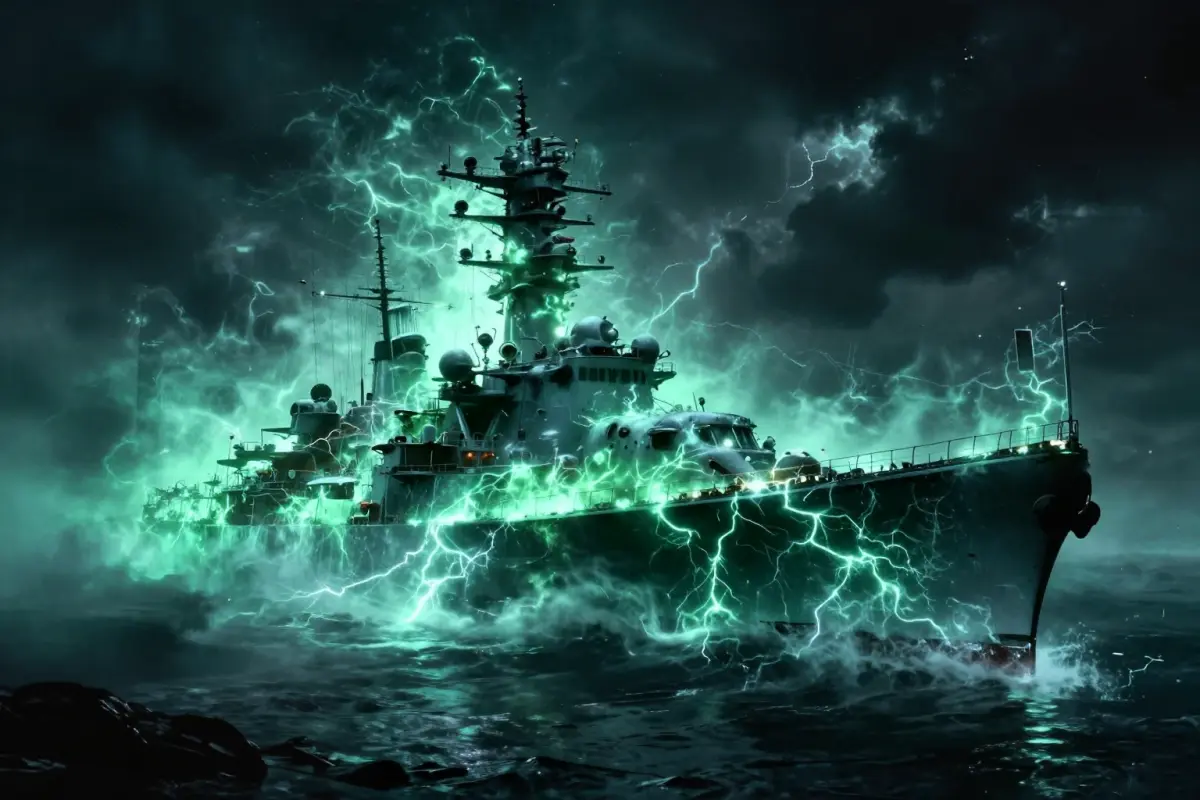
In the long, strange catalog of military conspiracy theories, few stories are as enduring or as disturbing as the Philadelphia Experiment. According to the legend, on or around October 28, 1943, the United States Navy conducted a top-secret experiment at the Philadelphia Naval Shipyard that rendered the destroyer escort USS Eldridge (DE-173) completely invisible — not just to radar, but to the naked eye. The story goes that generators aboard the ship were activated, producing an eerie green-blue glow that enveloped the hull, and then the ship simply vanished from the waters of Philadelphia and reappeared at the Norfolk Naval Shipyard in Virginia, approximately 200 miles away, before returning to Philadelphia. But the experiment, if it happened, had a horrific cost: crew members were allegedly found fused into the metal structure of the ship, their bodies merged with the steel decks and bulkheads. Others reportedly went insane, became invisibly phased in and out of reality, or spontaneously combusted. The story claims the experiment was based on Albert Einstein’s unified field theory and was part of a desperate effort to give Allied ships an advantage in the brutal Battle of the Atlantic against Nazi U-boats. It is a tale of science gone horribly wrong, of government secrecy run amok, and of men who paid the ultimate price for an experiment that official history says never happened.
The Philadelphia Experiment story did not emerge from declassified documents or whistleblowers or congressional hearings. It began with a handwritten letter. In 1955, a man named Carl M. Allen, writing under the pseudonym Carlos Allende (also known as Carlos Miguel Allende), sent a series of rambling, semi-literate letters to Morris K. Jessup, an astronomer and author who had just published a book called The Case for the UFO. Allen claimed to have witnessed the experiment firsthand from the deck of the SS Andrew Furuseth, a merchant marine ship moored in Philadelphia. He described seeing the Eldridge become surrounded by a glowing field, disappear entirely, and then reappear in Norfolk before returning to Philadelphia. Allen’s letters were passionate, detailed, and deeply strange — filled with references to Einstein’s unified field theory, invisible force fields, and government cover-ups of the most sinister kind. Jessup, intrigued but skeptical, attempted to investigate but found no corroborating evidence.
Carl Meredith Allen was born in 1925 in Springdale, Pennsylvania. He served in the United States Marine Corps during World War II, though his service record does not place him aboard the SS Andrew Furuseth or anywhere near the Philadelphia Naval Shipyard during the period when the experiment allegedly occurred. By the 1950s, Allen was drifting between jobs and addresses, cultivating an intense interest in UFOs, paranormal phenomena, and government conspiracies. His letters to Jessup were written in a distinctive, stream-of-consciousness style that combined genuine technical vocabulary with wild speculation. What made Allen’s letters compelling was the specificity of his claims: he named the ship, the location, the date, and the technology. He described the horrific effects on the crew. He even named specific individuals he claimed had been involved. But when researchers attempted to verify Allen’s claims, the evidence crumbled at every point. The USS Eldridge’s actual service record, obtained from the National Archives, showed that the ship was commissioned on August 27, 1943, and spent October 1943 undergoing shakedown training in the Bermuda area, not sitting in Philadelphia. The crew members who were located and interviewed in the 1980s uniformly denied that any such experiment had taken place. Allen himself gave contradictory accounts in different letters, and his credibility was seriously undermined by the inconsistencies.
The USS Eldridge was a real ship — a Cannon-class destroyer escort commissioned on August 27, 1943. Its actual wartime service was heroic and well-documented. After shakedown training near Bermuda in October 1943, the Eldridge served on convoy escort duty in the Atlantic and later supported the Allied invasion of southern France in 1944 and anti-submarine patrols in the Mediterranean. After World War II, the Eldridge was placed in reserve and transferred to Greece in 1951, where it was renamed the HS Leon (D-60). The ship served in the Greek Navy until being decommissioned and scrapped in the 1990s. The Eldridge’s complete service records are held by the National Archives and are available for public inspection. They show no gap, no classified period, and no mysterious experiment. The ship was exactly where the Navy said it was, doing exactly what the Navy said it was doing, on every date that the Philadelphia Experiment was alleged to have occurred.
The Philadelphia Experiment story might have remained an obscure correspondence between a crank and an astronomer if not for one of the strangest episodes in the history of American intelligence. In 1956, about a year after Allen began writing to Jessup, the Office of Naval Research (ONR) in Washington, D.C., received a curious package: a copy of Jessup’s book The Case for the UFO, annotated in the margins with handwritten notes in three different colored inks — apparently from Allen and two other individuals who used the names “Jemi” and “Mr. A.” The annotations discussed the Philadelphia Experiment, unified field theory, and other alleged government secrets with an air of insider knowledge. The ONR was sufficiently intrigued to reproduce the annotated book and distribute copies within the Navy. The reasons for the ONR’s interest have been debated: conspiracy theorists saw the distribution as evidence that the experiment was real, while ONR officials later said the interest was in the psychology of UFO belief. In 1963, a defense contractor called Varo Manufacturing Company published a limited edition of the annotated book — the famous “Varo Edition” — with a print run of approximately 100 copies. The existence of a Navy-distributed document about the experiment became the single most powerful piece of “evidence” cited by believers.
The Philadelphia Experiment legend draws much of its apparent credibility from its invocation of real scientists and real physics. Albert Einstein did indeed work for the U.S. Navy during World War II, serving as a consultant on explosives, torpedoes, and other ordnance matters. Einstein did develop work on a unified field theory — an attempt to unify gravity and electromagnetism into a single mathematical framework — but he considered his work unfinished and never published a complete theory. There is no evidence that Einstein ever worked on invisibility, teleportation, or any project resembling the Philadelphia Experiment. The legend sometimes invokes Nikola Tesla as well, claiming he contributed to the experiment’s technology. This is chronologically impossible: Tesla died on January 7, 1943, nearly ten months before the experiment allegedly took place. The physics described in the legend — using powerful electromagnetic fields to bend light around an object and render it invisible — is not consistent with known physics. While modern researchers have developed theoretical approaches to optical cloaking using metamaterials, these technologies require carefully engineered structures at the nanoscale and bear no resemblance to the generators-and-cables approach described in the story.
While the Philadelphia Experiment never happened, the Navy was conducting real experiments in Philadelphia during World War II that may have provided the seed for the legend. The most significant was degaussing — the process of demagnetizing a ship’s hull to make it invisible to magnetic naval mines deployed by German U-boats. Degaussing involved wrapping a ship’s hull in heavy electrical cables and running powerful electrical currents through them to neutralize the ship’s magnetic signature. The process produced visible electrical effects — humming generators, glowing cables, perhaps even a faint luminescence around the hull — that could easily have been misinterpreted by an uninformed observer as an “invisibility” experiment. The Navy also conducted extensive ship camouflage experiments during both World Wars, including dazzle camouflage with bold geometric patterns designed to confuse enemy range-finders. The combination of degaussing operations, camouflage experiments, and the general atmosphere of wartime secrecy at the Philadelphia Naval Shipyard provided fertile ground for rumor and speculation, especially when filtered through the imagination of a man like Carl Allen.
For decades after Allen’s letters and the Varo Edition, the Philadelphia Experiment remained a niche topic discussed primarily in UFO enthusiast circles. That changed dramatically in 1984 with the release of The Philadelphia Experiment, a feature film starring Michael Paré as a sailor who is displaced in time during the experiment and finds himself transported to 1984. The film took enormous liberties with the source material but introduced the story to a mass audience and transformed a crank letter into a pop culture phenomenon. The movie’s depiction — glowing green fog, electrical discharges, crew members fused into metal — became the standard visual vocabulary for the Philadelphia Experiment, even though none of these details appeared in Allen’s original letters. A sequel followed in 1993, and the Sci-Fi Channel produced a remake in 2012. Each adaptation layered new details onto the legend, blurring the line between the original claims and fictional embellishments until the two became virtually inseparable in the public imagination.
The cultural afterlife of the story also drew in new claimants. In the 1980s, a man named Al Bielek emerged to claim that he had personally participated in the Philadelphia Experiment and had been teleported through time to the year 1983. Bielek’s claims were elaborate — underground bases, time travel, alien contact, and secret government programs — but they were thoroughly discredited by researchers who found that his accounts contradicted both the established facts and each other. Serious researchers of the story, including Robert Goerman, whose investigation traced Allen’s background in detail, dismissed Bielek’s claims as fabrication.
The Philadelphia Experiment is, by nearly all historical and scientific measures, a myth. It originated from a single source — Carl Allen, a man whose credibility has been extensively and convincingly challenged. The ship at the center of the story, the USS Eldridge, was hundreds of miles away on the date the experiment allegedly occurred. The crew members who were found and interviewed uniformly denied that any such experiment took place. The scientific principles invoked are not supported by known physics. The Navy has consistently and categorically denied that the experiment ever occurred, and no documentary evidence has ever emerged to contradict that denial. But the Philadelphia Experiment endures because it speaks to something deeper than evidence: the belief that governments possess secret technologies beyond public comprehension, that official denials are proof of cover-ups, and that the truth is always more extraordinary than what we are told. It is a story about the limits of knowledge, the seduction of conspiracy, and the enduring human fascination with the possibility that somewhere, in some locked vault or hidden laboratory, the impossible is being made real — even when it isn’t.
References & Further Reading
📚 Recommended Reading: The Philadelphia Experiment by Charles Berlitz (on Amazon) — As an Amazon Associate, we earn from qualifying purchases.
Editorial note: the Philadelphia Experiment is classified as a debunked conspiracy theory by historians and the U.S. Navy. See our Editorial Policy.