The London Beer Flood of 1814: A Wave of Destruction
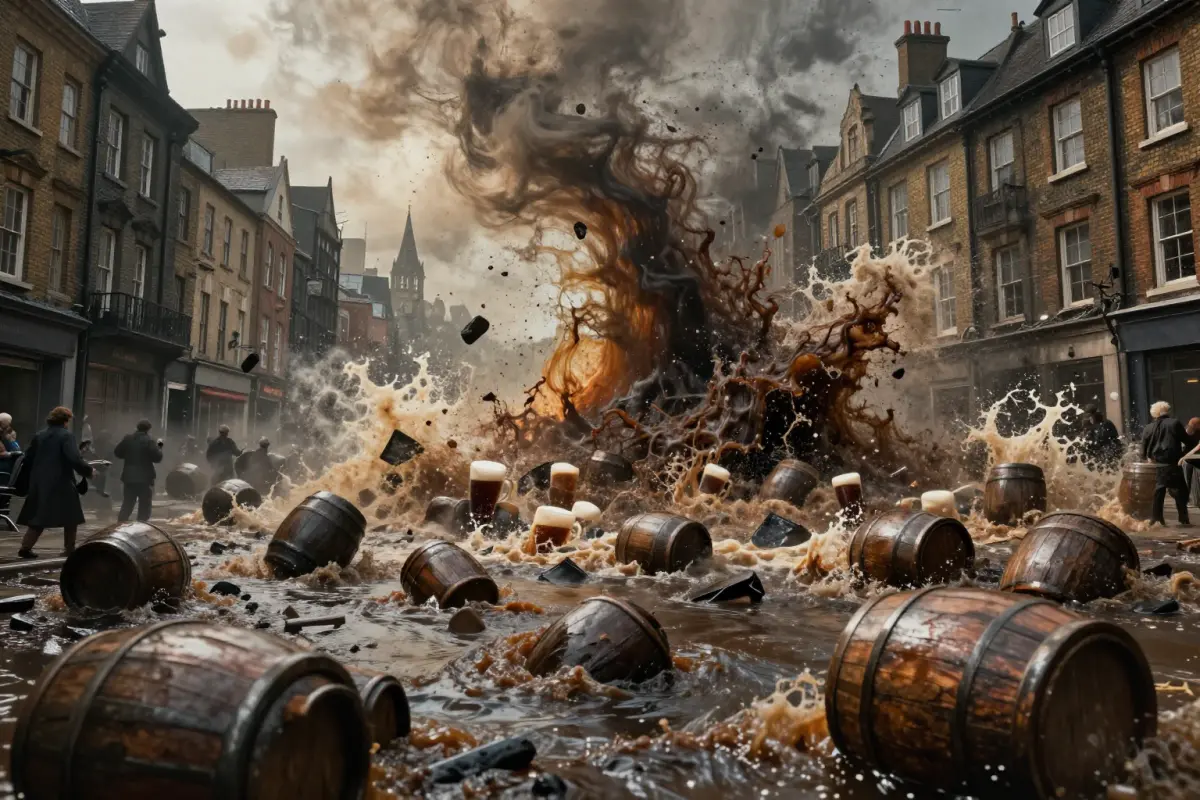
On the afternoon of Monday, October 17, 1814, in one of the most bizarre industrial disasters in history, a tsunami of beer — a wall of dark porter ale reportedly 15 feet high — roared through the crowded streets of one of London’s most notorious slums, killing at least eight people, demolishing homes, and flooding cellars with thousands of gallons of fermenting brew. The disaster began at Meux & Company’s Horse Shoe Brewery, located at the junction of Tottenham Court Road and Great Russell Street, when a massive wooden fermentation vat — 22 feet tall and holding the equivalent of more than 3,500 barrels of porter — ruptured catastrophically after one of its iron restraining hoops snapped. The escaping beer dislodged valves and burst surrounding vats, releasing a staggering 323,000 imperial gallons (approximately 1.47 million liters) of beer in a matter of minutes. The black torrent smashed through the brewery’s back wall and surged into the St. Giles rookery, a desperately poor, densely packed warren of tenements, narrow alleys, and overcrowded cellars. Two houses collapsed. A pub wall crumbled, trapping a teenage servant girl. An Irish family holding a wake for a two-year-old child was swept away in the flood.
The London of 1814 was a city in the throes of the Industrial Revolution — booming, overcrowded, and profoundly unequal. The population had swelled to over one million people, making it the largest city in Europe and one of the largest in the world. In the neighborhoods around the brewery, the St. Giles rookery, conditions were among the worst in the city. St. Giles was a labyrinth of narrow courts, dark alleys, and crumbling tenements, home to some of London’s poorest residents: Irish immigrants, displaced agricultural workers, prostitutes, and the destitute. Entire families crammed into single rooms, and many lived in basement dwellings — partially underground cellars that were damp, poorly ventilated, and terrifyingly vulnerable to flooding. The artist William Hogarth had immortalized the neighborhood’s desperation in his famous 1751 print Gin Lane, set in St. Giles, depicting the horrors of cheap gin addiction. Beer, by contrast, was considered the wholesome alternative — safer than the city’s often contaminated water supply, and consumed by men, women, and children alike in staggering quantities. The average Londoner drank an estimated several pints of beer per day, and porter — a dark, rich ale made with brown malt — was the city’s most popular style. The industrialization of brewing had led to ever-larger fermentation vessels to meet this enormous demand, and the vats at Meux’s brewery were among the largest ever constructed.
The Horse Shoe Brewery had stood at the corner of Great Russell Street and Tottenham Court Road for decades before Sir Henry Meux purchased it in 1809. Meux came from a wealthy brewing dynasty — his father, Sir Richard Meux, had been one of London’s most prominent brewers — and he set about expanding the brewery’s capacity to rival the largest operations in London. The centerpiece of the brewery was a series of enormous wooden fermentation vats, the largest of which measured 22 feet high and 60 feet in circumference. These vats were constructed from massive oak staves held together by heavy iron hoops, and each could hold approximately 135,000 imperial gallons of porter. A single vat contained enough beer to provide a pint to more than one million people. The scale of these vessels was staggering even by the standards of the day, and they were a source of considerable pride — and curiosity — for the brewery. Before the flood, the vats were something of a tourist attraction: visitors were allowed inside the empty vats, and the brewery occasionally hosted dinners inside the massive casks, with dozens of guests seated at long tables within the wooden chambers. It was a display of industrial bravado that would prove catastrophically premature.
The vats were not without their problems. In 1810, just a few years before the disaster, one of the large vats at the Horse Shoe Brewery had burst — a warning sign that was apparently not taken seriously enough. The vats were under enormous internal pressure from the fermenting beer, which produced carbon dioxide gas as a byproduct. The wooden staves expanded and contracted with changes in temperature and moisture, and the iron hoops that held them together were subject to metal fatigue, rust, and stress fractures. On the afternoon of October 17, 1814, one of those iron hoops on the largest vat snapped. According to accounts, a brewery worker noticed the broken hoop and reported it to a supervisor, but before any action could be taken — approximately one hour later — the entire vat ruptured catastrophically. The sudden release of 135,000 gallons of fermenting porter created an explosive blast of pressure that knocked out the valve of an adjacent vat, which in turn ruptured and released its contents. The chain reaction continued as the escaping beer smashed into surrounding vessels and barrels, ultimately releasing a combined total of between 128,000 and 323,000 imperial gallons of beer — enough to fill more than five Olympic swimming pools. The force of the eruption collapsed the back wall of the brewery, and the black, foaming torrent poured out into the streets of St. Giles.
The eruption was not a slow leak — it was a violent explosion. When the largest vat burst, the released pressure wave was powerful enough to blow out the back wall of the brewery building entirely. Witnesses described hearing a deafening boom that echoed through the narrow streets, followed moments later by a wall of dark, foaming porter ale surging through the lanes of St. Giles like a black tsunami. The wave was reportedly 15 feet high in places and moved with terrifying speed through the densely packed warren of alleys and courts. The terrain of St. Giles made the disaster far worse. The neighborhood was lower-lying than the brewery, which sat on slightly elevated ground at the junction of Tottenham Court Road and Great Russell Street. The escaping beer flowed downhill into a maze of narrow courts and dead-end alleys, many no wider than six or seven feet. The narrow passages funneled and concentrated the flood, turning side streets into raging torrents of beer, foam, and debris. Cellars — the cheapest and most desperate dwellings in the neighborhood — filled rapidly. Entire families living in subterranean rooms were trapped as thousands of gallons of porter poured through broken windows and collapsed walls, rising to the ceiling in minutes.
The destruction was swift and merciless. Two houses on New Street were completely demolished by the force of the wave. A third building, the Tavistock Arms pub on Great Russell Street, had its front wall collapse inward, crushing a teenage servant girl named Eleanor Cooper who was working in the pub’s cellar. She was just 14 years old. In one of the most heartbreaking episodes of the disaster, an Irish woman named Mary Mulvey was holding a wake for her two-year-old son in a basement dwelling when the flood hit. Mary and another of her children were swept away and killed. Hannah Banfield, a young mother at home with her infant daughter Sarah, was killed when the flood tore through their dwelling. Ann Saville died in one of the demolished houses on New Street. Elizabeth Smith was caught in the flood as it surged through the basement dwellings. William Reymond was another victim recorded in contemporary accounts. In total, eight people lost their lives, though some historians believe the actual toll may have been slightly higher, as many of the poorest residents lived in unrecorded cellar dwellings that might never have been thoroughly searched.
Many of the victims were Irish immigrants who had come to London seeking work during the upheavals of the Napoleonic Wars era. They were the invisible poor of Georgian London — people whose deaths might have gone entirely unremarked in any other context. It was only the sheer bizarreness of the cause — drowning in beer — that elevated their deaths into the public consciousness. The immediate aftermath of the flood was chaotic. Survivors described wading through waist-deep beer mixed with broken timber, shattered glass, and the debris of collapsed buildings. The smell of porter — rich, malty, and yeasty — filled the air for blocks around. Rescue efforts were haphazard and largely undertaken by neighbors and bystanders rather than any organized emergency response, as no formal emergency services existed in 1814 London. People dug through rubble with their bare hands, searching for survivors in the collapsed buildings and flooded cellars. The St. Giles workhouse opened its doors to those made homeless by the flood, providing temporary shelter for survivors who had lost everything. In a grim irony, some residents of the neighborhood were seen scooping up the escaped beer in whatever containers they could find — pots, pans, buckets, even their cupped hands. For people who could rarely afford to buy beer in quantity, the flood represented a perverse windfall, and reports suggest that some drank themselves into a stupor even as the bodies of their neighbors were still being recovered from the wreckage.
It took days to recover all the bodies. The flood had scattered debris and victims across a wide area, and the tangled ruins of the demolished houses had to be carefully dismantled. A coroner’s inquest was convened at the Workhouse of the Parish of St. Giles-in-the-Fields in the days following the disaster. The inquest heard testimony from brewery workers, neighbors, and witnesses, and examined whether the disaster was an unavoidable accident or the result of negligence on the part of the brewery’s management. Evidence suggested that a worker had noticed the broken hoop approximately an hour before the catastrophic failure and had reported it to a supervisor. However, the inquest ultimately ruled the deaths “by casualty,” finding that the flood was an Act of God — an unforeseeable accident for which no individual could be held criminally responsible. This was not an unusual verdict for industrial disasters in the early nineteenth century, when the concept of corporate negligence was still in its infancy and the law heavily favored property owners and employers over the poor.
The brewery’s owners faced civil lawsuits from survivors and the families of victims, but these cases were reportedly settled for relatively small amounts. The total damage was estimated at approximately £23,000 — a substantial sum at the time, equivalent to several million pounds today — but much of this represented property damage rather than compensation for lost lives. In a reflection of the era’s priorities, Parliament debated the excise duty owed on the lost beer, ultimately waiving the tax — a decision that saved the brewery from financial ruin and allowed Meux & Company to continue operating. The Horse Shoe Brewery was rebuilt and continued operations for decades after the flood. Sir Henry Meux even expanded the business, and the Meux brewing dynasty remained one of London’s most prominent throughout the nineteenth century. The brewery was eventually demolished in 1922, and the site is now occupied by the Dominion Theatre on Tottenham Court Road. Today, there is no physical memorial to the eight victims of the London Beer Flood at the site — a fact that reflects the historical invisibility of the poor of St. Giles, whose lives and deaths were rarely deemed worthy of commemoration.
The London Beer Flood did, however, contribute to a gradual shift in attitudes toward industrial safety. While no single piece of legislation was directly prompted by the disaster, the growing awareness that massive industrial vessels posed risks to surrounding communities informed later reforms in factory and workplace safety throughout the Victorian era. The construction of large fermentation vats continued, but with increasingly rigorous standards for materials, inspection, and maintenance. The flood also entered popular culture as one of London’s most extraordinary disasters. It has been the subject of numerous books, documentaries, and articles, and is frequently cited in lists of history’s strangest accidents. In 2014, on the 200th anniversary of the flood, a local pub called the Holborn Whippet brewed a special commemorative beer in honor of the victims. The story continues to fascinate because it sits at the intersection of so many compelling themes: the absurdity of drowning in beer, the vulnerability of the poor, the hubris of industrial expansion, and the thin line between everyday life and catastrophic disaster in the world’s first industrial city.
References & Further Reading
Wikipedia: Meux’s Brewery — History of the Horse Shoe Brewery and the Meux brewing dynasty
Wikipedia: St Giles, London — The history of the slum neighborhood devastated by the flood
Wikipedia: Porter (beer) — The dark ale style that flooded the streets of London in 1814
Molasses_Disaster" target="_blank" rel="noopener noreferrer">Wikipedia: Boston Molasses Disaster — The eerily similar 1919 industrial flood in Boston’s North End
Editorial note: The London Beer Flood is documented through contemporary newspaper reports, the coroner’s inquest records, parliamentary archives, and decades of historical research. See our Editorial Policy.