The Cadaver Synod: The Bizarre Trial Where a Dead Pope Was Dug Up and Condemned
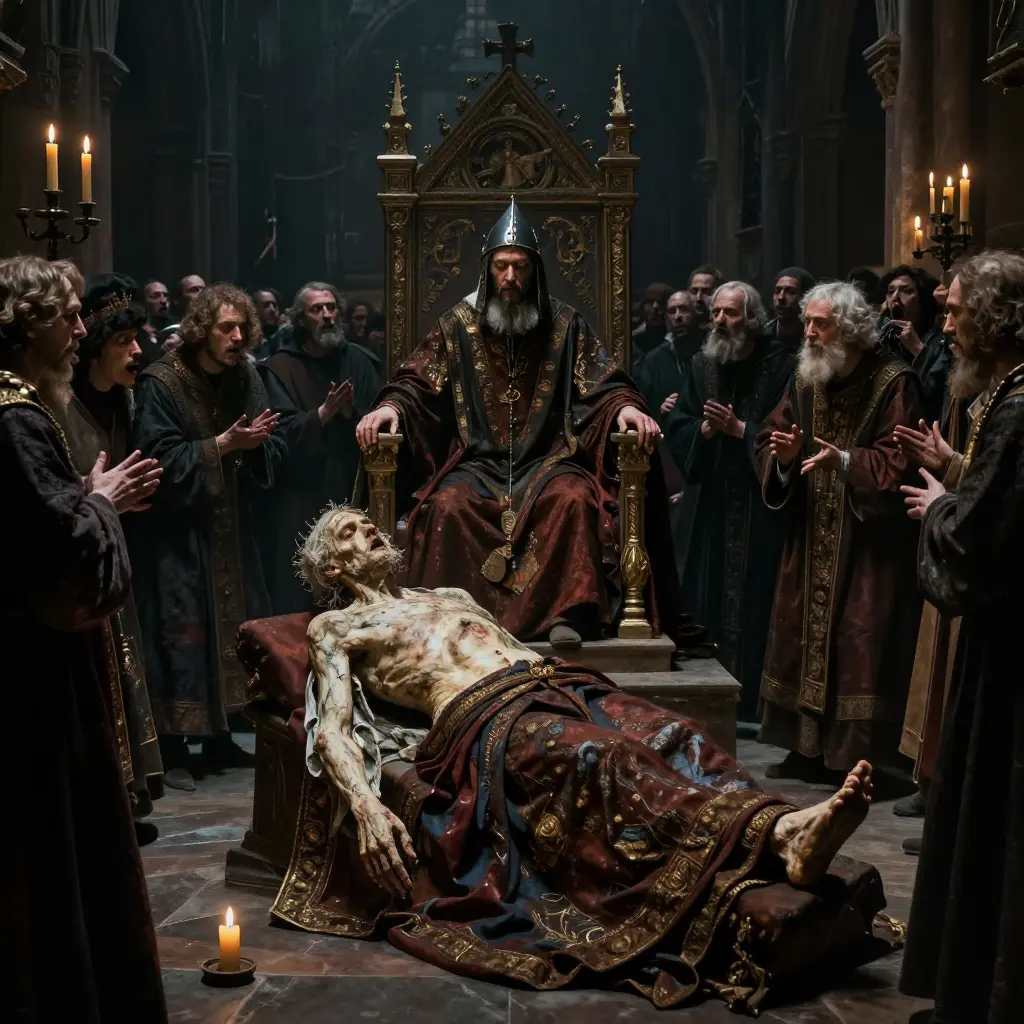
Pope Stephen VI presiding over the Cadaver Synod of 897 — one of the most grotesque and surreal events in the history of the Catholic Church
In January 897, in the Basilica of St. John Lateran in Rome — the cathedral church of the Pope, the spiritual heart of Western Christendom — a trial took place that was so grotesque, so surreal, and so profoundly disturbing that it has haunted the history of the Catholic Church for over a thousand years. The presiding judge was Pope Stephen VI (sometimes called Stephen VII), the supreme pontiff of the Roman Catholic Church, wearing the full regalia of his office. The defendant was Pope Formosus, who had served as Bishop of Rome from October 891 until his death on April 4, 896. The trial was real. The charges were real. The verdict was real. There was only one problem: Pope Formosus had been dead for approximately nine months. His corpse had been exhumed from its tomb, dragged into the basilica, dressed in the full papal vestments of white and gold, and propped up on a throne to face his accuser. A deacon was appointed to speak on behalf of the corpse, answering the charges as the dead pope sat in rigid, decaying silence, his sunken eyes staring at the living men who had orchestrated this nightmare. The charges against Formosus included perjury, illegal accession to the papacy, and violating canon law by holding multiple bishoprics simultaneously. Stephen VI shouted accusations at the corpse, and the deacon answered on its behalf. When the trial was over, Formosus was found guilty on all counts. His papacy was retroactively declared null and void. His right hand — the hand of blessing — was cut off. His papal vestments were stripped from his rotting body. All the ordinations and appointments he had made were declared invalid, plunging the Church into chaos. And then, as a final indignity, his corpse was carried out of the basilica, taken to a cemetery for foreigners and strangers, and dumped into a common grave. Weeks later, his body was exhumed again and thrown into the Tiber River. The Cadaver Synod — known in Latin as the Synodus Horrenda, the Horrible Synod — remains one of the most bizarre and disturbing events in the entire history of the papacy.
To understand why a pope would put a corpse on trial, it is necessary to understand the political nightmare that was the papacy in the late ninth century. This period, sometimes called the Saeculum Obscurum (the Dark Age) of the papacy, was marked by a rapid and chaotic succession of pontiffs, most of whom served for only months or a few years before being deposed, imprisoned, or murdered. Between 872 and 965, approximately two dozen popes were appointed — an average reign of less than four years. Between 896 and 904, there was, on average, a new pope every year. The papacy was not a spiritual office in any meaningful sense; it was a political prize, fought over by rival Roman aristocratic families, the Holy Roman Emperor, and various Italian noble houses who saw control of the papacy as a means to power, wealth, and influence. The most powerful families — including the house of Spoleto, the Tusculani, and the Crescentii — installed and deposed popes at will, treating the Chair of St. Peter as a political football. In this environment, the Cadaver Synod was not an aberration — it was a logical, if extreme, expression of the political warfare that had consumed the Church.
Pope Formosus (c. 816–896) was not a villain or a usurper — he was, by most accounts, a capable and respected churchman who had the misfortune of being pope during one of the most politically volatile periods in Roman history. Born in Rome around 816, Formosus rose through the Church hierarchy during the pontificate of Pope Nicholas I (858–867). In 864, Nicholas appointed Formosus as Bishop of Porto-Santa Rufina, a suburbicarian diocese near Rome. Formosus proved to be an able diplomat and was sent on important papal legations to France in 866 and 867, where he successfully negotiated on behalf of the pope with the Frankish king Charles the Bald. His diplomatic skills and intellectual reputation made him one of the most prominent churchmen in Rome, but they also made him a target for political enemies.
In 872, after the death of Pope Nicholas I, Formosus was a leading candidate for the papacy but was passed over in favor of Pope Adrian II and later Pope John VIII. John VIII proved to be a bitter enemy. In 875, John VIII accused Formosus of conspiring against the papacy and of aspiring to the papal throne himself. Formosus was excommunicated and fled Rome, taking refuge in Tours, France. He was eventually rehabilitated by Pope Marinus I in 883, who restored him to his see at Porto, and he continued to serve as Bishop of Porto for over twenty years before finally being elected pope in October 891 at the age of approximately 75. As pope, Formosus made a fateful political decision: in 896, he crowned Arnulf of Carinthia, the King of East Francia, as Holy Roman Emperor. This enraged the powerful house of Spoleto, which had its own imperial ambitions and viewed Arnulf as a threat to their control of Italy. When Formosus died on April 4, 896, the Spoletan faction saw an opportunity to exact revenge — not just on the dead pope, but on everything he had done, everyone he had appointed, and every alliance he had made.
The year 896 was one of the most chaotic in papal history, with four different men serving as pope in a single year. Pope Formosus died on April 4, 896. He was succeeded by Pope Boniface VI, who served for approximately fifteen days before dying — reportedly of gout, though some sources suggest he was forced out. Boniface was followed by Pope Stephen VI (the future judge of the Cadaver Synod), who was elected in May 896 with the backing of the Spoletan faction. Stephen VI served until August 897, when he was deposed and strangled. He was succeeded by Pope Romanus, who served for only about four months (August to November 897). The rapid turnover reflected the intense political competition between rival Roman families, each of which installed its own candidate and deposed the predecessor’s pope.
The Cadaver Synod took place in January 897 in the Basilica of St. John Lateran, the pope’s own cathedral and one of the most sacred spaces in Rome. Pope Stephen VI had Formosus’s body exhumed from its tomb — where it had been buried with full papal honors for approximately nine months — and brought into the basilica. The corpse was dressed in the full papal vestments that Formosus had worn in life: the white papal robe, the pallium (a woolen band worn around the neck), and the papal tiara or crown. The body was then propped up on a throne at the center of the basilica, in the position that a living defendant would occupy. The scene was macabre beyond description: a decaying corpse, dressed in the finest vestments of the Church, seated on the throne of St. Peter’s successor, surrounded by bishops, cardinals, and nobles, with Pope Stephen VI presiding from his own throne like a judge in a courtroom.
The charges against Formosus were threefold. First, Stephen VI accused Formosus of perjury — specifically, of violating an oath he had sworn never to return to Rome or seek the papacy after his exile by John VIII. Second, he accused Formosus of illegal accession to the papacy — of having unlawfully sought and obtained the office of pope. Third, he accused Formosus of violating canon law by holding the bishopric of Porto while simultaneously serving as Bishop of Rome (pope), a practice known as translation of sees, which was technically forbidden by Church canons. The charges were not entirely without legal basis — Formosus had indeed served as Bishop of Porto before becoming pope, and the question of whether he had properly resigned his see before assuming the papacy was a genuine canonical issue. But the trial was not about canon law. It was about politics. By declaring Formosus’s papacy invalid, Stephen VI and his Spoletan backers could undo all of Formosus’s appointments and ordinations, including the coronation of Arnulf of Carinthia as Holy Roman Emperor, and replace Formosus’s allies with their own.
The outcome of the trial was never in doubt. Stephen VI was both prosecutor and judge, and the synod was packed with his supporters. Formosus was found guilty on all counts. The sentence was brutal and deliberately humiliating. First, the papal vestments were stripped from the corpse, leaving the decaying body exposed. Then, Stephen VI ordered that Formosus’s right hand be cut off — the three fingers used to give the papal blessing, a symbolic act that was intended to destroy Formosus’s spiritual power and authority. The corpse was then dragged through the streets of Rome — a public spectacle designed to humiliate the dead pope and his supporters — and buried in a graveyard for foreigners and strangers, a deliberate insult to a man who had been the supreme pontiff of the Catholic Church. But the vandalism did not stop there. Stephen VI declared that all of Formosus’s ordinations and appointments were invalid. This meant that every priest Formosus had ordained, every bishop he had consecrated, and every official he had appointed was now stripped of their office. The effect was catastrophic — it created a crisis of legitimacy within the Church, as hundreds of clergy suddenly found their ordinations retroactively cancelled, their authority nullified, and their sacraments called into question. Finally, weeks after the initial burial, the body was exhumed again and thrown into the Tiber River, the final act of desecration in a campaign of posthumous punishment that shocked even the hardened political operators of ninth-century Rome.
According to contemporary accounts, the body of Pope Formosus did not remain in the Tiber River for long. Tenth-century chronicler Liutprand of Cremona reports that the corpse washed up on the banks of the river and was secretly recovered by monks who preserved the remains. The recovery of the body was seen by Formosus’s supporters as a sign of divine favor — a miraculous vindication of the wronged pope. The monks reportedly kept the body hidden, treating it with the reverence due to a martyr. The story of the body’s recovery added a powerful element of martyrdom and sainthood to Formosus’s posthumous reputation, and public sympathy shifted decisively in his favor. The image of the dead pope’s body, abused and desecrated by a living pope, floating in the river and then being recovered by devoted monks, was too powerful to ignore. It transformed Formosus from a political rival into a symbol of papal suffering and injustice, and it made Stephen VI look not just ruthless but monstrous — a perception that would cost Stephen his throne and his life within months.
The Cadaver Synod was a political success for Stephen VI and the Spoletan faction in the narrowest possible sense — Formosus was declared guilty, his appointments were nullified, and the coronation of Arnulf was invalidated. But the trial was a catastrophic public relations disaster. The spectacle of a pope screaming accusations at a corpse, the mutilation of the dead body, the desecration of the remains, and the dumping of the body in the Tiber River horrified the people of Rome and the wider Christian world. Even by the brutal standards of ninth-century Italian politics, the Cadaver Synod was considered deeply offensive and sacrilegious. Public opinion turned sharply against Stephen VI. The very act that was supposed to consolidate his power instead destroyed it.
The backlash came swiftly. In August 897 — less than eight months after the Cadaver Synod — Stephen VI was deposed. The exact circumstances of his downfall are unclear, but contemporary sources suggest that he was overthrown by a combination of popular uprising in Rome and political maneuvering by Formosus’s supporters. Stephen was imprisoned and, shortly thereafter, strangled to death in his cell. His reign, which had begun with the grotesque spectacle of a corpse on trial, ended with his own death at the hands of his enemies. He was succeeded by Pope Romanus, who served for approximately four months before himself being deposed. In November 897, Pope Theodore II was elected and immediately moved to reverse the Cadaver Synod’s verdict. Theodore II held a synod that annulled the Cadaver Synod, restored Formosus’s papacy, and ordered that his remains be recovered and reburied with full papal honors in St. Peter’s Basilica. Theodore’s reign lasted only twenty days — he died in December 897 — but his reversal of the Cadaver Synod was confirmed by his successor, Pope John IX (898–900), who held another synod that formally annulled the Cadaver Synod and prohibited any future trials of the dead.
The story does not end there. In 904, Pope Sergius III (904–911) ascended to the papal throne — a man who had been a partisan of Stephen VI and the Spoletan faction during the Cadaver Synod. Sergius III reaffirmed the Cadaver Synod’s verdict, once again declaring Formosus’s ordinations invalid and retroactively confirming Stephen VI’s condemnation of the dead pope. The reversal of the reversal of the reversal created a legal and theological tangle that would take decades to untangle. Sergius III’s decision reflected the continuing power of the Spoletan faction and demonstrated that the political battles that had produced the Cadaver Synod were far from resolved. The controversy over Formosus’s legacy continued to simmer for years, as successive popes and factions alternately condemned and rehabilitated his memory. The Cadaver Synod became a symbol of everything that was wrong with the medieval papacy — the corruption, the political manipulation, the violence, and the complete subordination of spiritual authority to temporal power.
The primary historical accounts of the Cadaver Synod come from several sources, each with its own biases and limitations. Liutprand of Cremona (c. 920–972), a Lombard historian and diplomat, provides one of the most detailed accounts of the trial in his Antapodosis (“Book of Retribution”), written several decades after the event. Liutprand was a partisan of the Holy Roman Emperor and was generally hostile to the papacy, which may have influenced his portrayal of the Cadaver Synod as a particularly egregious example of papal corruption. The Auxilius and Vulgarius manuscripts, written by supporters of Formosus in the immediate aftermath of the synod, provide contemporary accounts that are sympathetic to the dead pope and hostile to Stephen VI. The 10th-century catalog of popes (Liber Pontificalis) also contains relevant entries. Despite the biases of the individual sources, the basic facts of the Cadaver Synod — the exhumation, the trial, the guilty verdict, the mutilation, and the dumping of the body in the Tiber — are corroborated by multiple independent accounts and are not seriously disputed by historians.
The Cadaver Synod of 897 stands as one of the most extraordinary events in the history of the Catholic Church — a trial so bizarre that it sounds like fiction, but so well-documented that it is beyond dispute. A dead pope was dug up, dressed in vestments, propped on a throne, and screamed at by his successor. His body was mutilated, his legacy destroyed, and his remains thrown into a river. The trial was a pure expression of political power masquerading as ecclesiastical justice — an attempt by one faction to retroactively cancel the actions of a rival by destroying the man’s memory and undoing his every appointment. The backlash was swift and severe: Stephen VI was deposed and strangled within months, and successive popes reversed the synod’s verdict. But the damage was done. The Cadaver Synod exposed the utter corruption of the late ninth-century papacy and demonstrated how far the Church had fallen from its spiritual mission. It remains a powerful reminder that institutions, even the most sacred, are not immune to the corrosive effects of political power — and that the line between justice and vengeance is easily crossed when the accused cannot speak in his own defense, especially when he has been dead for nine months.
References & Further Reading
Wikipedia: Pope Formosus — Biography of the pope whose corpse was put on trial
📚 Recommended Reading: The Bad Popes by E.R. Chamberlin (on Amazon) — As an Amazon Associate, we earn from qualifying purchases.
Editorial note: The Cadaver Synod is attested by multiple independent contemporary and near-contemporary sources, including Liutprand of Cremona’s Antapodosis, the Auxilius and Vulgarius manuscripts, and entries in the Liber Pontificalis. See our Editorial Policy.