Indus Valley Civilization: Cities Before Their Time
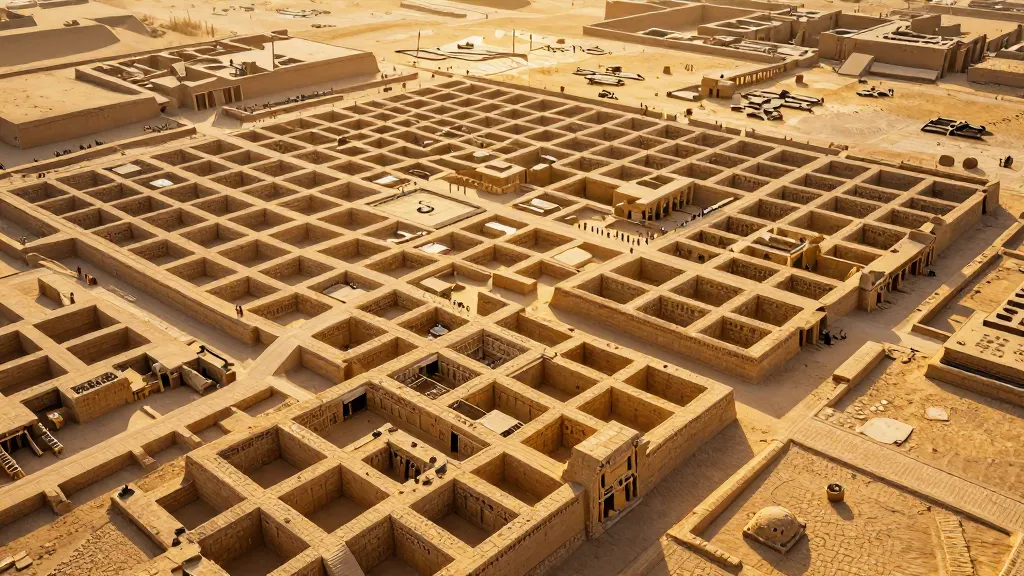
Between approximately 3300 and 1300 BCE, in the fertile floodplains of the Indus River and its tributaries in what is now Pakistan and western India, there arose a civilization of astonishing sophistication — and then, almost as mysteriously as it emerged, it vanished. The Indus Valley Civilization, also known as the Harappan Civilization after the first excavated city of Harappa, was one of the three cradles of ancient urban society, alongside ancient Egypt and Mesopotamia. At its peak around 2500–1900 BCE, it covered an estimated 1.25 million square kilometers — an area larger than ancient Egypt and Mesopotamia combined — and supported a population of between one and five million people. Its cities, including Mohenjo-daro, Harappa, Lothal, Dholavira, and Rakhigarhi, featured grid-based street layouts, standardized brick construction, advanced drainage and sanitation systems, and indoor toilets — amenities that would not reappear in urban planning for thousands of years. The Harappans developed a writing system that remains undeciphered to this day, carried on extensive trade with Mesopotamia and the Persian Gulf, and appear to have maintained a remarkably peaceful society with no evidence of standing armies, major weapons, or large-scale warfare. And then, around 1900–1300 BCE, the civilization fragmented and declined. Cities were abandoned. Writing ceased. Trade networks collapsed. The great cities of the Indus fell silent, gradually buried under silt and sand, not to be rediscovered until the 1920s.
The scope of the Indus Valley Civilization is staggering. Its extent stretched from the Himalayan foothills in the north to the Arabian Sea coast in the south, and from the Iranian border in the west to the Ganges-Yamuna doab in the east. Over 1,056 settlement sites have been identified, with new ones discovered regularly through ongoing archaeological surveys and satellite imagery. The civilization is divided into three phases: the Early Harappan (c. 3300–2600 BCE), the Mature Harappan (c. 2600–1900 BCE), and the Late Harappan (c. 1900–1300 BCE). It was during the Mature Harappan period that the civilization reached its zenith, with its major cities thriving simultaneously — a degree of urban coordination unmatched by any contemporary society. Unlike Egypt with its pharaohs and Mesopotamia with its kings, the Indus Valley Civilization left behind no palaces, no royal tombs, no monumental statues of rulers, and no clear evidence of centralized political authority. This absence of obvious hierarchy has led some scholars to propose that the Harappans may have organized their society along remarkably egalitarian lines — a theory that, if true, would make them one of the most successful egalitarian urban societies in human history.
The most immediately striking feature of the Indus Valley Civilization is the extraordinary sophistication of its urban planning. Cities like Mohenjo-daro and Harappa were built on grid-pattern street layouts — a design principle that would not become standard in Western urban planning until the Roman Empire, nearly two thousand years later. The streets were laid out at right angles, with main thoroughfares running north-south and east-west, creating organized residential blocks. The buildings were constructed from standardized baked bricks of uniform dimensions — typically in a ratio of 1:2:4 — a consistency that suggests centralized quality control and manufacturing standards far ahead of their time. Mohenjo-daro, the most extensively excavated site, covered an area of approximately 300 hectares and may have had a population of 40,000 to 60,000 people at its peak. The city was divided into a citadel mound in the west, containing large public buildings and possibly administrative structures, and a lower city in the east, containing residential neighborhoods, workshops, and markets.
Perhaps the most remarkable aspect of Harappan urban design was its sanitation system. Virtually every house in Mohenjo-daro and Harappa was equipped with an indoor toilet connected to a covered drainage system that ran beneath the streets. Wastewater was channeled through brick-lined drains with inspection covers, emptying into larger municipal sewers. This level of sanitation infrastructure would not be seen again until the modern era — the cities of medieval Europe, by contrast, emptied chamber pots into the streets. The Harappans also developed sophisticated water management systems. The city of Dholavira, located on an island in the Rann of Kutch in Gujarat, had an extraordinary system of reservoirs, dams, and channels for harvesting and storing rainwater — essential in an arid region with erratic monsoon rainfall. At Lothal, near the Gulf of Khambhat, archaeologists discovered what is widely regarded as the oldest known dock in the world — a brick-lined basin connected to the sea by a channel, allowing ships to be loaded and unloaded at high tide.
One of the most famous structures in the Indus Valley Civilization is the Great Bath of Mohenjo-daro, a large rectangular tank measuring approximately 12 meters long, 7 meters wide, and 2.4 meters deep, located on the citadel mound. The tank was made watertight by a lining of bitumen and gypsum mortar laid between two layers of tightly fitted baked bricks — a construction technique that proved so effective that the tank still holds water today, more than 4,500 years after it was built. The Great Bath was surrounded by corridors, porticos, and rooms, suggesting it served a public or ritual function. Archaeologists believe it may have been used for ritual purification — a practice that would later become central to Hindu religious tradition. The discovery of the Great Bath was one of the most significant finds of the early excavations at Mohenjo-daro in the 1920s, and it remains one of the most iconic structures of the ancient world.
Of all the mysteries surrounding the Indus Valley Civilization, none is more tantalizing than its writing system. The Harappans produced thousands of inscriptions on seals, tablets, pottery, and metal objects, using a script that consists of over 400 distinct signs. The script typically reads from right to left, though some inscriptions show boustrophedon (alternating direction) patterns. The average inscription is remarkably short — most contain only five to six signs, with the longest known inscription containing just 26 characters. This brevity has been a major obstacle to decipherment: without lengthy texts to provide context and patterns, linguists have had little material to work with. The Indus script has been the subject of intense study since the civilization’s discovery in the 1920s, and numerous scholars have proposed decipherments — linking it to Dravidian languages, Indo-Aryan languages, Sumerian, and even various proto-languages — but none of these attempts has achieved widespread acceptance. The script remains one of the most significant undeciphered writing systems in the world, alongside Linear A of the Minoans and the Rongorongo script of Easter Island.
The inability to read the Indus script has profoundly limited our understanding of Harappan society. We do not know what the people called themselves, what language they spoke, what their political system was, or what their religious beliefs entailed. The seals on which the script primarily appears — small, square steatite tablets typically featuring an animal image and a line of text — were clearly used for trade and administrative purposes, as identical seals have been found at sites hundreds of kilometers apart. Some seals feature images of animals — bulls, elephants, tigers, and a mysterious “unicorn” animal that appears on more seals than any other creature — alongside the undeciphered text. One famous seal depicts a figure seated in a cross-legged posture reminiscent of later yogic meditation, surrounded by animals, leading some scholars to suggest connections to later Hindu iconography. But without the ability to read the accompanying text, these interpretations remain speculative — intriguing but unverifiable.
In recent years, computer scientists and computational linguists have turned to the Indus script, applying machine learning, statistical analysis, and pattern recognition algorithms in hopes of achieving what human scholars have not. A widely discussed 2009 study by researchers at the University of Washington and the Tata Institute used statistical models to argue that the Indus script likely represents a spoken language rather than a purely symbolic system — a conclusion that, while encouraging, did not crack the code. Other researchers have used AI to identify patterns in sign sequences, finding evidence of consistent grammatical structure. However, the fundamental problem remains: the inscriptions are too short, and there is no bilingual text (no “Rosetta Stone” for the Indus script) to provide a key. Until such a text is discovered, the Indus script is likely to remain a mystery, locking away the civilization’s history, literature, and identity behind an impenetrable wall of symbols.
Perhaps the most remarkable — and most debated — aspect of the Indus Valley Civilization is the near-total absence of evidence for warfare. Unlike contemporary civilizations in Egypt and Mesopotamia, which left behind extensive iconography of battles, conquests, and military rulers, the Harappans produced no known depictions of armies, battles, or military campaigns. No large caches of weapons have been found. No city walls appear to have been designed for defense against human attackers. No royal tombs filled with weapons and armor have been discovered. The cities show no signs of violent destruction. The “priest-king” bust — a famous soapstone figure found at Mohenjo-daro showing a bearded man with a shawl and headband — suggests some form of authority figure, but there is no evidence that this authority was maintained through military force. The “dancing girl” bronze statuette — a small, elegant figure of a young woman with bangles covering her left arm, cast using the lost wax process around 2500 BCE — speaks to a society that valued art and craftsmanship.
The apparent peacefulness of Harappan society has led to intense scholarly debate. Some archaeologists argue that the absence of evidence for warfare is exactly what it appears to be: evidence that the Indus Valley Civilization was genuinely peaceful and cooperative, managing its vast territory through trade, shared cultural practices, and perhaps some form of council-based governance. Others caution that the absence of evidence is not evidence of absence — the Harappans may have had military institutions that have simply not been preserved or recognized. What is clear is that the Indus Valley Civilization achieved something remarkable: a vast, coordinated urban society spanning over a million square kilometers that flourished for centuries without the visible apparatus of military domination that characterized nearly every other ancient civilization.
The most haunting question about the Indus Valley Civilization is also the most basic: what happened to it? Around 1900 BCE, the Mature Harappan period began to give way to the Late Harappan phase. Cities were gradually abandoned. The standardized brick construction ceased. Writing disappeared. Trade networks with Mesopotamia and the Persian Gulf contracted and then collapsed. The population dispersed eastward and southward. By approximately 1300 BCE, the urban phase of the civilization was over. Unlike the dramatic collapses of other ancient societies, the decline of the Indus Valley Civilization appears to have been gradual, taking place over several centuries. But gradual does not mean well-understood.
The most widely accepted explanation is climate change. A landmark 2016 paleoclimate study published in the journal Geology analyzed sediments from an ancient lake near Mohenjo-daro and found evidence that the summer monsoon, which had brought reliable rainfall to the Indus region for millennia, began to weaken significantly around 2000–1900 BCE. The decline in monsoon rainfall would have devastated agriculture, dried up the rivers that sustained the cities, and made the urban way of life unsustainable. This theory is supported by geological evidence that the Ghaggar-Hakra River (often identified with the legendary Saraswati River of Vedic literature) dried up around this time, possibly due to tectonic shifts that redirected its tributaries. Many Harappan sites were located along the Ghaggar-Hakra, and its desiccation would have forced mass migration. The Aryan invasion theory — once the dominant explanation — has been largely discredited by archaeological evidence showing no signs of violent destruction at Indus sites. A 2019 DNA study of remains from Rakhigarhi, one of the largest Harappan sites, found genetic continuity between the Harappan population and modern South Asian populations, suggesting that there was no large-scale population replacement but rather a gradual cultural transformation — the descendants of the Harappans did not disappear; they adapted, migrated, and evolved into the cultures that followed.
The Indus Valley Civilization is both the most impressive and the most enigmatic of the ancient world’s great urban societies. It was larger than Egypt and Mesopotamia combined. Its cities were planned with a sophistication that would not be matched for millennia. Its sanitation systems were better than those of many 19th-century European cities. Its people traded across the known world, maintained what appears to have been a remarkably peaceful society, and developed a writing system that we still cannot read. And then, over the course of several centuries, it faded away — not with a dramatic battle or a catastrophic eruption, but with a slow, quiet withdrawal, as the monsoons weakened and the rivers dried and the people dispersed. The Harappans did not truly disappear — their descendants live on in the genetic makeup and cultural traditions of South Asia. But their cities, their script, and their identity were lost for over 3,000 years, buried beneath the silt of the Indus. The Harappans built a world that was, in many ways, ahead of its time. Perhaps the greatest mystery is not that they disappeared, but that they existed at all — and achieved so much, so long ago, only to be forgotten.
References & Further Reading
Wikipedia: Dholavira — The Indus city with sophisticated water harvesting systems in Gujarat
Wikipedia: Lothal — Home of the world’s oldest known dock and major trade center
📚 Recommended Reading: The Indus by Andrew Robinson (on Amazon) — As an Amazon Associate, we earn from qualifying purchases.
Editorial note: Archaeological understanding of the Indus Valley Civilization continues to evolve as new excavations, DNA studies, and paleoclimate data emerge. See our Editorial Policy.