The Pyramids of Giza: 4,500 Years Later, We Still Cannot Fully Explain How They Were Built
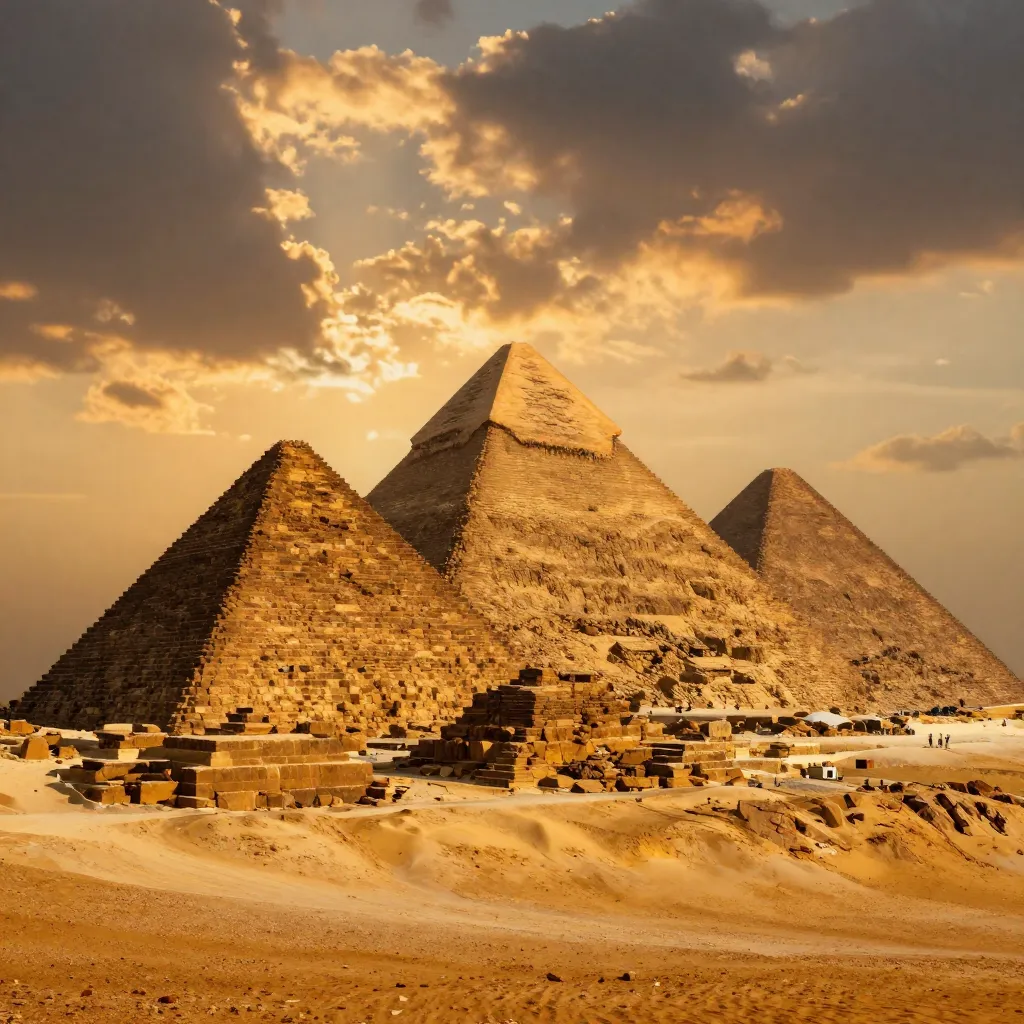
On the edge of the Western Desert, where the golden sands meet the green ribbon of the Nile Valley, three monumental forms rise from the Giza Plateau with a silence that is almost audible. They have stood there for more than 4,500 years — through the rise and fall of pharaohs, the conquests of Greeks and Romans, the spread of Christianity and Islam, the birth of the modern world — watching human history unfold beneath their massive, time-worn flanks. The Great Pyramid of Giza, the largest of the three, was the tallest man-made structure on Earth for over 3,800 years, a record unmatched by any other building in history. It is composed of an estimated 2.3 million stone blocks, many weighing 2.5 tons apiece, with some of the granite blocks in the King’s Chamber tipping the scales at up to 80 tons. Its base is level to within approximately 2.1 centimeters. Its sides are aligned to the four cardinal directions with a precision of 3/60th of a degree. And yet, despite centuries of study, despite the efforts of some of the finest archaeological minds in history, we still cannot fully explain how it was built.
The Giza Plateau sits on the outskirts of modern Cairo, on the west bank of the Nile River, overlooking the fertile floodplain that sustained Egyptian civilization for millennia. In the Old Kingdom period (circa 2686–2181 BCE), this plateau was chosen as the burial ground for the most powerful pharaohs of the Fourth Dynasty — a period often called the “Age of the Pyramids.” The three pyramids at Giza were built during a remarkably concentrated span of approximately 85 years (circa 2589–2504 BCE), during the reigns of Khufu (Greek: Cheops), Khafre (Chephren), and Menkaure (Mycerinus). The complex also includes the Great Sphinx, temples, causeways, satellite pyramids, and boat pits containing full-size disassembled wooden vessels. The sheer scale and precision of the Giza complex — achieved with copper tools, wooden sledges, rope, and human labor — remains one of the most astonishing engineering accomplishments in human history.
The Great Pyramid, built for Pharaoh Khufu (Fourth Dynasty, circa 2560 BCE), is the oldest and largest of the three Giza pyramids. Its original height was 481 feet (146.6 meters), though the loss of its polished white Tura limestone casing stones over the centuries has reduced it to approximately 455 feet. Each side of the base measures approximately 754 feet, covering an area of roughly 13 acres. The outer casing stones, quarried at Tura across the Nile, were highly polished white limestone that would have made the pyramid shine brilliantly in the Egyptian sun, visible for miles across the desert. Most of these casing stones were stripped away in later centuries for building materials in Cairo. The precision of the construction remains staggering by any standard. The base is level to within approximately 2.1 centimeters across its entire 13-acre footprint. The sides are aligned to true north, south, east, and west with an accuracy of 3/60th of a degree. The joints between the casing stones were so fine that a razor blade cannot fit between them.
The interior of the pyramid contains a sophisticated system of passages and chambers, including the King’s Chamber with its massive granite sarcophagus (too large to have been carried in after construction), the Queen’s Chamber, the Grand Gallery — a soaring corridor 153 feet long and 28 feet high with a corbelled ceiling — and a system of relieving chambers above the King’s Chamber that distribute the enormous weight of the stone above. The original entrance, on the north face at a height of approximately 56 feet, was concealed with great care. The Arab entrance tunnel, still used by visitors today, was created by Caliph al-Ma’mun in approximately 820 CE, who tunneled through the limestone in search of treasure.
The question of how the pyramids were built has occupied scholars, engineers, and dreamers for millennia. The Greek historian Herodotus, writing in the 5th century BCE, visited Egypt and recorded that the Great Pyramid took 20 years to build and employed 100,000 workers — figures that are now considered likely exaggerated. Modern Egyptologists estimate a workforce of approximately 20,000 to 30,000 skilled laborers working in rotating shifts over approximately two decades. The fundamental challenge is that no ancient Egyptian text, illustration, or blueprint has ever been found that describes the construction process in detail. The Egyptians were prodigious record-keepers — they documented religious rituals, agricultural cycles, legal proceedings, and military campaigns with meticulous care — but they left no “how-to” manual for building pyramids. This absence of documentation is itself a mystery: either the methods were so well-known that they needed no explanation, or they were considered sacred knowledge not to be shared.
The dominant family of theories centers on ramps — inclined planes along which blocks were hauled on wooden sledges. The external straight ramp theory, proposed in the 19th century by Flinders Petrie after his meticulous surveys of Giza, posits a single long ramp extending from the quarry to the pyramid’s summit. The problem: such a ramp would need to be enormous, potentially longer than the pyramid itself. The spiral ramp theory suggests that a ramp wound around the outside of the pyramid in an ascending spiral. This solves the length problem but creates difficulties with turning corners and maintaining alignment. The internal ramp theory, proposed by French architect Jean-Pierre Houdin in 2007, suggests that the lower portions were built using an external ramp, while the upper portions were constructed using an internal spiral ramp built into the pyramid’s structure — a ramp that still exists today, hidden within the stone. Houdin’s theory gained attention when microgravity analysis detected what appeared to be a spiral-shaped density variation inside the pyramid.
In 2013, archaeologists working at Wadi al-Jarf, an ancient port on the Red Sea coast of Egypt, made a discovery that transformed our understanding of pyramid construction logistics: a collection of papyrus fragments now known as the Wadi al-Jarf Papyri. The most significant of these documents is the “Diary of Merer” — a day-by-day logbook kept by an Egyptian middle-ranking inspector who led a team of approximately 200 workers. The diary, dating to the 27th year of Khufu’s reign, documents several months of operations in which Merer’s team transported Tura limestone blocks from the quarries across the Nile to the construction site at Giza. The entries describe the process in detail: opening the quarries, extracting the stones, loading them onto boats, sailing them through canal systems to the Giza harbor, and delivering them to the construction site. The diary provides the most direct contemporaneous evidence of pyramid construction logistics ever discovered.
One of the most important archaeological discoveries at Giza has been the workers’ village, excavated by archaeologists Mark Lehner and Zahi Hawass beginning in the 1990s. The village reveals a workforce of skilled, well-fed, well-organized professionals — dramatically different from the popular image of whipped slaves toiling under the desert sun. The village contained bakeries capable of producing thousands of loaves of bread daily, breweries, evidence of medical care including treated fractures and amputations, and organized food distribution systems. Animal bones show that workers ate prime cuts of beef, sheep, and goat. The workers were organized into competing teams with names like “The Drunkards of Menkaure” and “The Friends of Khufu” — indicating pride and camaraderie. The workforce appears to have been drawn from across Egypt, serving in rotating shifts as a form of national service.
The Great Pyramid does not stand alone. The Second Pyramid, built for Pharaoh Khafre, appears taller than Khufu’s because it sits on higher ground, but is actually slightly shorter at 448 feet. The Third Pyramid, built for Pharaoh Menkaure, is the smallest at 213 feet. The Great Sphinx, carved from a single outcrop of limestone, is approximately 240 feet long and 66 feet high — and is believed to represent the face of Pharaoh Khafre, though this attribution remains debated. Near Khufu’s pyramid, archaeologists discovered boat pits containing full-size disassembled wooden boats — the most famous being the Khufu Ship, a 143-foot vessel reassembled from 1,224 pieces. In 2017, the ScanPyramids project used muon tomography to detect a previously unknown large void above the Grand Gallery, approximately 100 feet long — the first major internal structure discovered in the Great Pyramid since the 19th century. Its purpose remains unknown.
The Pyramids of Giza have outlasted every other wonder of the ancient world — the Hanging Gardens of Babylon, the Colossus of Rhodes, the Lighthouse of Alexandria, the Temple of Artemis, the Statue of Zeus, the Mausoleum at Halicarnassus — all gone, reduced to rubble, memory, and legend. Only the pyramids remain. We know far more about them now than we did a century ago: the Wadi al-Jarf Papyri have given us the voice of a man who actually delivered stone to Khufu’s pyramid. The workers’ village has revealed the human face of the labor force. ScanPyramids has detected hidden voids that no explorer has ever entered. But the fundamental question — exactly how the pyramids were built — continues to resist a complete answer. The competing ramp theories each explain part of the evidence but none explains all of it. The precision of the alignment, the scale of the logistics, and the sophistication of the internal architecture all remain partially mysterious — not because they are supernatural, but because they represent a level of engineering mastery achieved by a civilization that did not record its methods in a form we can read. The pyramids are a reminder that human genius is not a modern invention, that extraordinary things can be accomplished with simple tools and extraordinary organization, and that even the most studied monuments on Earth can still surprise us.
References & Further Reading
Wikipedia: Egyptian Pyramids — Overview of pyramid construction across Egyptian history
Wikipedia: Great Sphinx of Giza — The limestone giant guarding the Giza plateau
Wikipedia: Jean-Pierre Houdin — The French architect who proposed the internal spiral ramp theory
📚 Recommended Reading: The Complete Pyramids by Mark Lehner (on Amazon) — As an Amazon Associate, we earn from qualifying purchases.
Editorial note: The Pyramids of Giza are documented through extensive archaeological investigation including Mark Lehner and Zahi Hawass's excavations, Pierre Tallet's discovery of the Wadi al-Jarf Papyri, and the ScanPyramids project. See our Editorial Policy.