The Curse of Tutankhamun: Myth, Media, and the Science Behind Egypt's Most Famous Legend
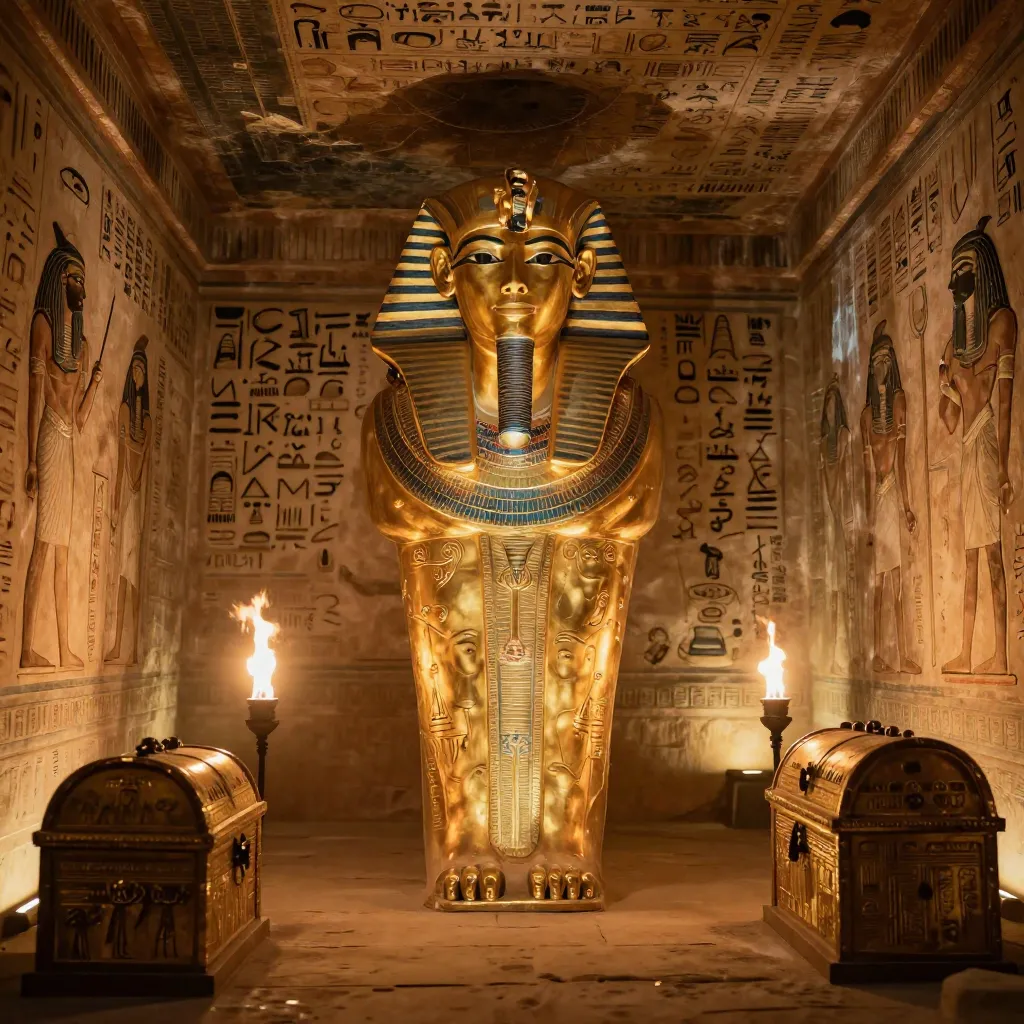
On November 4, 1922, a team of Egyptian workers led by the British archaeologist Howard Carter uncovered a step cut into the bedrock of the Valley of the Kings — a step that led down to a sealed doorway bearing the cartouches of a pharaoh the world had nearly forgotten. Behind that doorway lay Tutankhamun, the boy-king who had died around 1323 BCE at approximately nineteen years of age, buried in a tomb crammed with over five thousand objects: golden chariots, jewel-encrusted jewelry, a solid gold death mask of breathtaking beauty, and a mummy lying within a nest of coffins, the innermost made of 110 kilograms of solid gold. It was the most spectacular archaeological discovery of the twentieth century — the only known near-intact royal burial from ancient Egypt. And within weeks, the story took a darker turn. Lord Carnarvon, Carter's financial backer, died in Cairo on April 5, 1923, just weeks after the tomb's ceremonial opening. The lights of Cairo were said to have gone out at the moment of his death. Back in England, Carnarvon's dog howled and died simultaneously. The press went wild. “The Curse of Tutankhamun” was born — a tale of supernatural vengeance so compelling that it has persisted for over a century, inspiring films, novels, and a permanent place in the popular imagination.
The truth about Tutankhamun's curse is more interesting than the myth — because the real story reveals as much about us as it does about the ancient Egyptians. It is a story about media sensationalism, the psychology of superstition, the genuine biological hazards lurking in ancient tombs, and the human compulsion to find patterns and meaning in random events. The curse of the pharaohs may not be supernatural, but the forces that created and sustained the myth — fear of death, fascination with the exotic, and the profit motive of a voracious press — are every bit as powerful as any ancient spell.
Howard Carter had been digging in Egypt since he was seventeen years old. By 1922, he was forty-eight and had been searching the Valley of the Kings for fifteen years under the patronage of George Herbert, the 5th Earl of Carnarvon, a wealthy English aristocrat who had sunk a fortune into the hunt for an undiscovered royal tomb. Carnarvon was losing patience. Year after year, Carter had produced little of significance, and the earl was on the verge of withdrawing his funding. Carter persuaded him to finance one final season. On November 4, 1922, Carter's workers uncovered a step. By the next day, they had exposed a staircase descending to a plastered doorway bearing the seals of the royal necropolis. Carter immediately wired Carnarvon: “At last have made wonderful discovery in Valley a magnificent tomb with seals intact re-covered same for your arrival congratulations.” Carnarvon arrived in Egypt on November 23. On November 26, Carter made a small hole in the second doorway, inserted a candle, and peered inside. When Carnarvon asked if he could see anything, Carter reportedly replied: “Yes, wonderful things.” What he saw was an antechamber stuffed with gilded couches, alabaster vessels, chariots, and golden shrines — the treasure of a pharaoh undisturbed for over three thousand years.
The excavation that followed was one of the most meticulous in archaeological history. Carter spent nearly a decade documenting and removing the tomb's contents, photographing everything in situ, and conserving fragile artifacts. The discovery made Tutankhamun the most famous pharaoh in the world — a curious fate for a king who had ruled for only about a decade and died in his teens, whose greatest achievement, in historical terms, was the restoration of the traditional Egyptian religion after the upheavals of Akhenaten's monotheistic revolution.
Lord Carnarvon died on April 5, 1923, in the Continental-Savoy Hotel in Cairo, less than six months after the tomb's ceremonial opening. The official cause of death was blood poisoning resulting from an infected mosquito bite on his cheek, complicated by pneumonia. He was fifty-six years old and had been in poor health for years, suffering from a chronic respiratory condition that had led his doctors to recommend the dry Egyptian climate in the first place. The death of an elderly, sickly aristocrat from an infected insect bite was, by any rational measure, unremarkable. But the press transformed it into something extraordinary.
At the moment of Carnarvon's death, the story went, all the lights in Cairo went out. In truth, Cairo's electrical supply was notoriously unreliable, and blackouts were common. Back at Carnarvon's estate in Highclere Castle in Hampshire, his beloved dog allegedly howled and dropped dead at the precise moment of her master's demise — a story that cannot be verified. The press, particularly the London Daily Mail and its aggressive correspondent Arthur Merton, seized upon these details and wove them into a narrative of supernatural revenge. The idea of a pharaoh's curse was irresistible: it combined the exotic glamour of ancient Egypt, the frisson of the supernatural, and the moral satisfaction of seeing arrogant modern intruders punished for violating the sanctity of the dead.
The most influential amplifier of the curse story was Sir Arthur Conan Doyle, the creator of Sherlock Holmes and a fervent believer in spiritualism and the paranormal. Conan Doyle publicly speculated that “elementals” — malicious spirit entities placed by Egyptian priests to guard the tomb — might have been responsible for Carnarvon's death. His comments, reported worldwide, lent the curse story the credibility of one of the most famous authors in the English-speaking world. Other newspapers invented or exaggerated details: fake inscriptions threatening doom on tomb violators were widely reported, though no such inscription existed in Tutankhamun's tomb, and the deaths of anyone even tangentially connected to the excavation were eagerly catalogued and attributed to the curse.
The list of people “killed by the curse” grew rapidly in the press, but a careful examination reveals a very different picture. A study published in the British Medical Journal in 2002 analyzed the survival of 44 Westerners who were in Egypt during the excavation and could be documented as having been exposed to the tomb. The results were decisive: there was no statistical association between exposure to the tomb and premature death. Of the 44 individuals, 25 were exposed to the tomb. Their average age at death was 70 years. Lord Carnarvon was the only person closely associated with the excavation who died within the first year. George Jay Gould, an American financier who visited the tomb, died of pneumonia in May 1923 — after developing a cold. Prince Ali Kamel Fahmy Bey, who had visited the tomb, was shot and killed by his wife in July 1923. Arthur Mace, a member of Carter's team, died in 1928 of pneumonia after years of declining health. Richard Bethell, Carter's secretary, was found dead in his bed in 1929 from circulatory failure. Each of these deaths was attributed to the curse by the press, yet none occurred under mysterious circumstances.
Howard Carter himself, the man who spent more time in the tomb than anyone, lived until 1939, dying of lymphoma at the age of sixty-four — seventeen years after opening the tomb. If any person on Earth had been “cursed,” it would have been Carter. He was not. The statistical reality is unambiguous: opening Tutankhamun's tomb was not dangerous. The curse was a media creation, sustained by selective attention — remembering the deaths, forgetting the survivors — and the irresistible narrative appeal of supernatural revenge.
The failure of the supernatural curse theory does not mean that ancient tombs are harmless. Since the 1960s, scientists have proposed several biological explanations for why some people who entered Egyptian tombs became ill. The most widely discussed is the presence of pathogenic fungi, particularly Aspergillus species such as Aspergillus niger and Aspergillus flavus, which can cause serious respiratory infections in immunocompromised individuals. These fungi thrive in warm, dark, enclosed environments — exactly the conditions found in sealed tombs. When a tomb is opened after millennia, fungal spores can be aerosolized and inhaled, potentially causing aspergillosis, a dangerous lung infection. Other proposed biological agents include bacteria that can form durable spores surviving for centuries, ammonia gas from decomposing organic materials, and toxic chemicals used in ancient mummification. However, the connection between these agents and specific deaths in the Tutankhamun case remains speculative. No one has demonstrated that Tutankhamun's tomb contained unusual concentrations of pathogens, and many of the “curse deaths” clearly had nothing to do with biology. The scientific hypothesis is plausible but unproven in this specific case.
The Tutankhamun curse persists because it satisfies deep psychological needs that have nothing to do with ancient Egypt. It speaks to the fear of death and the taboo against disturbing the dead — a fear so fundamental that virtually every human culture has developed rituals and beliefs about the proper treatment of corpses. It appeals to the desire for cosmic justice, the comforting idea that violations of sacred boundaries will be punished. It exploits the allure of the exotic, the Western fascination with ancient Egypt as a land of magic, mystery, and hidden power. And it serves a commercial purpose: curse stories sell newspapers, books, movie tickets, and museum passes. The curse of Tutankhamun is not a story about ancient Egypt. It is a story about the modern world's relationship with the past — a relationship built on desire, guilt, and the profit motive.
The curse of Tutankhamun is one of the great ironies of archaeological history. Howard Carter's discovery was a triumph of patience, skill, and determination — a moment when the modern world reached across three thousand years and touched the ancient one directly. The objects from the tomb are among the most recognized and admired artifacts in human history. And yet, for much of the public, the first association with Tutankhamun is not beauty, artistry, or historical knowledge — it is a curse that never existed, fabricated by journalists, amplified by a famous author of detective fiction, and sustained by the human weakness for a good ghost story. The real lesson of the Tutankhamun curse is not about ancient magic but about modern credulity — about how easily a compelling narrative can override evidence, how readily we see patterns in random events, and how powerfully we want to believe that the dead can reach across the centuries and touch the living. The pharaohs had no need of curses. The living were quite capable of inventing their own.
References & Further Reading
Britannica: Tutankhamun — Authoritative biography of the boy-king and the discovery of his tomb
Wikipedia: Howard Carter — Biography of the archaeologist who discovered Tutankhamun's tomb
Britannica: Howard Carter — Overview of Carter's career and the excavation that made him famous
📚 Recommended Reading: The Tutankhamun Deception: The True Story of the Mummy's Curse by Gerald O'Farrell (on Amazon) — As an Amazon Associate, we earn from qualifying purchases.
Editorial note: historical interpretations are continuously revised as new archaeological evidence and forensic analyses emerge. See our Editorial Policy.