The New England Vampire Panic of 1892: When a TB Outbreak Spawned a Vampire Hunt
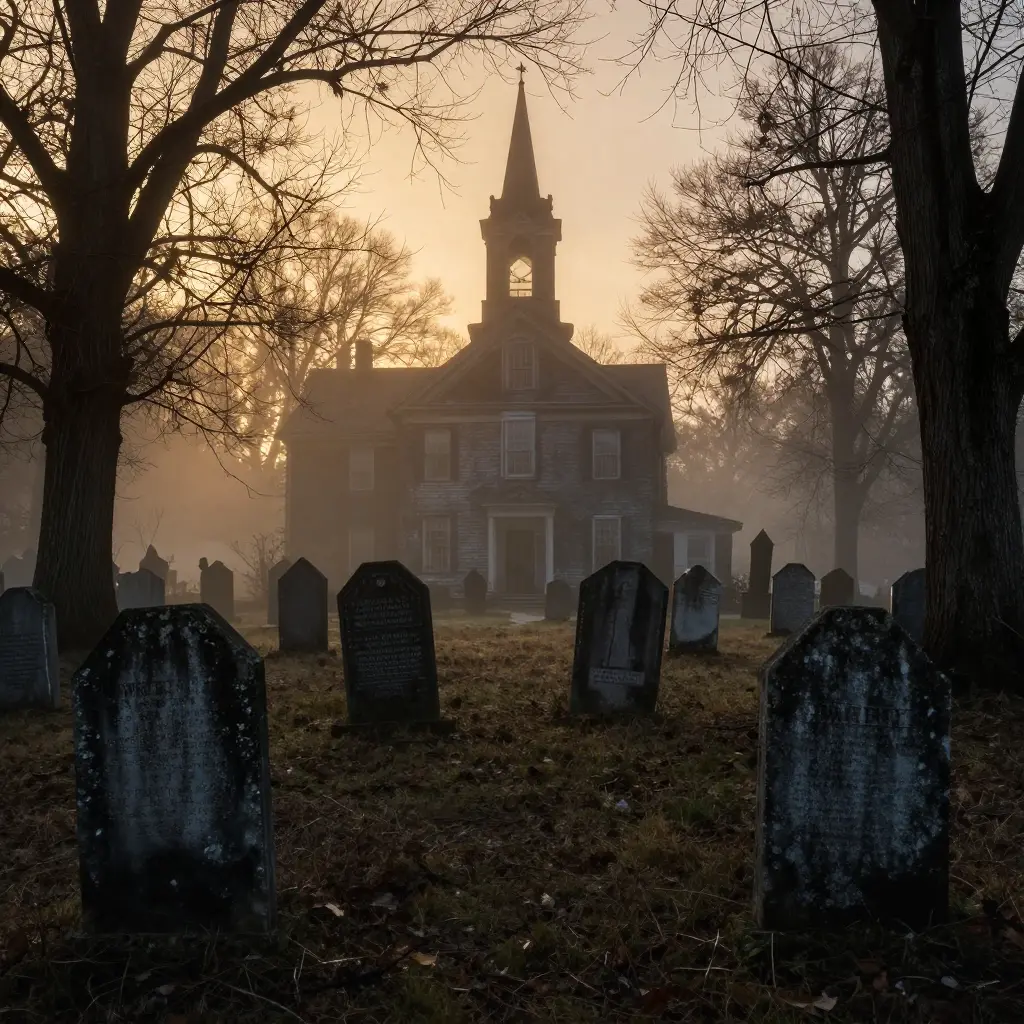
On a cold March morning in 1892, a group of men gathered at the Chestnut Hill Cemetery in Exeter, Rhode Island, with shovels in their hands and dread in their hearts. They were there to dig up the dead. The bodies belonged to the family of George Brown, a modest farmer who had watched, helpless, as consumption — the dreaded wasting disease now known as tuberculosis — claimed his wife Mary Eliza in 1883, his eldest daughter Mary Olive in 1884, and his youngest daughter Mercy Lena just weeks earlier, in January 1892. Now his only surviving child, his son Edwin, was gravely ill, coughing blood, growing thinner by the day. The townspeople of Exeter had a theory, one rooted in generations of folk belief: one of the dead Brown women was a vampire, rising from the grave at night to drain the life from her surviving relatives. The only way to save Edwin was to exhume the bodies, inspect them for signs of vampirism, and perform the appropriate ritual. George Brown, exhausted and desperate, gave his permission. On March 17, 1892, the men opened the graves. What they found horrified them. The bodies of Mary Eliza and Mary Olive had decomposed as expected. But Mercy Lena, who had been buried in a crypt for only two months during the cold New England winter, was remarkably preserved. Her skin was still lifelike. Her cheeks had color. And when they opened her chest cavity, they found her heart and liver contained liquid blood. To the terrified villagers, this was proof positive: Mercy Brown was a vampire. They cut out her heart and liver, burned them on a nearby rock, and mixed the ashes with medicine for Edwin to drink. It did not work. Edwin died two months later.
The Mercy Brown case is the most famous documented instance of the New England vampire panic, a wave of superstitious terror that swept through rural New England from the 1780s through the 1890s, claiming dozens — possibly hundreds — of victims. It was not the work of uneducated primitives. These were Yankee farmers, the descendants of Puritans, living in the shadow of universities and churches in one of the most literate regions of the United States. And yet, when their families began dying one by one from a disease they could not understand and could not cure, they turned to an ancient folk tradition that offered the only explanation that made sense: the dead were feeding on the living. The panic was concentrated in Rhode Island, eastern Connecticut, southern Massachusetts, Vermont, and other areas of rural New England — the same region that, two centuries earlier, had been convulsed by the Salem witch trials. The connection is not coincidental: both events represent the explosive collision of ignorance, fear, and community pressure in isolated communities facing threats they could not comprehend.
To understand the vampire panic, you must first understand the disease that caused it. Tuberculosis, known in the 18th and 19th centuries as consumption, was one of the most feared diseases in human history — and certainly the deadliest in 19th-century America. It was called consumption because it appeared to literally consume its victims from the inside out: a healthy person would develop a persistent cough, begin to lose weight, grow pale and weak, sweat through the night, and gradually waste away over months or years. The disease attacked the lungs, causing them to slowly dissolve into a bloody, sputum-filled mess. Victims coughed up blood, their voices grew hoarse, their eyes sunken, their skin ghostly white. It was a horrific, lingering death — and it was everywhere. Consumption was the leading cause of death in 19th-century America, accounting for roughly one in every four deaths in some regions. The disease is caused by the bacterium Mycobacterium tuberculosis, identified by Robert Koch in 1882 — a discovery that earned him the Nobel Prize and should, in theory, have ended the vampire panic overnight. But the news traveled slowly to rural New England, and old beliefs die hard. Even after Koch’s discovery, exhumations continued for another decade.
What made tuberculosis so terrifying to rural communities was its pattern of transmission. Modern medicine recognizes it as bacterial, spreading through close contact within households. But to a 19th-century farmer watching his family die one by one, the pattern seemed supernatural. When one family member died of consumption, another would fall ill. Then another. Then another. It was as if the dead were reaching back from the grave to claim the living. This observation — medically accurate in its description of household transmission, but catastrophically wrong in its interpretation — was the seed from which the vampire panic grew.
The vampire belief that took root in New England was not the same as the European vampire tradition familiar from Bram Stoker’s Dracula and Hollywood films. There were no capes, no fangs, no castles in Transylvania, no fear of garlic or crucifixes. The New England vampire was a subtler, more domestic creature — and in some ways, more terrifying. The folk belief held that when a family member died of consumption, that person’s spirit could drain the life force from surviving relatives, causing them to sicken and die in the same manner. The remedy was to exhume the body of the suspected vampire and look for specific signs. If the corpse was unusually well-preserved — if the skin was still lifelike, the cheeks flushed, the limbs flexible — this was taken as evidence that the dead person was not truly dead but was maintaining a connection to the living. Most critically, if the heart or other organs contained liquid blood, this was considered definitive proof of vampirism. The prescribed ritual typically involved burning the heart and liver, scattering or consuming the ashes, and in some cases rearranging the bones of the skeleton to prevent the vampire from rising. This was not mindless mob violence. It was a carefully performed folk ritual, carried out with solemnity and genuine belief, often with the consent and participation of the grieving family.
The people of rural New England did not use the word “vampire” to describe what they were doing. That term was applied later, by outsiders — journalists, folklorists, and sensation-seeking newspaper reporters who recognized the parallels between the New England rituals and the European vampire legends popularized by Stoker’s novel, published in 1897, just five years after the Mercy Brown case. The New Englanders themselves used terms like “the dead feeding on the living” or simply described the ritual without naming it. Folklorist Michael Bell, who has spent decades studying the phenomenon, argues that the New England tradition is better understood as a folk medical practice than as a vampire myth — a desperate attempt to combat a terrifying disease using the only explanatory framework available.
The great American naturalist and writer Henry David Thoreau even recorded a vampire exhumation in his journal in March 1859, demonstrating how widespread and accepted the practice was in rural New England. Thoreau wrote about a family in a nearby town that had lost multiple members to consumption and had exhumed the body of the first to die, finding it “remarkably fresh.” The heart was burned and the ashes given to the surviving family members. Thoreau, who was not generally sympathetic to superstition, reported the matter without ridicule, suggesting that the practice was common enough to be unremarkable even to a Harvard-educated intellectual.
The Mercy Brown case was neither the first nor the last of the New England vampire exhumations — merely the most famous. Folklorists and historians have documented dozens of similar cases spanning over a century, and many more likely went unrecorded. In approximately 1819, Nancy Young of Foster, Rhode Island, was exhumed and burned after her family suffered multiple deaths from consumption. In 1854, the Ray family of Jewett City, Connecticut, exhumed and burned the bodies of multiple family members who had died of the disease. In 1874, the Wilbur family of Exeter, Rhode Island, performed a similar ritual. In 1817, Frederick Ransom’s father had his son’s body exhumed in South Woodstock, Vermont, and the heart burned. Each case followed the same pattern: multiple deaths in a single family from consumption, followed by the exhumation of the most recently deceased family member, inspection of the body, and ritual burning of the heart and other organs.
Perhaps the most archaeologically significant case was discovered in 1990, when children playing near a gravel mine in Griswold, Connecticut, found a colonial-era cemetery. Connecticut state archaeologist Nick Bellantoni excavated the site and found one burial — designated “J.B.” based on brass tacks on the coffin lid — that had been ritually rearranged. The skeleton had been beheaded, with the skull and thighbones placed atop the ribs and vertebrae in a skull-and-crossbones pattern. The rearrangement occurred approximately five years after death, consistent with the New England vampire ritual. The bones belonged to a man of about fifty who had died in the 1830s. The J.B. skeleton remains one of the most compelling physical evidences of the vampire panic, providing archaeological proof that the exhumations were not a myth or an exaggeration by journalists but a real, practiced ritual with a specific signature. The remains are now housed at the Connecticut State Museum of Natural History at the University of Connecticut in Storrs.
In 1896, just four years after the Mercy Brown case, a physician named Dr. William Browning published an article in the Providence Journal titled “Vampirism in New England.” Browning’s article was one of the first medical commentaries on the phenomenon, and it represents the moment when the medical establishment began to publicly engage with the folk practice. Browning, who understood the bacterial nature of tuberculosis, described the exhumation rituals with a mixture of clinical detachment and cultural fascination. He documented several cases and noted that the practice was “by no means uncommon” in rural Rhode Island. His article helped bring the vampire panic to wider public attention and marked the beginning of the transition from folk belief to historical curiosity.
The New England vampire panic did not end dramatically, with a single revelation or proclamation. It ended slowly, unevenly, as the germ theory of disease gradually replaced folk explanations in the popular consciousness. The critical turning point was Robert Koch’s discovery of the tuberculosis bacillus in 1882, which provided a scientific explanation for the disease that had terrified rural communities for generations. Once people understood that consumption was caused by a bacterium — not by the undead — the rationale for the vampire rituals collapsed. But the transition was not instantaneous. In rural areas where folk traditions ran deep and medical access was limited, the old beliefs persisted for years. The Mercy Brown case itself occurred ten years after Koch identified the tuberculosis bacterium, a testament to the tenacity of folk belief in the face of scientific progress. The final defeat of the vampire panic came not from a single discovery but from the gradual modernization of rural New England — improved roads, accessible doctors, hospitals, and public health campaigns that educated communities about the bacterial nature of tuberculosis.
The New England vampire panic is a story about what happens when people face an invisible, unstoppable killer with no understanding of its cause. It is easy, from the comfort of the 21st century, to dismiss the Exeter villagers as ignorant and superstitious. But they were not stupid. They were observing a real phenomenon — the clustering of tuberculosis deaths within families — and drawing a logical, if incorrect, conclusion from the evidence available to them. The dead person was the only connection between the victims; therefore, the dead person must be causing the deaths. The tragedy of the vampire panic is not that people believed in vampires but that they had no better alternative. George Brown watched his family die one by one, and the only remedy his community could offer was to burn his daughter’s heart and mix the ashes with medicine. That he consented to this ritual is not evidence of his ignorance but of his desperation. The real monsters in the New England vampire panic were not the undead but the bacteria that killed silently and the poverty that left rural communities without access to the medical knowledge that might have saved them.
References & Further Reading
Wikipedia: Robert Koch — The scientist who discovered the tuberculosis bacterium in 1882
📚 Recommended Reading: Food for the Dead: On the Trail of New England's Vampires by Michael E. Bell (on Amazon) — As an Amazon Associate, we earn from qualifying purchases.
Editorial note: historical interpretations of folk practices are continuously refined as new documentary and archaeological evidence emerges. See our Editorial Policy.