The Dancing Plague of 1518: When Hundreds Danced Themselves to Death
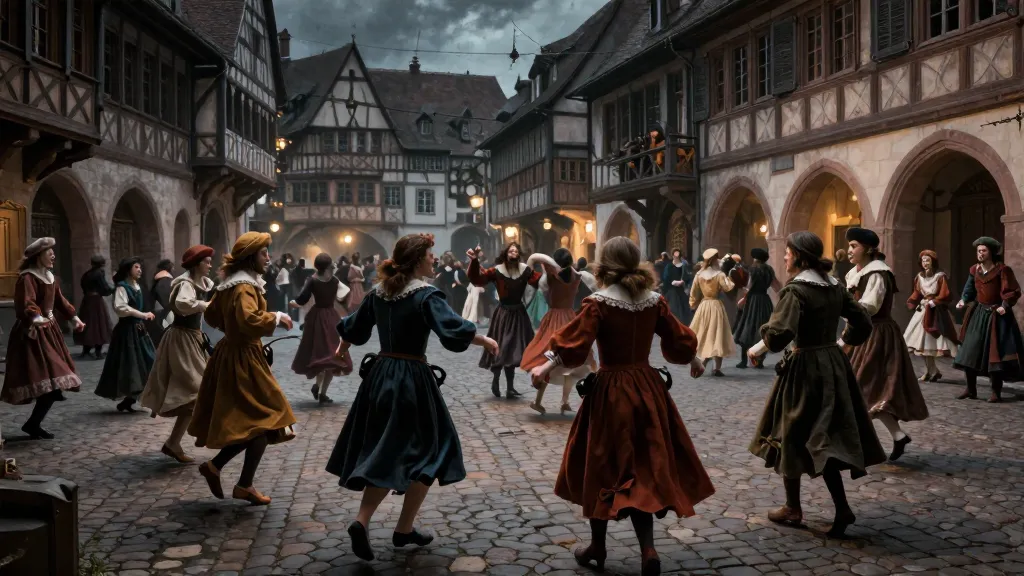
In the summer of 1518, the city of Strasbourg — then a prosperous commercial hub in the Holy Roman Empire — was gripped by a nightmare that defies modern comprehension. It began with a single woman. In mid-July, a housewife known as Frau Troffea stepped out of her half-timbered home onto a narrow cobbled street and began to dance. She had no musical accompaniment, no partner, and no apparent reason. She simply danced — arms flailing, feet pounding the cobblestones, her body moving with a compulsive, relentless energy that she could not control. She danced for six days without stopping. By the end of the first week, thirty-four others had joined her. By August, the number had swelled to approximately 400 people, their bodies jerking and spinning through the streets in a macabre, involuntary carnival. Some danced until their feet bled. Some danced until they collapsed from sheer exhaustion and never got up. According to medieval chronicles, as many as fifteen people per day were dying by the height of the epidemic — their hearts simply stopping, their brains overwhelmed by the physical toll of ceaseless motion. The city authorities, physicians, and clergy were powerless to explain it, and their attempts to cure the afflicted only made things worse. The Dancing Plague of 1518 remains one of the most bizarre and terrifying episodes in the history of medicine — a mass event that has never been adequately explained and that challenges our understanding of the relationship between mind, body, and society.
The Dancing Plague was not an isolated incident. Between the fourteenth and seventeenth centuries, dozens of similar outbreaks of compulsive dancing swept through communities across medieval and early modern Europe — in Germany, France, the Netherlands, and Switzerland. These episodes, known collectively as “dancing mania” or “St. Vitus’s Dance”, shared a common pattern: otherwise normal people would suddenly begin to dance uncontrollably, often for days or weeks, apparently unable to stop. Some were reported to have screamed, begged for help, or wept while their bodies continued to move. Many collapsed and died. The 1518 Strasbourg outbreak is the best-documented case, thanks to detailed city records, physicians’ notes, and the chronicles of local historians. It is also the most deadly — and the most disturbing, because the city’s response to the crisis reveals a worldview so alien to modern thinking that the event can barely be understood without appreciating the beliefs, fears, and social conditions of the time.
According to the city records of Strasbourg, the outbreak began on or around July 14, 1518, when Frau Troffea began dancing in the street outside her home. She danced alone for approximately six to seven days, drawing increasing attention from neighbors, passersby, and eventually the city authorities. She was not performing, not celebrating, not exercising. She appeared to be in a trance-like state, unable to stop her own movement. Within a week, thirty-four people had joined her — not by choice, apparently, but because they too were seized by the same compulsive urge to dance. By early August, the number had risen to hundreds. The dancers were predominantly lower-class women, though men and people of higher social status were also affected.
The afflicted danced day and night, often in the open air, sometimes in the guildhalls and marketplaces that the city had opened to accommodate them. They did not respond to shouts, touches, or entreaties from family members. Some tore their clothing. Some foamed at the mouth. Some collapsed and were carried away, only to resume dancing when they regained consciousness. Contemporary accounts describe the scene as chaotic and deeply disturbing — a city overtaken by a strange, involuntary convulsion that no one could explain or control. As the weeks wore on, the death toll began to mount. Dancers perished from heart attacks, strokes, and sheer physical exhaustion. The precise number of deaths is a matter of historical controversy — some sources claim as many as fifteen per day at the peak, while modern historians such as John Waller have argued that the death toll was probably in the dozens rather than the hundreds. What is not in dispute is that people died — they danced until their bodies gave out, and they did so in a state of apparent compulsion that they were powerless to resist.
One of the earliest recorded outbreaks of dancing mania occurred in Erfurt, Germany, in 1237, when a group of children danced wildly through the streets in an episode that some historians have linked to the later legend of the Pied Piper of Hamelin. In 1374, a massive outbreak of dancing mania struck the cities along the Rhine River, affecting thousands of people across dozens of communities. The dancers writhed, screamed, and claimed to see visions. Some walked on their hands. Some tore at their clothing. Clergy and physicians were baffled. Additional outbreaks were recorded in 1463, 1510, and 1531, among other dates. All of these episodes shared the same basic pattern: sudden onset, compulsive dancing, trance-like states, occasional deaths, and eventual dissipation after weeks or months. The frequency of these outbreaks across the 14th–17th centuries suggests that whatever caused them was deeply embedded in the social and psychological conditions of medieval European life — conditions that included paranoia about supernatural forces, devastating plagues, and the ever-present threat of starvation.
The response of the Strasbourg city authorities to the dancing plague is one of the most astonishing chapters in the history of medicine — and one of the most tragic. Confronted with hundreds of people dancing themselves to death, the city council consulted physicians, clergy, and learned experts. The consensus, rooted in the medical theories of the time, was that the dancers were suffering from “hot blood” — an imbalance of the humors that was causing their bodies to overheat and their limbs to move involuntarily. The prescribed cure was more dancing. The theory was that the afflicted needed to dance the illness out of their systems — to keep moving until the excess heat and bad humors were expelled.
To facilitate this “cure,” the city took several extraordinary measures. A wooden stage was constructed in the heart of the city, specifically to give the dancers a dedicated space to move. Professional musicians were hired to play for the dancers, on the theory that music would help guide and regulate their movements. Extra food and shelter were provided to keep the dancers alive while they danced, though many refused food or were unable to eat. The result was predictable in the worst possible way. The musicians and the stage did not cure the dancers — they intensified the epidemic. The music provided a rhythm that drew in new dancers. The stage provided a focal point that concentrated the afflicted and encouraged onlookers to join. By giving the dancing official sanction and material support, the city authorities transformed a disturbing local phenomenon into a full-scale public health catastrophe. It was not until weeks later, when the dancers were finally removed from the public eye and taken to religious shrines for prayer and penance, that the epidemic began to subside. The city eventually banned dancing and music in public spaces, and the outbreak gradually faded — though individual cases continued to be reported for months afterward.
The famous Renaissance physician and alchemist Paracelsus (Theophrastus von Hohenheim) visited Strasbourg several years after the 1518 outbreak and wrote his own account of the event. Paracelsus rejected the supernatural explanations favored by the clergy and instead proposed that the dancing mania was caused by psychological and social factors. He divided the dancers into three categories: those who danced out of anger, those who danced out of sexual frustration, and those who danced out of religious ecstasy. While his specific categories now seem quaint, Paracelsus was remarkably prescient in recognizing that the dancing plague was fundamentally a psychological phenomenon, not a physical disease. He argued that the dancers were not possessed by demons or cursed by saints — they were people whose minds had cracked under the pressure of unbearable social and emotional stress. His insights anticipated by nearly five centuries the modern theory of mass psychogenic illness, though he lacked the vocabulary and the clinical framework to develop the idea fully.
To understand the Dancing Plague, it is essential to understand the world in which it occurred. Alsace in 1518 was a region under extreme stress. The previous several years had been marked by famine, disease, and devastating social upheaval. A severe drought had ruined crops. Syphilis, introduced to Europe from the New World, was ravaging the population. Leprosy and Bubonic plague were ever-present threats. The region’s peasant population was ground down by crushing taxation imposed by the church and the nobility. The religious upheavals of the early Reformation were beginning to fracture the spiritual certainties that had held medieval society together. For the lower classes — the very people most affected by the dancing plague — life was a daily ordeal of hunger, disease, exploitation, and fear. The intolerable pressure of these conditions, argue modern researchers, created a psychological environment in which mass psychogenic illness could flourish. The dancing was not random. It was a physical expression of collective despair — the body’s desperate, involuntary response to a mind that could no longer cope.
The question of what caused the Dancing Plague of 1518 has been debated for centuries, and no single theory has achieved universal acceptance. The most widely accepted explanation is mass psychogenic illness (conversion disorder), championed by the historian John Waller of Michigan State University. Waller argues that the dancing plague was a form of mass hysteria — a psychological contagion in which extreme stress, transmitted through social suggestion, produces real physical symptoms. The dancers were not faking; their bodies were genuinely moving without their conscious control. This theory explains why the outbreak occurred among the most stressed and powerless members of society, why it spread through social contact, and why it responded to changes in the social environment such as removal from public view.
A second prominent theory involves ergot poisoning. Ergot is a fungus (Claviceps purpurea) that grows on rye grain, particularly in wet conditions. Ergot contains alkaloid compounds related to LSD, and ergot poisoning (ergotism) can cause convulsions, hallucinations, spasmodic movements, and psychotic episodes. The theory, first proposed in the twentieth century, is that the dancers had consumed bread made from ergot-contaminated rye. However, critics note that ergotism typically causes a wider range of symptoms than just dancing, and that the social pattern of the outbreak — spreading from person to person in a specific social context — is more consistent with psychogenic illness than with food poisoning.
Some medical historians have suggested that the dancers may have been suffering from a form of viral encephalitis — an inflammation of the brain that can cause involuntary movements, confusion, and altered consciousness. This theory explains the neurological symptoms but struggles to account for the highly specific, culturally shaped form of the outbreak. Many scholars now believe that the Dancing Plague was caused by a perfect storm of physical and psychological stressors. Ergot contamination or a mild neurological pathogen may have triggered the initial cases, while mass psychogenic illness drove the spread and escalation of the epidemic. The cultural context — a society steeped in beliefs about St. Vitus’s curse and demonic possession — provided the specific form that the hysteria took.
The most thorough modern investigation of the Dancing Plague has been conducted by John Waller, a historian of medicine at Michigan State University, whose 2008 book A Time to Dance, A Time to Die is the definitive English-language study of the event. Waller argues that the key to understanding the outbreak lies in the power of belief. In early sixteenth-century Strasbourg, there was a widespread folk belief that St. Vitus — a Sicilian martyr — could curse sinners with an uncontrollable urge to dance. The city’s inhabitants lived in fear of this curse. When Frau Troffea began to dance, Waller argues, she was not suffering from a random neurological event — she was expressing, through her body, a deeply held cultural fear. Others who shared the same fear, and who were already under extreme psychological stress, were susceptible to the same conversion reaction. The epidemic spread not through a pathogen but through social suggestion — the same mechanism that drives modern outbreaks of mass psychogenic illness in schools, factories, and military barracks around the world.
The Dancing Plague of 1518 is not the only example of mass psychogenic illness in history — it is merely one of the most dramatic. Modern examples include the Tanganyika Laughter Epidemic of 1962, in which an outbreak of uncontrollable laughter at a girls’ school in Tanzania spread to hundreds of people and forced the closure of fourteen schools. In 2011, more than a dozen teenage girls in Le Roy, New York, developed sudden-onset tic disorders that spread through social contact, generating intense media attention and eventually being diagnosed as conversion disorder. During the COVID-19 pandemic, outbreaks of mass psychogenic illness were reported among factory workers and schoolchildren on multiple continents. In all of these cases, the pattern is the same: extreme stress, social contagion, and real physical symptoms produced by psychological distress. The mechanisms that drove the Dancing Plague of 1518 are still with us — they are part of the human condition.
The Dancing Plague of 1518 is a story about the terrifying power of the human mind — specifically, the power of the collective mind under extreme duress. It is a story about a community that was so deeply stressed, so profoundly afraid, and so trapped by its circumstances that its members’ bodies began to express what their minds could not articulate. Frau Troffea and the hundreds who followed her were not mad, not poisoned, and not cursed by a saint. They were people — mostly poor, mostly female, mostly powerless — whose psychological suffering became so overwhelming that it erupted in the most dramatic way imaginable: through their bodies, in the streets, in front of everyone. The city authorities made things worse because they acted on the basis of beliefs that we now know to be false. But the underlying dynamic — the conversion of psychological distress into physical symptoms, the transmission of those symptoms through social contact, the escalation of the crisis through well-meaning but misguided intervention — is still active today. The Dancing Plague reminds us that the boundary between mind and body is not as firm as we like to believe, that human beings are deeply susceptible to the power of suggestion, and that the most dangerous epidemics are not always caused by viruses or bacteria. Sometimes the plague comes from within — a dance of despair that no medicine can stop, a mystery as old as civilization itself.
References & Further Reading
Wikipedia: Dancing Mania — The wider history of choreomania across medieval and early modern Europe
Wikipedia: Ergotism — The fungal poisoning theory, its symptoms, and historical outbreaks
📚 Recommended Reading: A Time to Dance, A Time to Die by John Waller (on Amazon) — As an Amazon Associate, we earn from qualifying purchases.
Editorial note: This account draws on city records of Strasbourg, the chronicles of medieval historians, and the research of John Waller. See our Editorial Policy.