The Hum: A Mysterious Sound That Torments Thousands Worldwide Yet Remains Unexplained
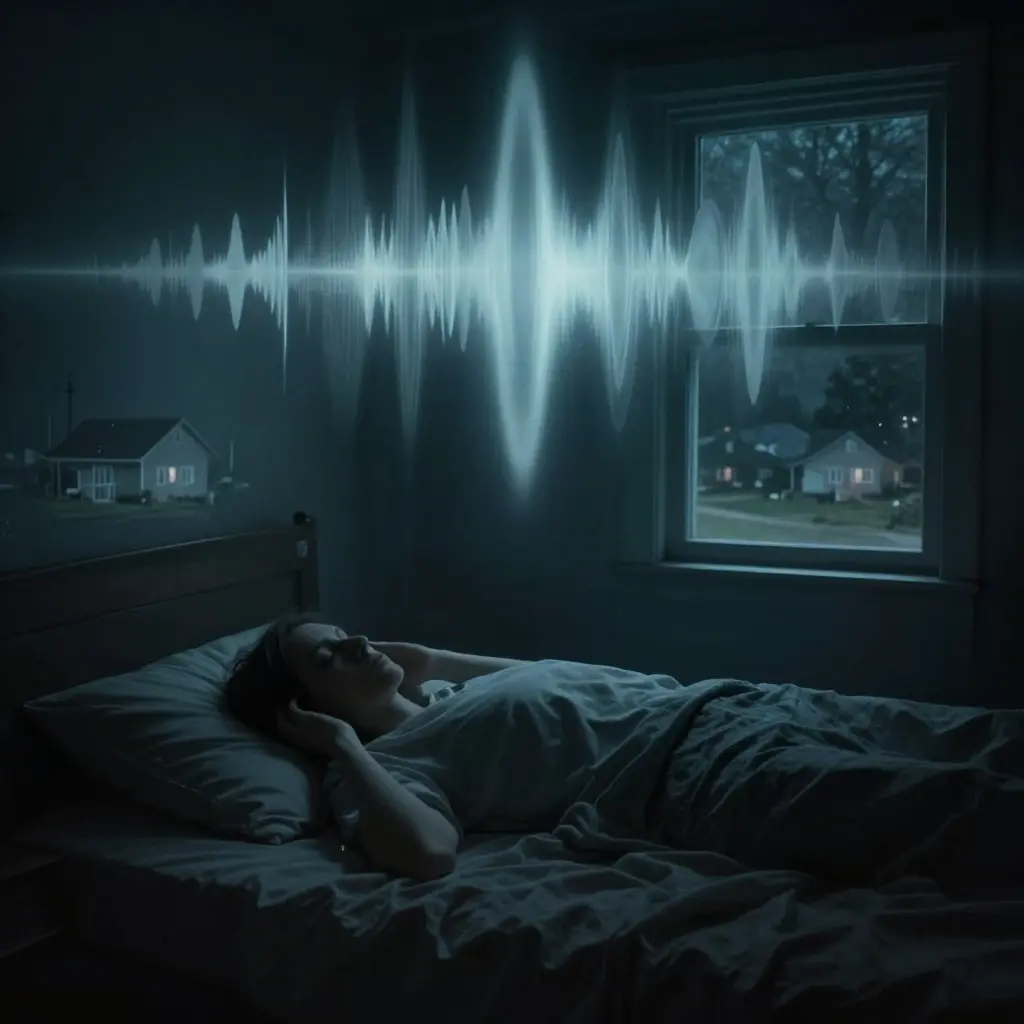
Imagine lying in bed at night, trying to sleep, when a low, persistent droning sound begins to creep into your consciousness. It sounds like a diesel engine idling in the distance — a deep, throbbing rumble that never quite fades away. You get up and check outside. Nothing. No trucks, no machinery, no traffic. You ask your spouse if they hear it. They look at you blankly. You check every room in the house, every appliance, every vent. You cut the power to the entire house. The sound gets louder. You step outside into the night. Silence. You go back inside. The drone returns. Welcome to the world of The Hum — one of the most pervasive and frustrating unexplained phenomena of the modern age. It is heard by an estimated 2 to 4 percent of the population in affected areas worldwide, yet remains invisible to acoustic instruments, inaudible to the vast majority of people, and maddeningly resistant to explanation.
The Hum is not a single phenomenon but a category of similar reports — a collection of individual experiences that share enough common features to suggest a common cause, or at least a common set of possible causes. The classic description is remarkably consistent across thousands of reports: a low-frequency rumbling or droning noise, often compared to a diesel engine idling, a large electrical transformer, or a fleet of trucks in the distance. The sound is almost always more noticeable indoors than outdoors, more noticeable at night than during the day, and more noticeable in quiet environments. Many hearers report that the sound stops momentarily when they make a noise — coughing, turning their head, or even exhaling audibly — and then resumes. The Hum cuts across demographics, though it appears to disproportionately affect people over 50 and has a slight female bias. It has been the subject of government investigations, university studies, and at least one Congressional inquiry. And yet, for the people who hear it, the most important fact about The Hum is the simplest: no one has been able to make it stop.
The most famous case — and the one that first brought the phenomenon to wide public attention — is the Taos Hum of Taos, New Mexico. Reports of a persistent, unexplained low-frequency noise in the Taos area began in the early 1990s. Approximately 2 percent of the local population reported hearing it. For some, it was a minor annoyance. For others, it was life-destroying — chronic sleep deprivation, headaches, nosebleeds, anxiety, and depression. Some moved away from Taos entirely, unable to tolerate the relentless drone. The complaints became so persistent that they attracted the attention of the United States Congress. In 1993, New Mexico Senator Jeff Bingaman requested a formal investigation, and a team of researchers from Los Alamos National Laboratory, Sandia National Laboratories, and the University of New Mexico was assembled to study the phenomenon. The researchers deployed arrays of sensitive microphones, seismometers, and electromagnetic monitoring equipment. Despite months of effort, the instruments detected no acoustic signal that corresponded to the hearers’ descriptions. The investigation cost an estimated $75,000 and produced no definitive answer.
The Taos Hum was the first to gain national attention, but it was far from the only one. In the late 1970s and 1980s, over 800 residents in the Bristol area of the United Kingdom reported hearing a persistent low-frequency humming noise, prompting a government-funded investigation by the University of Salford’s Acoustics Research Centre that identified possible sources including industrial equipment, road traffic, and gas pipelines, but could not pinpoint a single cause. In 1999, residents of Kokomo, Indiana, began reporting a low-frequency humming that caused headaches, nausea, and sleep disturbance; the Indiana Department of Environmental Management identified two industrial facilities as possible sources, and complaints declined after modifications were made. Beginning around 2011, residents of Windsor, Ontario, reported a persistent rumbling that was studied by the University of Windsor and Natural Resources Canada, which identified U.S. Steel’s Zug Island facility in nearby Michigan as a likely source — though U.S. Steel declined to cooperate fully, and the issue became a minor diplomatic incident. In 2006, residents of Auckland, New Zealand, added the Southern Hemisphere to the Hum map.
In 2012, Dr. Glen MacPherson, a lecturer at the University of British Columbia, began hearing a mysterious low-frequency humming noise at his home near Sechelt, British Columbia. His experience was typical: the sound was more noticeable indoors and at night, it stopped when he made a noise, and no one else in his household could hear it. MacPherson created the World Hum Map and Database Project — an online platform where Hum hearers could report their experiences and pin their locations on a global map. By 2014, he had collected survey responses from 576 self-described Hum hearers from around the world, and his analysis found remarkable consistency: a low-frequency drone, more noticeable indoors and at night, audible only to a small percentage of the population. MacPherson’s data suggested that The Hum was a global phenomenon, not confined to specific geographic locations.
Over the past four decades, researchers have proposed dozens of possible explanations. Industrial and mechanical sources are the most straightforward — heavy equipment, particularly large fans, compressors, pumps, and diesel generators, can produce low-frequency noise that travels long distances and penetrates buildings. High-pressure gas pipelines have also been identified as potential sources. The medical explanation centers on tinnitus, which affects roughly 10 to 15 percent of the population and is usually described as a ringing or buzzing, though a subset of sufferers experience low-frequency tinnitus that closely matches the description of The Hum. Spontaneous otoacoustic emissions — sounds generated by the outer hair cells of the cochlea — could explain the slight female bias in Hum reports, as they are more common in women. However, the tinnitus explanation cannot account for geographic clustering or why multiple people in the same area report hearing the same sound simultaneously.
One of the more intriguing scientific explanations was proposed by researchers studying ocean microseisms — faint, continuous seismic vibrations caused by ocean waves interacting with the seafloor. In 2015, a team published a study in Geophysical Research Letters demonstrating that ocean microseisms produce a continuous low-frequency hum at frequencies between approximately 0.1 and 10 Hz — well within the range reported by Hum hearers. The researchers showed that microseisms generated by storms in the North Atlantic could be detected by seismometers deep inland, hundreds of miles from the coast. This theory could explain why The Hum is a global phenomenon, why it is more noticeable at night when ambient noise levels are lower, and why buildings can amplify it through resonance. However, ocean microseisms have been present throughout human history, so this theory cannot easily explain why The Hum appears to be a modern phenomenon with most reports dating from the late twentieth century onward.
Statistical analysis of Hum reports reveals a consistent demographic profile. According to MacPherson’s 2014 survey of 576 Hum hearers, approximately 2 to 4 percent of the population in affected areas can hear The Hum. Hearers are disproportionately over the age of 50, though younger people also report the experience. There is a slight female bias — about 55 to 60 percent of hearers are women. A significant percentage — roughly 60 percent — report that the sound stops momentarily when they make a noise, a detail particularly puzzling because it suggests an interaction between the hearer’s own auditory system and the perceived sound that is not easily explained by either external noise or simple tinnitus.
For the people who hear The Hum, the experience is not merely a curiosity. It is a chronic, inescapable torment. The relentless drone follows them into their homes, their bedrooms, their most private moments of attempted rest. Sleep becomes a battle. Concentration becomes impossible. And worst of all, almost no one else can hear it. Friends and family may be sympathetic at first, but over time, skepticism sets in. Doctors suggest antidepressants or anti-anxiety medication, treating the symptom rather than the cause — because the cause is unknown. When hearers complain to local governments or environmental agencies, they are often met with bewilderment or dismissal. In extreme cases, the suffering has led to suicide. While the exact number is not known, Hum researchers have documented cases of hearers who took their own lives after years of sleep deprivation and despair. These tragedies underscore the urgency of finding an explanation — and a solution. The Hum is not merely an acoustic puzzle. It is a public health issue.
The Hum remains one of the most puzzling and persistent unexplained phenomena of the modern world. It has been investigated by government agencies, national laboratories, and university researchers. It has been the subject of Congressional inquiries, international diplomatic discussions, and at least one comprehensive global database. And yet it has not been definitively explained. It may be industrial noise. It may be tinnitus. It may be ocean microseisms. It may be electromagnetic radiation. Or — and this is perhaps the most likely possibility — it may be all of these things, a collection of different phenomena that happen to produce similar subjective experiences in a small percentage of the population. What is certain is that the people who hear The Hum are suffering, and they deserve to be taken seriously. The Hum is a reminder that the world still contains mysteries that science has not yet solved — and that the most important mysteries are the ones that cause real human suffering.
References & Further Reading
Wikipedia: Tinnitus — The medical condition most commonly proposed as an explanation for The Hum
Wikipedia: Otoacoustic Emission — The inner-ear phenomenon that may account for some Hum experiences
📚 Recommended Reading: Greatest Mysteries of the Unexplained (on Amazon) — As an Amazon Associate, we earn from qualifying purchases.
Editorial note: scientific understanding of acoustic phenomena and auditory perception is continuously evolving. See our Editorial Policy.