The Hessdalen Lights: Mysterious Glowing Orbs That Haunt a Norwegian Valley
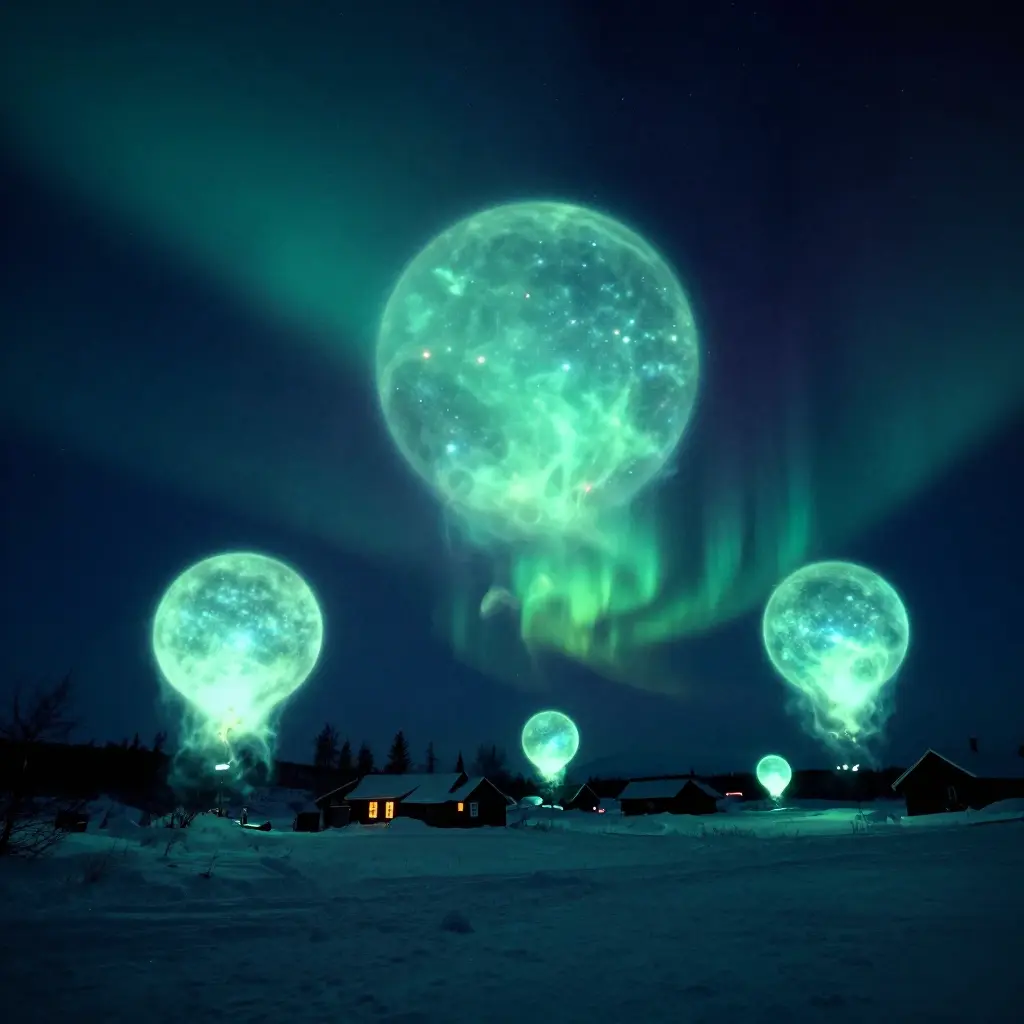
In the remote Hessdalen valley of central Norway, about 120 kilometers south of Trondheim, something extraordinary has been happening for nearly a century. Silent, glowing orbs of light — brilliant white, warm yellow, fiery red, and occasionally blue — appear in the sky without warning, hovering above the frozen farmland and dark pine forests. They float. They zigzag. They merge and split. They vanish without a trace. Sometimes they last only a few seconds; other times, they linger for well over an hour. During the peak of the phenomenon between December 1981 and mid-1984, witnesses reported seeing the lights up to twenty times per week, transforming this tiny Scandinavian farming community of fewer than two hundred people into one of the most actively studied anomalous phenomena sites on Earth. Unlike most UFO sightings, the Hessdalen Lights are repeatable, partially predictable, and scientifically documented — captured on radar, photographed by automated camera stations, and analyzed with spectroscopic instruments by physicists from Norway, Italy, and beyond. After more than four decades of sustained scientific investigation, no single theory has conclusively explained what these lights are, why they appear here, or why they behave the way they do.
The Hessdalen valley is a narrow, north-south oriented valley approximately 15 kilometers long, situated at roughly 617 meters above sea level in the municipality of Holtålen in Trøndelag county, Norway. It is isolated, sparsely populated, and surrounded by mountains carved from ancient granite and gneiss rock some 400 million years ago. The valley’s geology is particularly noteworthy: it sits atop quartz-rich rock formations, is bisected by geological fault lines, and shows evidence of significant mineral deposits including copper and zinc — details that would prove critical to the scientific investigation. Unusual lights in the region were first reported as early as the 1930s, but it was not until the spectacular wave of sightings that began in late 1981 that the phenomenon attracted serious scientific and public attention.
The modern era of the Hessdalen Lights began in December 1981, when residents of the valley began reporting frequent, bright, unexplained lights in the sky above their community. The descriptions were remarkably consistent: glowing orbs, usually white or yellow but sometimes red or orange, ranging in apparent size from a few centimeters to the size of a car. They appeared both day and night, though they were most dramatic against the dark Nordic sky. They moved silently — sometimes hovering in place, sometimes drifting slowly across the valley, and sometimes accelerating with astonishing speed before changing direction abruptly. Some witnesses described the lights as appearing to respond to their presence, brightening when observers flashed lights at them or altering their trajectory when approached. The frequency of the sightings was extraordinary: during the peak period from late 1981 through mid-1984, observers documented the lights 15 to 20 times per week. The phenomenon attracted tourists, journalists, and curiosity seekers from across Scandinavia and beyond, turning the quiet valley into an impromptu observatory.
What made the 1981-1984 wave so significant was not merely its intensity but its consistency. This was not a handful of unreliable witnesses reporting vague shapes on a single night. The lights appeared repeatedly, were observed by dozens of credible witnesses simultaneously, and were captured on photograph and film. The Norwegian media covered the phenomenon extensively, and the Norwegian Defence Research Establishment took an interest. Local residents, many of them farmers and laborers with no particular interest in UFOs or the paranormal, were genuinely bewildered. The lights did not behave like aircraft, helicopters, weather balloons, satellites, or any other known aerial phenomenon. They produced no sound. They generated no detectable heat. They left no physical trace on the ground. They simply appeared, performed their silent aerial ballet, and vanished — only to return, night after night, week after week, for more than two years.
The extraordinary frequency of the 1981-1984 wave prompted the first serious scientific investigation. In 1983, Dr. Erling Strand of Østfold University College launched Project Hessdalen, a collaborative effort involving Norwegian and Swedish research organizations, university scientists, and volunteer engineers. The project deployed an impressive array of scientific instruments into the valley: radar systems, laser rangefinders, spectrographic cameras, magnetometers, and photographic equipment. The goal was straightforward: observe the lights with scientific rigor, collect measurable data, and determine their physical characteristics. Between 1983 and 1985, Project Hessdalen conducted multiple field campaigns. The results were remarkable. The lights were detected on radar, confirming that they were physical phenomena and not optical illusions. Spectrographic analysis of the light emissions revealed specific chemical signatures — emission lines consistent with scandium and iron among other elements — suggesting that the lights were genuine luminous phenomena producing their own light.
The success of the initial campaigns inspired further research. In 1998, a permanent Hessdalen Automatic Measurement Station (AMS) — a small building known locally as the “Blue Box” — was installed in the valley, equipped with automated cameras, spectrometers, and sensors that could detect and record the lights 24 hours a day, 365 days a year. The AMS represented a breakthrough: for the first time, the lights could be monitored continuously, generating a database of sightings that could be analyzed statistically. Between 1998 and 2004, a joint Italian-Norwegian scientific project led by Dr. Massimo Teodorani and Dr. Bjørn Gitle Hauge conducted further field investigations, deploying additional instruments and publishing their findings in peer-reviewed scientific journals. Hauge’s radar measurements provided some of the most precise data on the lights’ size, altitude, and movement patterns ever collected.
One of the most significant scientific findings from the Hessdalen research is the spectroscopic analysis of the light emissions. When the light from the orbs was passed through a spectroscope — an instrument that separates light into its component wavelengths — researchers detected specific emission lines corresponding to particular chemical elements. The detected elements included scandium, iron, and oxygen, as well as nitrogen emission lines. This spectroscopic signature is consistent with a plasma — a gas in which atoms have been stripped of some of their electrons, producing characteristic light emissions. The presence of metal ions suggests that the plasma may be generated from dust particles or geological minerals present in the valley. These findings are critical because they rule out many prosaic explanations: optical illusions, reflections, and atmospheric lensing do not produce specific elemental emission spectra. The Hessdalen Lights are producing their own light through a physical process that involves the ionization of matter.
After more than four decades of research, the Hessdalen Lights remain unexplained — but several competing scientific hypotheses have emerged. The most prominent is the plasma hypothesis, championed by Dr. Teodorani, an Italian astrophysicist who has studied the lights extensively. According to this theory, the Hessdalen Lights are a form of naturally occurring atmospheric plasma — a self-luminous ball of ionized gas, similar to but distinct from ball lightning. The spectroscopic evidence supports this interpretation, showing emission lines consistent with plasma containing metal ions. However, the plasma hypothesis struggles to explain the lights’ observed behavior — their ability to hover for extended periods, change direction abruptly, and appear to respond to observers. Natural plasma phenomena, such as ball lightning, typically last only seconds and do not exhibit the complex, seemingly purposeful movement patterns documented at Hessdalen.
A second major hypothesis involves piezoelectricity — the generation of electrical charge in certain minerals, particularly quartz, when subjected to mechanical stress. The Hessdalen valley sits atop quartz-rich rock formations, and the region is bisected by geological fault lines. According to the piezoelectric theory, tectonic stress in the valley’s rocks generates electrical charges that ionize the air above, producing luminous plasma orbs. This theory is appealing because it explains why the phenomenon occurs specifically in Hessdalen: the unique combination of quartz-rich geology, fault lines, and topography creates conditions favorable for piezoelectric charge generation. However, critics note that the piezoelectric effect typically produces very small amounts of electricity, and it is unclear whether it could generate the large, sustained, and intensely bright lights documented at Hessdalen. A related hypothesis, sometimes called the “natural battery” theory, proposes that the valley’s geology — which includes significant deposits of copper and zinc — acts as a giant natural battery, with groundwater serving as an electrolyte, generating electrical currents that ionize the air above.
Over the decades, researchers have systematically evaluated and eliminated numerous prosaic explanations. Aircraft and helicopters have been ruled out by radar data showing stationary or hovering objects and by the complete absence of engine noise. Weather balloons, satellites, and meteors have been excluded based on movement patterns and duration. The planet Venus, often blamed for UFO sightings, cannot account for lights that hover, zigzag, and change color. Optical illusions and atmospheric refraction have been ruled out by the spectroscopic evidence showing genuine light emission. Headlights from cars have been ruled out by radar detections of objects at altitude. A 2015-2016 seismic correlation study examined whether earthquake activity could be linked to the lights, with mixed results. Recent data from 2025-2026 has found a correlation between increased light activity and geomagnetic disturbances during Solar Cycle 25, suggesting that solar activity may play a role — but this does not explain why the lights occur specifically in Hessdalen and not in other locations affected by geomagnetic storms.
As of the mid-2020s, the Hessdalen Lights continue to appear, though at a much reduced frequency compared to the spectacular 1981-1984 peak. Current estimates suggest approximately 10 to 20 sightings per year. Project Hessdalen, now in its fifth decade, remains one of the longest-running scientific investigations of an anomalous phenomenon in history. The research infrastructure in the valley has been continuously upgraded. The original 1998 AMS has been supplemented by additional automated stations with multispectral cameras, VLF/ELF radio receivers, magnetometers, and weather sensors. A drone program launched in the mid-2020s allows researchers to fly instruments directly toward and around the lights when they appear, capturing higher-resolution spectral and motion data than ever before. The drone footage has revealed that some orbs appear to emerge from ground level or ridge lines before rising into the sky — a crucial observation that suggests the lights may originate from geological processes rather than atmospheric ones.
The research community has also embraced citizen science, launching a mobile app that allows visitors to report sightings in real time, complete with GPS coordinates and smartphone photographs. The valley has become a modest tourist destination, with a small visitor center and guided “light-watching” excursions offered during the winter months when the long Nordic nights provide optimal viewing conditions. While the frequency of sightings has declined from its 1980s peak, the quality of the data has improved dramatically, thanks to advances in spectroscopic instruments, digital cameras, and computational analysis. The long-term dataset — spanning more than four decades — is now one of the most comprehensive records of anomalous light phenomena ever assembled.
The Hessdalen Lights stand as one of the most scientifically documented unexplained phenomena in the world. Unlike most UFO sightings — which are fleeting, poorly observed, and impossible to study after the fact — the Hessdalen Lights have been captured on instruments, analyzed with spectroscopes, tracked on radar, and monitored by automated stations for decades. The evidence is clear: something real and physical is producing light in the Hessdalen valley, and it has been doing so for at least ninety years. The most likely explanation involves some form of naturally occurring plasma, generated by the valley’s unique geological and atmospheric conditions — but the specific mechanism remains elusive, and the lights’ complex behavior continues to challenge every proposed theory. As instruments improve and data accumulates, the answer may eventually emerge — or the Hessdalen Lights may continue to remind us that even in the 21st century, the natural world still holds secrets that science has not yet unlocked. Until then, the lights continue to glow in the Norwegian sky — silent, beautiful, and utterly unexplained.
References & Further Reading
Project Hessdalen Official Website — Live data, sighting reports, and scientific publications
Wikipedia: Ball Lightning — Related phenomenon with similarities to the Hessdalen Lights
NaturPhilosophie: The Complex Electro-Chemistry Behind the Hessdalen Lights
World Below: Norway Hessdalen Lights Revisited (2026 Update)
📚 Recommended Reading: UFOs: Generals, Pilots by Leslie Kean (on Amazon) — As an Amazon Associate, we earn from qualifying purchases.
Editorial note: Scientific understanding of anomalous atmospheric phenomena continues to evolve as new data and analytical methods emerge. See our Editorial Policy.