Spontaneous Human Combustion: Can People Really Self-Ignite?
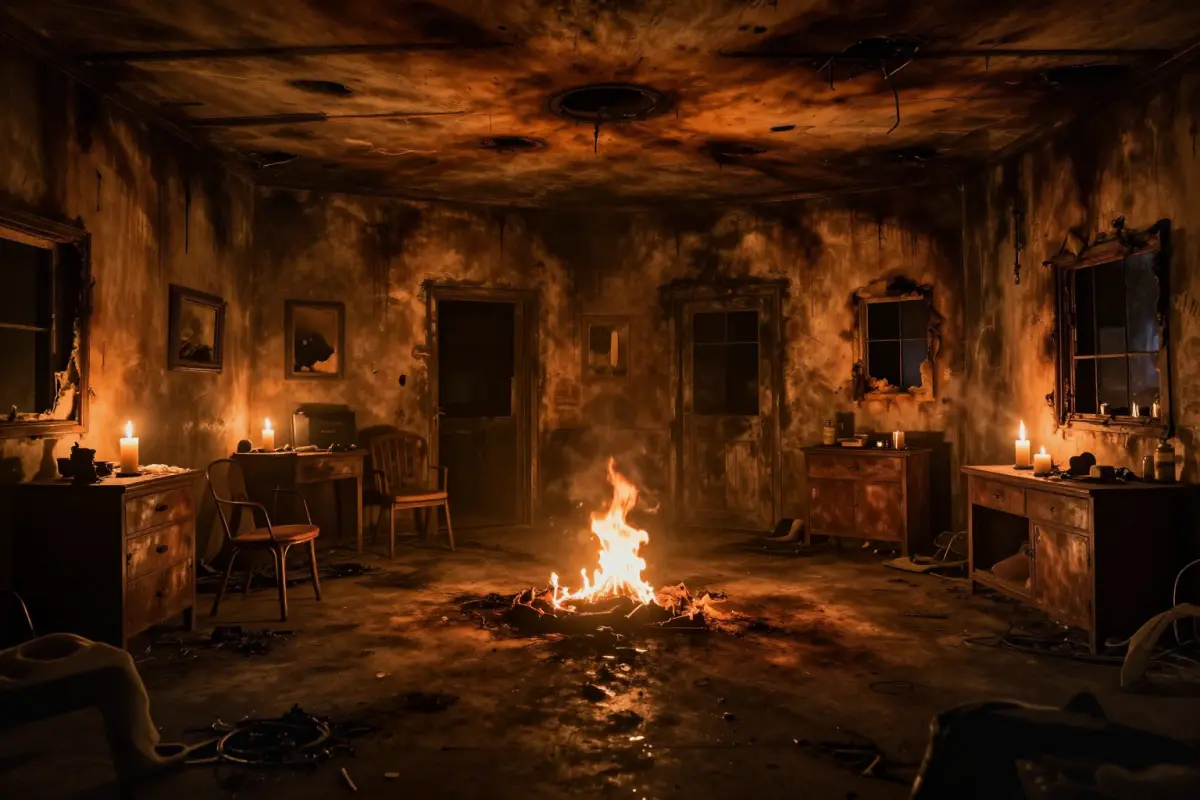
Imagine, for a moment, the most terrifying death conceivable: you are sitting alone in your favorite armchair, perhaps dozing after a meal, when without warning — without any spark, any flame, any external source of ignition whatsoever — your body begins to burn from the inside out. Within hours, you are reduced to a pile of gray ash. Your torso, your head, your internal organs — all consumed by an intense, localized fire that generates temperatures comparable to a crematorium. Yet the chair beneath you is only partially burned. The carpet around you is scorched but not destroyed. The newspapers on the table beside you are untouched. The walls are merely coated with a fine layer of soot. There are no scorch marks trailing away from the body, no evidence of accelerants, no signs of any external flame. It is as though the fire came from within — as though the body itself, without cause or explanation, simply decided to combust. This is the concept of spontaneous human combustion (SHC), one of the most enduring and disturbing mysteries in the history of forensic science. It is a phenomenon that has haunted the medical literature since the seventeenth century, inspired one of the most controversial death scenes in English literature, and continues to fascinate and terrify in equal measure.
The idea that a human body could ignite without any external cause has been debated for more than three and a half centuries. The earliest known written account dates to 1663, when the Danish anatomist Thomas Bartholin described the death of a woman in Paris who was allegedly reduced to ashes in her bed while the bedclothes around her remained unscorched. Over the following centuries, dozens of similar cases were reported in medical journals, newspapers, and legal records across Europe and North America. In 1853, Charles Dickens caused a public furor by using spontaneous human combustion to kill off the character Mr. Krook in his novel Bleak House — a plot device that critics denounced as medically impossible but that Dickens defended by citing published case reports. The debate raged for months in the letters pages of London newspapers. Dickens was not persuaded. “I have no need to observe,” he wrote, “that I do not willfully or negligently mislead my readers.” The controversy highlighted the tension between the dramatic power of the SHC concept and the scientific skepticism that had always surrounded it — a tension that persists to this day.
Of all the alleged cases of spontaneous human combustion, none is more famous — or more thoroughly investigated — than the death of Mary Hardy Reeser in St. Petersburg, Florida, in July 1951. On the morning of July 2, Reeser’s landlady, Pansy Carpenter, arrived at the 67-year-old widow’s apartment to deliver a telegram. When no one answered the door, Carpenter noticed that the doorknob was unusually hot. She called the police. Officers who entered the apartment discovered a scene of almost incomprehensible destruction. In the corner of the room, Mary Reeser’s easy chair had been largely destroyed, and in its place was a pile of gray ash approximately 4 feet in diameter. Within the ash were the chair’s coil springs, a section of Reeser’s spine, her left foot still wearing a black silk slipper, and a skull “shrunken to the size of a teacup”. The rest of her body — her torso, arms, right leg, internal organs, and head — had been entirely consumed.
What made the scene so baffling was the selectivity of the destruction. The fire had apparently burned with enough intensity to reduce a human body to ash — a process that typically requires sustained temperatures of 1,400 to 1,800 degrees Fahrenheit (760 to 980 degrees Celsius) for two to three hours in a modern crematorium. Yet the damage to the surrounding room was remarkably limited. A nearby candle had melted into a puddle of wax. The plastic light switch covers were warped. The upper walls and ceiling were coated with a fine layer of soot. But the rest of the apartment — including bedsheets just a few feet from the chair — was virtually untouched. There was no trail of burning, no evidence of accelerants, no sign that a fire had spread from any external source. The St. Petersburg police were so baffled that they called in the FBI, who conducted their own investigation. The FBI ultimately concluded that Reeser had most likely fallen asleep while smoking a cigarette and that the cigarette had ignited her nightgown, triggering what forensic scientists call the “wick effect.”
The Reeser case was far from the first alleged instance. One of the earliest and most frequently cited historical accounts is the death of Countess Cornelia di Bandi of Cesena in 1731, who was found in her bedroom reduced to ashes, with only her head, her lower legs, and three fingers remaining. In 1966, the case of Dr. John Irving Bentley added another chapter to the legend. Bentley was a 92-year-old retired physician living in Coudersport, Pennsylvania. On December 5, 1966, a meter reader entered Bentley’s home and discovered that the doctor’s body had been almost entirely consumed by fire — only his lower right leg and foot remained, still wearing a slipper and resting next to a hole that had been burned through the floor. As in the Reeser case, the damage to the surrounding room was surprisingly limited. Bentley had been a heavy smoker and was known to have dropped cigarette ashes in the past.
Perhaps the most remarkable modern case occurred on December 22, 2010, in Galway, Ireland, when Michael Faherty, a 76-year-old man, was found dead in his home. His body had been severely burned, but the fire was almost entirely contained to his body and the area immediately surrounding it. The fireplace in the room showed signs of recent use, and there was evidence of smoke damage, but no evidence of an external ignition source. What made the Faherty case extraordinary was the official ruling: the coroner, Dr. Ciaran McLoughlin, recorded the cause of death as “spontaneous combustion” — reportedly the first time such a verdict had been returned in an Irish coroner’s court. Dr. McLoughlin stated that he had consulted medical textbooks and fire experts and found no other explanation for the localized nature of the fire. The verdict attracted worldwide media attention and reignited the debate over whether spontaneous human combustion was a genuine phenomenon or a forensic misinterpretation.
The primary scientific explanation for alleged cases of spontaneous human combustion is the wick effect — a process in which the human body, when clothed, burns in a manner analogous to a candle. In this model, the victim’s clothing acts as the wick, absorbing melted body fat (which serves as the fuel) and drawing it upward through the fabric by capillary action. The fat burns with a smoky, yellow flame at temperatures between approximately 500 and 800 degrees Celsius (932 to 1,472 degrees Fahrenheit) — sufficient to consume the torso over a period of 7 to 13 hours. The process is slow, steady, and highly localized, which explains why the fire does not spread significantly beyond the body. The extremities — feet, hands, and sometimes the head — often survive because they contain less fat and are farther from the core of the fire.
The wick effect was demonstrated experimentally by Brian J. Ford in 1998, who wrapped pig carcasses (which have similar fat content to humans) in cloth and ignited them with a small flame. The resulting fires produced results strikingly similar to alleged SHC scenes: the torso was consumed, the extremities survived, and the surrounding area was relatively undamaged. Around the same time, Dr. John de Haan of the California Criminalistic Institute conducted a similar experiment, again using a pig carcass, which demonstrated that body fat could fuel a fire for several hours at high temperatures without the need for any external accelerant. The wick effect accounts for nearly all of the characteristic features of alleged SHC cases: the localized nature of the fire, the survival of extremities, the finding that victims are often discovered in a seated or reclining position, and the apparent absence of an external ignition source — which is typically a cigarette, a candle, a fireplace ember, or a malfunctioning heating pad, small and common items that may be consumed or overlooked during the investigation.
The scientific consensus on spontaneous human combustion is clear: there are no verified cases in the medical literature of a human body igniting without an external source. The National Fire Protection Association does not recognize SHC as a legitimate fire cause. Professors of forensic medicine have stated unequivocally that every alleged case, when examined carefully, has a plausible explanation — usually involving the wick effect and an overlooked ignition source. And yet the legend persists. There is something about the concept of spontaneous human combustion that speaks to a deep, primal fear: the fear that our own bodies might betray us, that the flesh we inhabit might turn against us without warning. It is a fear amplified by the genuinely eerie nature of the crime scenes — the pile of ash, the surviving foot, the untouched newspaper. The wick effect explains how these fires happen. But the emotional power of the images — the elderly woman reduced to ash in her armchair, the retired doctor with nothing left but a slippered foot, the Irish grandfather burned beyond recognition while his fireplace smoldered harmlessly — is harder to dispel with science. The mystery of spontaneous human combustion may have been solved in the laboratory. But in the popular imagination, the fear of burning from within remains very much alive.
References & Further Reading
Wikipedia: Mary Reeser — The 1951 St. Petersburg, Florida case known as the “Cinder Woman”
Wikipedia: Fire Investigation — The forensic science of determining fire causes
📚 Recommended Reading: Ablaze! (on Amazon) — As an Amazon Associate, we earn from qualifying purchases.
Editorial note: Spontaneous human combustion is documented through centuries of medical case reports, forensic investigations, and peer-reviewed scientific research. See our Editorial Policy.