The Wow! Signal: Did We Receive a Message From Aliens in 1977?
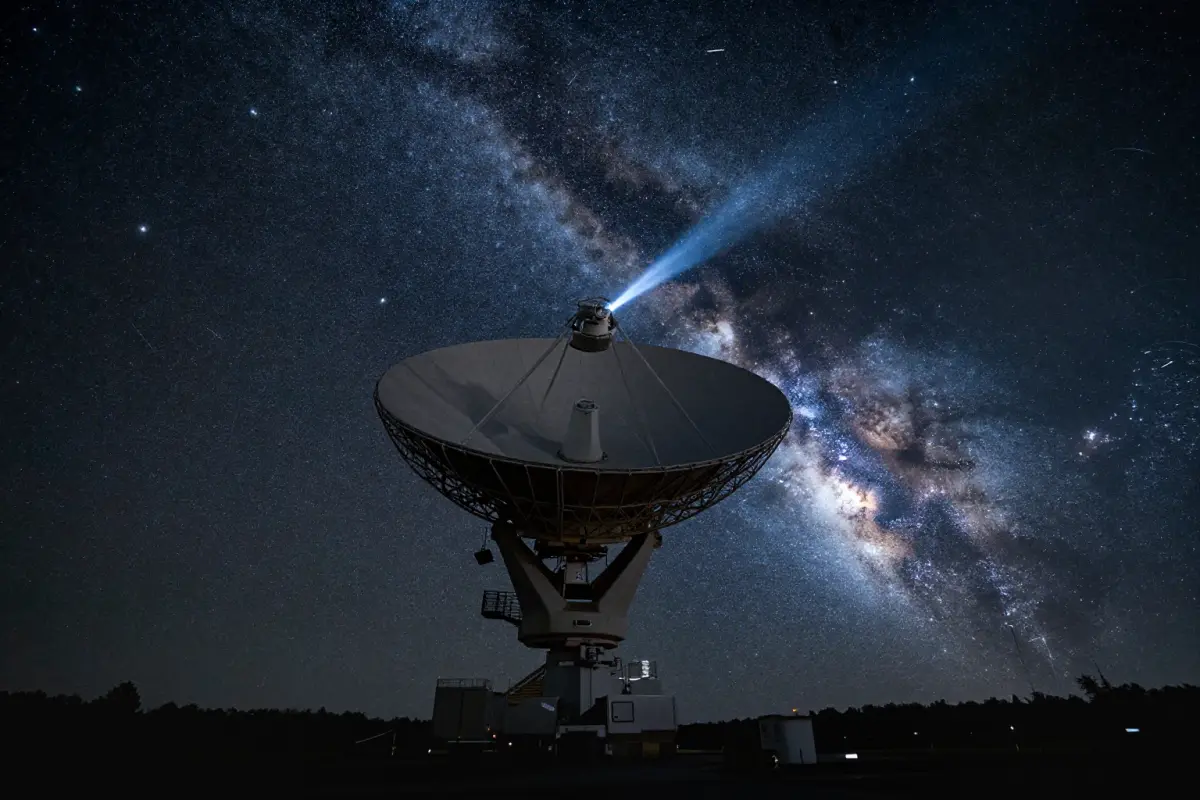
On the night of August 15, 1977, at 11:16 PM Eastern Daylight Time, a radio telescope in the rolling farmland of central Ohio detected something extraordinary — a narrowband radio signal so powerful, so precisely tuned, and so eerily consistent with what scientists had predicted an extraterrestrial transmission would look like that the astronomer who found it three days later could only write a single word in the margin of the computer printout: “Wow!”. The signal, which arrived at a frequency of 1420.40575177 MHz — almost exactly the legendary hydrogen line, a frequency considered the most logical channel for interstellar communication — lasted for precisely 72 seconds, the exact duration expected for a signal detected by a fixed radio telescope as the Earth rotated. It was 30 times stronger than the typical background noise of deep space. It came from the direction of the constellation Sagittarius, near the densely packed star fields of the galactic center. And then, despite decades of searching by some of the most powerful radio telescopes ever built, it was never heard again. The Wow! Signal remains, nearly half a century later, the strongest candidate signal ever detected in the history of SETI — the Search for Extraterrestrial Intelligence — and one of the most tantalizing unsolved mysteries in the history of science.
The Wow! Signal was detected by the Big Ear radio telescope, operated by the Ohio State University Radio Observatory in Delaware, Ohio. The Big Ear was the brainchild of John Kraus, a pioneering radio astronomer and professor at Ohio State who designed and built the telescope in the 1950s and 1960s. By the 1970s, the Big Ear was one of the longest-running SETI projects in the world, systematically scanning the sky for narrowband radio signals that might indicate the presence of an intelligent civilization elsewhere in the galaxy. The telescope used a fixed, non-movable reflector that relied on the rotation of the Earth to scan different regions of the sky, observing each point for approximately 72 seconds as it drifted through the telescope’s field of view. The telescope had two feed horns — receiving antennas mounted at the focal point of the reflector — that scanned slightly different regions of the sky several minutes apart. This dual-horn design was a built-in verification mechanism: a genuine celestial signal should appear in both horns at different times, while terrestrial radio interference would likely appear in only one.
On the night of August 15, 1977, the Big Ear was engaged in a routine SETI scan of the sky — one of thousands of such scans conducted over the years. The telescope’s computer recorded the incoming data as a continuous printout of characters, each representing the signal intensity measured over a 12-second integration period. The intensity scale used by the Big Ear ran from 0 to 9 for low-intensity signals, then continued with letters A through Z for progressively stronger signals, with “U” representing a signal intensity approximately 30 times the background noise level. A few days later, Jerry R. Ehman, a volunteer astronomer who had previously worked at Ohio State as an assistant professor of electrical engineering and astronomy before funding cuts ended his paid position, was reviewing the computer printouts at his kitchen table. He noticed something that stopped him cold: a sequence of characters reading “6EQUJ5”, representing a signal that rose sharply from the background level (6), climbed through increasing intensity levels (E, Q, U), peaked at “U” — the highest intensity the system could record — and then declined symmetrically (J, 5). This smooth rise-and-fall pattern was exactly what would be expected from a celestial source drifting through the telescope’s beam as the Earth rotated. Ehman was so stunned that he grabbed a red pen, circled the sequence, and wrote “Wow!” in the margin — a spontaneous exclamation that would become one of the most famous annotations in the history of science.
The signal’s characteristics were remarkable by every measure. The frequency of 1420.40575177 MHz was extraordinarily close to the hydrogen line — the natural emission frequency of neutral hydrogen atoms, the most abundant element in the universe. This frequency had been proposed as early as 1959 by physicists Giuseppe Cocconi and Philip Morrison in a landmark paper in Nature as the most logical frequency for interstellar communication, because any technologically advanced civilization would know the frequency and would recognize its significance. The signal’s bandwidth was extremely narrow, approximately 10 kHz or less — a characteristic typical of artificial transmissions and very unlike the broadband emissions produced by natural astrophysical phenomena such as pulsars, quasars, or interstellar gas clouds. The 72-second duration matched precisely the time it would take for a fixed antenna to scan a point source as the Earth rotated, confirming that the signal originated from a specific direction in the sky. And the signal was detected in only one of the Big Ear’s two feed horns, adding a layer of complexity that has never been fully explained.
The hydrogen line frequency at approximately 1420.40575177 MHz (a wavelength of about 21 centimeters) is often called the “watering hole” of the radio spectrum because it sits in a relatively quiet region of the electromagnetic spectrum, between the noise generated by galactic synchrotron radiation at lower frequencies and atmospheric absorption at higher frequencies. Cocconi and Morrison’s reasoning was elegant: since hydrogen is the most common element in the universe and its emission frequency is known to every astronomer, any civilization with radio technology would be aware of this frequency. It would be the cosmic equivalent of a universal telephone number — a frequency that any intelligent species would think to check. The hydrogen line frequency is now protected by international agreement for radio astronomy use, meaning that terrestrial transmitters are prohibited from broadcasting at or near this frequency. The fact that the Wow! Signal arrived at precisely this frequency was one of the most compelling arguments that it could be an artificial transmission. Natural astrophysical phenomena do not typically produce narrowband emissions at this specific frequency with the intensity and duration observed.
The Wow! Signal appeared to originate from the direction of the constellation Sagittarius, near the star cluster M55, at celestial coordinates corresponding to the Chi Sagittarii star group, in the general direction of the center of the Milky Way galaxy. This region of the sky is extraordinarily dense with stars — the galactic center contains billions of stars packed into a relatively small volume of space, making it a statistically promising place to search for extraterrestrial signals. In 2020, amateur astronomer Alberto Caballero used data from the European Space Agency’s Gaia space observatory to search for sunlike stars in the Wow! Signal’s region of origin. He identified a candidate star — designated 2MASS 19281982-2640123 — located approximately 1,800 light-years from Earth, a sunlike star that could potentially host habitable planets. While this identification is intriguing, it remains highly speculative: the Wow! Signal’s true origin has never been confirmed, and the signal has never been detected again from any direction.
One of the defining characteristics of the Wow! Signal — and one of the most frustrating for scientists — is that it has never been detected again. Despite dozens of follow-up observations using increasingly powerful telescopes over more than four decades, the signal has never recurred. This absence of repetition is deeply significant, because one of the fundamental principles of science is that results must be reproducible. A signal that appears once and never again cannot be confirmed, no matter how compelling its characteristics. In 1987, astronomer Robert Gray used the same Big Ear telescope to search for the signal at the same coordinates — no detection. In 1995 and 1996, Gray used the Very Large Array (VLA) in New Mexico, one of the most powerful radio telescope arrays in the world, to search for the signal over extended periods — no detection. In 1999, Gray used the University of Tasmania’s 26-meter radio telescope in Australia — no detection. The Allen Telescope Array in California, designed in part for SETI observations, has also searched for the signal without success. Each of these follow-up observations was more sensitive than the original Big Ear, meaning that if the signal were a persistent phenomenon, it should have been detected again.
Jerry Ehman himself was deeply cautious about the discovery. In interviews, he repeatedly emphasized that he could not confirm the signal was of extraterrestrial origin. “Even if it were intelligent beings sending a signal, they’d do it far more than once,” Ehman told the Cleveland Plain Dealer in 1994. “We should have seen it again when we looked for it 50 times. Something suggests it was an Earth-bound signal that simply got reflected off a piece of space debris.” Ehman’s scientific rigor and refusal to speculate beyond the evidence stood in marked contrast to the sensational treatment the signal received in popular media.
Over the decades since 1977, numerous hypotheses have been proposed to explain the Wow! Signal without invoking extraterrestrial intelligence. Earth-based radio frequency interference (RFI) was considered and largely ruled out: the Big Ear’s design included filters specifically designed to reject terrestrial signals, and the signal’s characteristics were consistent with a celestial source. The possibility of a secret military satellite transmission was also considered, though no satellite program has ever been identified that could account for the signal. Reflection off a piece of space debris — a possibility that Ehman himself favored — remains plausible but unproven. In 2016–2017, astronomer Antonio Paris proposed that the signal might have been caused by hydrogen gas surrounding two comets — 266P/Christensen and P/2008 Y2 (Gibbs) — which were in the general vicinity of the Wow! Signal’s coordinates at the time of the detection. However, this hypothesis has been widely criticized: comets are not known to produce strong, narrowband emissions at 1420 MHz, and subsequent observations of the same comets have not produced signals comparable to the Wow! Signal. Most SETI researchers regard the comet hypothesis as unconvincing. No proposed explanation has been confirmed, and the Wow! Signal remains genuinely unexplained.
In 2012, on the 35th anniversary of the Wow! Signal’s detection, the Arecibo Observatory in Puerto Rico beamed a response message toward the signal’s point of origin as part of a publicity event organized by the National Geographic Channel. The message, transmitted from Arecibo’s 305-meter (1,000-foot) dish, contained approximately 10,000 Twitter messages submitted by the public, along with video messages from celebrities and scientists. The transmission was largely symbolic, but it underscored the cultural significance of the Wow! Signal. The Arecibo Observatory itself suffered catastrophic damage and was decommissioned in 2020, marking the end of an era for radio astronomy and SETI.
The Wow! Signal occupies a unique position in the history of science — a moment when the universe seemed to whisper, and then fell silent. The signal’s characteristics were remarkably consistent with what scientists had predicted an extraterrestrial transmission would look like: narrowband, at the hydrogen line frequency, of appropriate duration, and from a promising direction in the sky. And yet, the signal has never been repeated, never confirmed, and never adequately explained. The competing hypotheses all have significant weaknesses, and none has been universally accepted. The extraterrestrial hypothesis, while tantalizing, suffers from the same fatal flaw: a signal that appears once and never again is, by definition, unconfirmable. Jerry Ehman, the man who discovered the signal, spent the rest of his life cautioning against reading too much into it. “I can speculate, too, but there’s nothing to back it up,” he said. The Wow! Signal may have been the most important detection in the history of SETI — or it may have been an unremarkable glitch, a fleeting reflection, a transient phenomenon of no cosmic significance. We simply do not know. And until the signal is detected again, we may never know. It remains, in the truest sense, a mystery — one that humbles us with the reminder that the universe is under no obligation to make itself understood.
References & Further Reading
📚 Recommended Reading: We Are Not Alone (on Amazon) — As an Amazon Associate, we earn from qualifying purchases.
Editorial note: The Wow! Signal is documented through the records of the Ohio State University Radio Observatory and decades of peer-reviewed research in radio astronomy and SETI. See our Editorial Policy.