The Terracotta Army: 8,000 Unique Warriors Guarding an Emperor Who Conquered Death
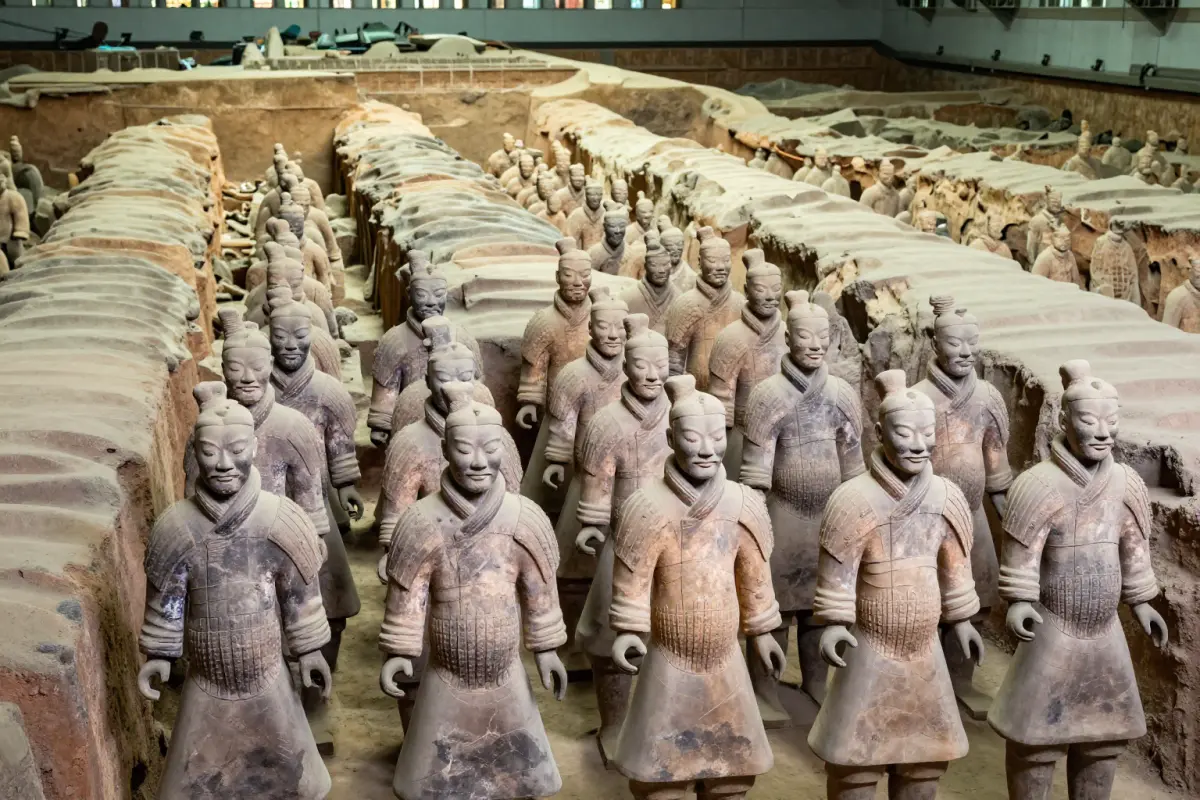
In March 1974, a group of farmers digging a well near the city of Xi’an in China’s Shaanxi province struck something hard beneath the soil. It was not water. It was a head — a life-sized clay head with an eerily individualized face, staring up at them from two thousand years of burial. The farmers had accidentally stumbled upon what would become one of the greatest archaeological discoveries of the twentieth century: the Terracotta Army, a vast subterranean force of approximately 8,000 soldiers, 130 chariots, and 670 horses, all crafted from fired clay and arranged in battle formation to guard the tomb of Emperor Qin Shi Huang, the man who unified China in 221 BCE. No two warriors are exactly alike. Each has a unique face — individualized features, expressions, hairstyles, and armor — as if a real army had been frozen in clay and buried alive. And the army may be the least of it. The emperor’s actual tomb — a vast mound reported to contain flowing rivers of liquid mercury representing China’s great waterways — has never been opened.
Before there was an army, there was an emperor. Ying Zheng was born in 259 BCE, the son of the king of Qin, one of several warring states competing for control of the Chinese heartland. By the time he was thirty-eight, Ying Zheng had conquered every rival state and proclaimed himself Qin Shi Huang — the First Emperor of a unified China. The achievements of his brief but transformative reign (221–210 BCE) are staggering: he standardized writing, currency, weights, and measures across the empire; he connected existing fortifications into the first Great Wall of China; he built an extensive network of roads and canals; and he established the administrative framework that would govern China for two millennia. He was also, by all accounts, ruthless, paranoid, and consumed by a single overriding obsession: cheating death.
As Qin Shi Huang aged, his terror of mortality grew. He dispatched expeditions to search for the mythical Isles of the Immortals in the Eastern Sea. He consulted alchemists who fed him concoctions containing cinnabar — a mercury sulfide mineral that may have gradually poisoned him. And he poured the resources of an entire empire into the construction of his mausoleum, a project that reportedly employed 700,000 workers and took nearly forty years to complete. The Terracotta Army was only one component of this vast funerary complex, which covers an area of approximately 56 square kilometers — a city of the dead designed to mirror the emperor’s capital in life.
The Terracotta Army is distributed across four pits east of the emperor’s tomb mound, arranged as if facing east — the direction from which the emperor’s conquered enemies would have come. Pit 1, the largest, measures approximately 230 meters long and 62 meters wide and contains the main infantry force — an estimated 6,000 warriors arranged in eleven columns within a vast underground gallery supported by earthen walls and wooden beams. Pit 2 contains a smaller but more diverse force of infantry, cavalry, chariots, and archers — approximately 1,400 figures. Pit 3 appears to be the army’s command headquarters, with high-ranking officers and a war chariot — only about 68 figures, but positioned as if directing the larger force in Pits 1 and 2.
And then there is Pit 4 — empty. The pit was clearly started, with the same structural framework as the others, but it was never filled. No warriors, no horses, no chariots. The most widely accepted explanation is that construction was interrupted by the emperor’s death in 210 BCE and the subsequent collapse of the Qin Dynasty. Qin Shi Huang’s successor reigned for only three years before the dynasty fell to rebellion. The workers may have been conscripted for military service or simply abandoned the project as the empire crumbled. But other theories persist: some researchers have suggested that Pit 4 was left deliberately empty, perhaps as a symbolic gesture — a reminder that no army, however vast, can truly protect against mortality itself.
Perhaps the most astonishing feature of the Terracotta Army is its individuality. No two warriors are identical. Each has a distinct face — different noses, cheekbones, ears, eyes, and expressions. Some look stern, some anxious, some calm. Scholars have identified at least ten basic face molds, but each was modified by hand — features were added, subtracted, and refined with clay tools before firing, producing the extraordinary individuality that makes the army so haunting. The warriors were built from standardized components (heads, torsos, arms, legs, hands) mass-produced in workshops, then assembled and individually customized — a modular approach that anticipated industrial manufacturing techniques by two millennia. Archaeologists have identified the names or marks of at least 87 master craftsmen stamped or scratched onto hidden surfaces of the figures, allowing researchers to track which workshops produced which warriors.
The warriors carried real bronze weapons — swords, spears, halberds, crossbow triggers — not ceremonial replicas. Many swords remain sharp enough to cut paper after 2,200 years. Some blades show traces of chromium salt coating, which researchers initially suggested was an ancient anti-corrosion treatment, though more recent studies have proposed the chromium may have come from the lacquer used on the weapon handles rather than an intentional protective layer.
When the Terracotta Army was buried, every warrior was painted in vivid, lifelike colors — pink skin, black hair, red and blue robes, green armor, and intricate decorative patterns. For over two thousand years, the paint remained intact beneath the soil. But when the warriors were exposed to air during excavation, the colors began to curl and flake off within minutes — sometimes within seconds. The sudden change in humidity and the drying of the underlying lacquer layer caused the paint to detach almost instantly. Conservators watched helplessly as brilliant reds, blues, and greens turned to gray dust before their eyes. Today, only a handful of figures retain significant traces of their original paint, and modern conservation teams use advanced techniques to stabilize the colors on newly excavated warriors before they are exposed to the air. The loss of the original paint is one of the great tragedies of modern archaeology.
The Terracotta Army, for all its magnificence, is a peripheral feature of Qin Shi Huang’s funerary complex. The emperor himself lies — presumably — beneath a vast earthen mound approximately 76 meters high, located about 1.5 kilometers west of the warrior pits. This mound has never been excavated. What lies beneath it is known only from a single ancient source: the Records of the Grand Historian by Sima Qian, written approximately a century after the emperor’s death. Sima Qian’s description is extraordinary. He wrote that the tomb contained a replica of the emperor’s palace, complete with towers, pavilions, and a ceiling inlaid with pearls and gems representing the stars and heavens. The floor featured a relief map of China’s geography, with rivers and oceans of liquid mercury mechanically circulated to mimic the flow of real waterways. Crossbow traps were rigged to fire on any intruder. Combustible minerals were used to create everlasting lamps fueled by whale oil. And after the tomb was sealed, Sima Qian wrote, the workers who had built it were sealed inside alive to ensure that its secrets would never be revealed.
In the 1980s and again in the 2000s, Chinese scientists conducted soil surveys of the tomb mound and found elevated levels of mercury — significantly higher than surrounding areas, concentrated in patterns that some researchers claimed corresponded to the locations of China’s major rivers. Ground-penetrating radar and other remote-sensing techniques have detected anomalies beneath the mound consistent with large underground chambers, but their contents remain unknown. China has consistently chosen not to excavate the main tomb, citing concerns about preservation. The lessons of the Terracotta Army — where priceless paint was lost in minutes — have made authorities deeply cautious about opening the tomb before conservation technology is adequate to protect whatever lies within.
The Terracotta Army stands in its pits today as it has for over two thousand years — rank upon rank of clay soldiers, each with a unique face, each staring eastward, waiting for an enemy that will never arrive. They were created by an emperor who conquered all of China and then tried, with equal determination, to conquer death itself. He failed. The mercury he may have ingested in pursuit of immortality likely killed him. The dynasty he founded collapsed within four years of his death. But the army he commissioned survived — silent, patient, and magnificent — buried beneath the fields of Shaanxi province until a group of farmers with a shovel brought them back to light. The greatest mystery — what lies inside the emperor’s unopened tomb — may remain unanswered for generations. But the warriors themselves are mystery enough: 8,000 individual faces, each one different, each one a person who never existed, standing guard over an emperor who wanted to live forever.
References & Further Reading
Wikipedia: Qin Shi Huang — Biography of the first emperor of unified China
📚 Recommended Reading: The Terracotta Army by John Man (on Amazon) — As an Amazon Associate, we earn from qualifying purchases.
Editorial note: The Terracotta Army is documented through decades of Chinese archaeological research, conservation science, and historical records. See our Editorial Policy.