Dead Sea Scrolls: The 2,000-Year-Old Texts That Rewrote Biblical History
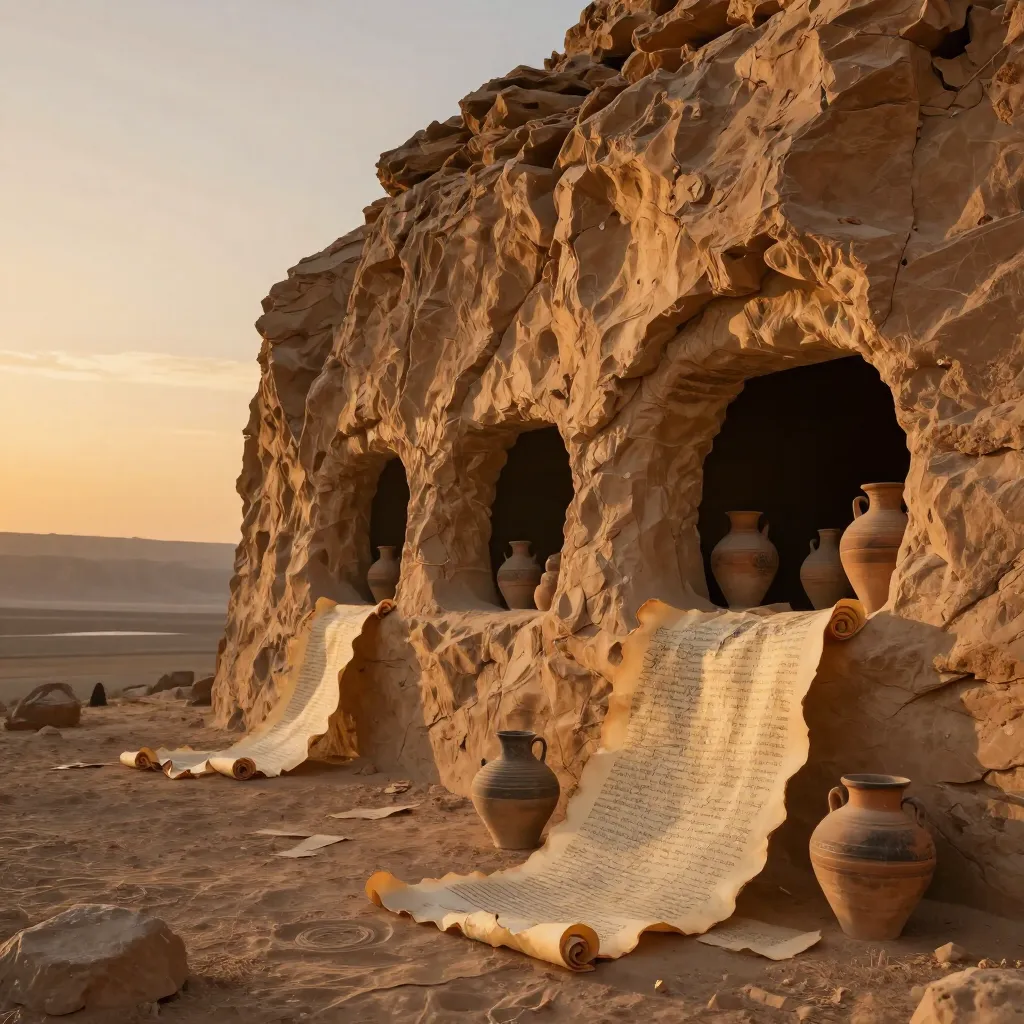
In 1946 or 1947 — the exact date remains uncertain — a young Bedouin shepherd named Muhammed edh-Dhib was tending his goats among the rugged limestone cliffs overlooking the northwestern shore of the Dead Sea, in a desolate, sun-scorched landscape near the ruins of an ancient settlement called Khirbet Qumran. According to the most widely recounted version of the story, one of his goats had wandered off, and edh-Dhib threw a stone into a small cave opening in the cliff face to encourage the animal to come out. Instead of a goat, he heard the sound of pottery shattering. Curious, he climbed into the cave — now known as Cave 1 — and found several large clay jars with lids still intact. Inside the jars were ancient scrolls of leather, wrapped in linen cloth, darkened by two millennia of desert air. He had stumbled upon what would become one of the greatest archaeological discoveries of the 20th century — perhaps of all time. Over the following decade, archaeologists and Bedouin treasure-hunters would explore a total of 11 caves in the cliffs above Qumran, recovering approximately 981 texts — including the oldest surviving manuscripts of the Hebrew Bible, previously unknown religious texts, and a mysterious copper scroll that may describe billions of dollars in hidden treasure. The Dead Sea Scrolls would fundamentally reshape our understanding of biblical history, ancient Judaism, and the origins of Christianity.
The Judean Desert where the scrolls were found is one of the most inhospitable landscapes on Earth — a rainless, furnace-hot wilderness of rock, sand, and salt, plunging from the hills of Judea down to the lowest point on the planet’s surface at the Dead Sea, approximately 1,400 feet (430 meters) below sea level. The extreme aridity of the region is precisely what preserved the scrolls for over 2,000 years: the lack of moisture prevented the animal-skin parchment from decomposing. The settlement of Qumran, located on a marl terrace about 13 miles (21 kilometers) east of Jerusalem and a mile south of the Dead Sea shore, was occupied during the Second Temple period (roughly 150 BCE to 68 CE). Most scholars believe it was inhabited by the Essenes — an ascetic Jewish sect described by the ancient historians Philo of Alexandria, Flavius Josephus, and Pliny the Elder — who lived communally, practiced rigorous ritual purity, studied scripture, and awaited an apocalyptic confrontation between the forces of good and evil. The scrolls date from approximately 250 BCE to 68 CE, a period that encompasses the rise of the Roman Empire, the reign of Herod the Great, the life of Jesus of Nazareth, and the Jewish Revolt against Rome that culminated in the destruction of the Second Temple in 70 CE.
The story of the scrolls’ discovery is itself a tale of accident, intrigue, and academic detective work. After edh-Dhib and his companions retrieved the scrolls from Cave 1, they brought them to a dealer in Bethlehem, who in turn offered them to various potential buyers. Four of the initial scrolls were purchased by Metropolitan Athanasius Yeshue Samuel of the Syrian Orthodox Church in Jerusalem, who recognized their potential antiquity but did not fully grasp their significance. The remaining three scrolls were acquired by Professor Eleazar Sukenik of the Hebrew University of Jerusalem, who confirmed their authenticity almost immediately. In 1948, as the Arab-Israeli War engulfed Palestine, Metropolitan Samuel smuggled his four scrolls to the United States, where they were authenticated by Professor William F. Albright of Johns Hopkins University — the most prominent biblical archaeologist of the era — who declared them to be of “indubitable antiquity” and dated them to approximately the 2nd century BCE. The authentication electrified the academic world. In 1949, archaeologists identified the location of Cave 1 and conducted the first formal excavation, recovering additional scroll fragments and confirming that the cave was the source of the manuscripts.
Over the following years, the search intensified. Between 1951 and 1956, an eight-kilometer strip of cliffs was thoroughly investigated by archaeologists and Bedouin searchers, yielding a total of 11 caves containing manuscripts. Of these, five were discovered by Bedouin and six by archaeologists. Cave 4, discovered by Bedouin in 1952, proved to be the richest: it contained approximately 15,000 fragments from roughly 580 manuscripts — an enormous jigsaw puzzle of ancient text that would take decades to assemble and publish. The scrolls were written in Hebrew (the majority), Aramaic, Greek, and a few texts in Nabataean. Most were written on parchment (processed animal skin), some on papyrus, and one extraordinary document — the Copper Scroll — was inscribed on thin sheets of copper. The scrolls ranged from complete, well-preserved manuscripts like the Great Isaiah Scroll to tiny, fragmentary scraps bearing only a few letters — but even the smallest fragments could contain critical textual information.
The Dead Sea Scrolls comprise approximately 981 texts discovered in 11 caves near Qumran between 1947 and 1956. The scrolls date from approximately 250 BCE to 68 CE — making them over 1,000 years older than the next-oldest known Hebrew Bible manuscripts (the Aleppo Codex, circa 920 CE). The texts include copies of every book of the Hebrew Bible except Esther. Cave 4 contained the most material: approximately 15,000 fragments from about 580 manuscripts. The Temple Scroll is the longest at 28 feet (8.6 meters). The scrolls are currently housed in the Shrine of the Book at the Israel Museum in Jerusalem. Full publication of all scroll material was not completed until 2009 — more than 60 years after the initial discovery.
The contents of the Dead Sea Scrolls are extraordinarily diverse, spanning the full spectrum of ancient Jewish religious literature. The most significant category is the biblical manuscripts — copies of every book of the Hebrew Bible except Esther. These manuscripts predate the previously oldest known Hebrew Bible texts by more than a millennium, providing an unprecedented window into the transmission of biblical scripture. The crown jewel of the collection is the Great Isaiah Scroll (1QIsaa), dated to approximately 125 BCE — the oldest complete copy of any book of the Hebrew Bible ever discovered. The Isaiah Scroll is remarkable for its close correspondence to the Masoretic Text, the standard Hebrew Bible text that was finalized centuries later. The match is not perfect — there are spelling variations, minor grammatical differences, and occasional alternative readings — but the overall fidelity of transmission over more than 1,000 years is striking, confirming that the scribes who copied the Hebrew Bible preserved the text with extraordinary care.
Beyond the biblical manuscripts, the scrolls include a wealth of texts that were previously unknown or known only from later translations. The Apocryphal and pseudepigraphal works include copies of the Book of Enoch, the Book of Jubilees, and Tobit — texts that were excluded from the canonical Hebrew Bible but were widely read in the Second Temple period. The sectarian documents — texts that appear to have been produced by the Qumran community itself — include the Community Rule (also called the Manual of Discipline), which describes the communal organization, membership requirements, and ritual practices of the group; the War Scroll (1QM), which describes an apocalyptic battle between the “Sons of Light” and the “Sons of Darkness” — a cosmic conflict involving both human armies and supernatural forces; the Thanksgiving Hymns (Hodayot), a collection of poetic prayers attributed in part to the mysterious “Teacher of Righteousness”; and the Damascus Document, which describes the community’s laws and history. The Temple Scroll (11Q19) — at 28 feet (8.6 meters) the longest scroll found — presents God’s own instructions for building and operating the Temple, in some cases offering alternative versions of biblical laws.
One of the most intriguing figures in the scrolls is the “Teacher of Righteousness” (Moreh ha-Zedek) — a priestly leader who appears in multiple texts as the founder or guiding figure of the Qumran community. The Teacher is described as having received divine revelation and as having been opposed by the “Wicked Priest” and the “Man of Lies” — figures who persecuted the Teacher and his followers. The identity of the Teacher, the Wicked Priest, and the Man of Lies has been debated for decades, with scholars proposing various historical figures from the Hasmonean period (2nd century BCE). The Teacher of Righteousness has sometimes been compared to the figure of Jesus — both were charismatic religious leaders who challenged the established order and gathered devoted followers — though the differences between the Qumran sect and early Christianity are at least as significant as the similarities.
The most tantalizing mystery in the entire collection is the Copper Scroll (3Q15), discovered in Cave 3 in 1952. Unlike every other scroll in the collection, the Copper Scroll was inscribed on thin sheets of copper rather than parchment or papyrus — a material choice that suggests its contents were considered too important to risk on perishable materials. The scroll was so oxidized and brittle when discovered that it could not be unrolled by conventional means — it was eventually cut into strips at the University of Manchester in 1955–1956. The scroll lists 64 locations where vast quantities of gold, silver, and other treasures were hidden — including precise measurements, landmarks, and descriptions of underground hiding places. The descriptions are strikingly specific: “In the ruin that is in the Valley of Achor, under the steps leading to the east, forty-two cubits beneath, lies a chest of silver and its vessels, with a total weight of seventeen talents.” The estimated total value of the described treasure, if it ever existed, has been calculated in the billions of dollars. Despite decades of searching and numerous expeditions, not a single treasure described in the Copper Scroll has ever been recovered. Some scholars believe the treasure was real and was hidden by the Jerusalem Temple authorities during the Roman siege of 70 CE. Others argue the Copper Scroll is a work of fiction or a legendary text with no basis in reality.
The question of who wrote and collected the Dead Sea Scrolls has been one of the most fiercely debated topics in biblical scholarship since the discovery. The dominant theory — held by the majority of scholars since the 1950s — is the Qumran-Essene hypothesis. According to this view, the scrolls were the library of the Essenes, an ascetic Jewish sect described by Philo, Josephus, and Pliny the Elder. Pliny specifically locates the Essenes on the western shore of the Dead Sea, “above” Ein Gedi — a description that matches the location of Qumran. The archaeological evidence from Qumran — including ritual immersion pools (mikva’ot), communal dining rooms, scribal implements, and a large cemetery of over 1,100 graves — is consistent with a communal, religiously observant community. The sectarian texts found in the caves describe a community that practiced ritual purity, studied scripture, shared meals, and awaited an apocalyptic final battle between good and evil — all features consistent with what the ancient historians tell us about the Essenes.
However, the Qumran-Essene hypothesis is not universally accepted. An alternative theory — the Jerusalem origin theory — proposes that the scrolls were part of the library of the Jerusalem Temple, smuggled out and hidden in the Qumran caves during the Roman siege of Jerusalem in 70 CE to prevent the texts from being destroyed. Proponents of this theory point out that the scrolls include texts that reflect a wide range of Jewish thought and practice, not all of which is consistent with the Essene sect’s specific beliefs. Other scholars have proposed various middle-ground positions, suggesting that the caves contained a mixture of Essene sectarian texts and manuscripts from other Jewish communities in the region. The debate remains unresolved — and it matters, because the origins of the scrolls affect how we interpret their significance for understanding the development of Judaism and Christianity.
Perhaps the most profound impact of the Dead Sea Scrolls has been on our understanding of the relationship between Judaism and Christianity. Before the scrolls’ discovery, the prevailing view was that Rabbinic Judaism (the form of Judaism that developed after the Temple’s destruction) and Christianity were two fundamentally distinct religious traditions that diverged sharply from the beginning. The scrolls revealed a far more complex picture. The Second Temple period was characterized by a remarkable diversity of Jewish thought — multiple sects, multiple interpretations of scripture, multiple messianic expectations, and multiple approaches to ritual purity, Temple worship, and the afterlife. The Qumran community practiced rituals that look remarkably like precursors to Christian practices: ritual baptism (immersion in water for purification), communal meals with blessing of bread and wine, a strong messianic expectation (the community expected not one but two — and possibly three — messiahs), and an apocalyptic worldview centered on a final judgment. These parallels do not mean that Christianity evolved directly from the Qumran community, but they demonstrate that many of the ideas and practices associated with early Christianity were part of the broader Jewish milieu of the first century BCE and CE. The scrolls have made it impossible to understand Christianity without understanding Second Temple Judaism — and they have made it impossible to understand Second Temple Judaism without recognizing its extraordinary theological diversity.
The Dead Sea Scrolls are, at their core, a library — a collection of texts carefully preserved, copied, studied, and ultimately hidden by people who lived on the edge of the known world, in a tiny settlement overlooking the salt-crusted expanse of the Dead Sea, during one of the most turbulent and consequential periods in human history. The scrolls survived for over 2,000 years in the arid caves above Qumran — outlasting the people who wrote them, the sect that preserved them, and the empires that rose and fell around them. When they emerged into the light of the 20th century, they brought with them answers to questions scholars had been asking for centuries — and new questions that no one had thought to ask. They confirmed the general reliability of the biblical text, revealed the theological richness and diversity of Second Temple Judaism, shed light on the origins of both Rabbinic Judaism and Christianity, and introduced us to the mysterious Teacher of Righteousness, the apocalyptic Sons of Light, and the Copper Scroll’s elusive treasure. The scrolls are now housed in the Shrine of the Book in Jerusalem — a building designed to look like the lids of the clay jars in which they were found — and their contents are available online through the Israel Antiquities Authority’s digital library. But their greatest significance may be this: they remind us that the texts we consider sacred, the stories we tell about our past, and the beliefs that shape our civilizations are the product of real people — living in real places, at real moments in time — who went to extraordinary lengths to preserve what they believed mattered most.
References & Further Reading
📚 Recommended Reading: The Dead Sea Scrolls by John J. Collins (on Amazon) — As an Amazon Associate, we earn from qualifying purchases.
Editorial note: The Dead Sea Scrolls are documented through the publications of the Israel Antiquities Authority, the Discoveries in the Judaean Desert series (Oxford University Press, 1955–2009), and the work of archaeologists including Roland de Vaux, Eleazar Sukenik, and Yigael Yadin. See our Editorial Policy.