The Winchester Mystery House: 38 Years of Building, Staircases to Nowhere, and a Heiress Haunted by Grief
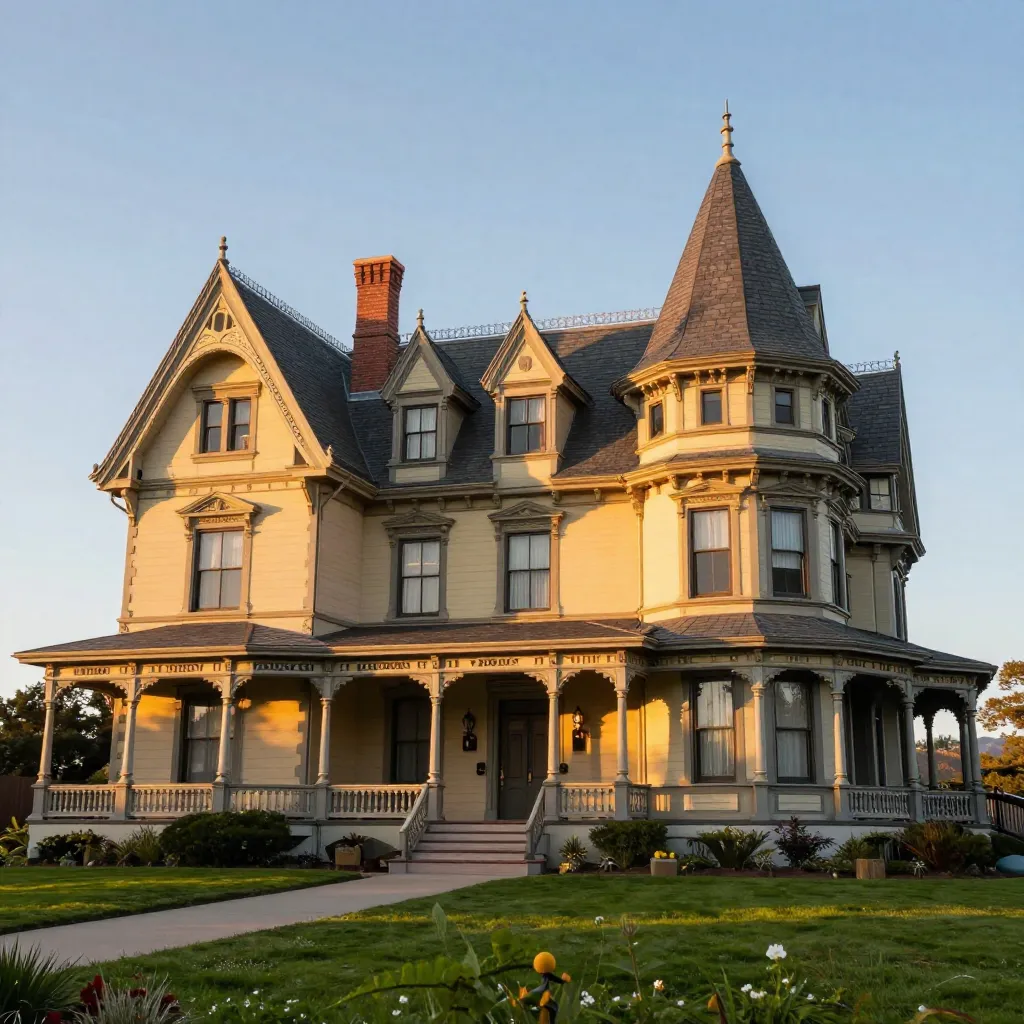
For thirty-eight years — from 1884 until her death in September 1922 — a reclusive widow named Sarah Lockwood Pardee Winchester employed a crew of carpenters who worked in shifts, twenty-four hours a day, seven days a week, three hundred and sixty-five days a year, building and rebuilding and adding onto a house that would never be finished. By the time she died, the modest eight-room farmhouse she had purchased on the outskirts of San Jose, California had metastasized into a sprawling, bewildering 160-room mansion: a labyrinth of staircases that led to ceilings, doors that opened onto three-story drops, windows set into floors, secret passages, upside-down columns, and the number 13 repeated obsessively throughout — in chandelier hooks, in bathroom tiles, in the number of steps in a staircase, in the panes of a window. The Winchester Mystery House, as it came to be known, is one of the strangest buildings in America — a monument to grief, or guilt, or madness, or something that defies easy explanation.
The story most people know goes like this: Sarah Winchester, heiress to the Winchester Repeating Arms Company fortune, was told by a Boston spiritualist medium that she was cursed — that the spirits of every person ever killed by a Winchester rifle were seeking revenge, and that they had already taken her infant daughter and her husband. The medium gave her a choice: move west, and never stop building. If the sound of hammers never ceased, the spirits would be appeased, and Sarah would live. If she stopped, she would die. Whether this story is literally true, partly true, or a complete fabrication invented after her death is one of the many debates that surround the Winchester Mystery House. What is not in dispute is the house itself — a staggeringly bizarre architectural achievement that continues to puzzle and unsettle everyone who walks its crooked hallways.
Sarah Lockwood Pardee was born around 1840 in New Haven, Connecticut, into a prosperous family. She was well-educated — she spoke four languages and attended the Young Ladies Collegiate Institute at Yale College. In September 1862, she married William Wirt Winchester, the only son of Oliver Winchester, president and principal owner of the Winchester Repeating Arms Company. The Winchester rifle was one of the most successful and lethal firearms of the nineteenth century. The company’s Model 1873 — known as “The Gun That Won the West” — was a lever-action repeating rifle capable of firing multiple rounds without reloading, giving its user a devastating advantage in combat. The Winchester rifle was widely used by settlers, lawmen, and soldiers during the American Indian Wars, and the company’s fortunes grew enormous.
Sarah and William’s marriage was marked by tragedy. On July 15, 1866, their only child, Annie Pardee Winchester, died at just six weeks old — apparently of marasmus, a form of severe malnutrition and wasting. The death devastated Sarah. She never had another child. Then, on March 7, 1881, William Wirt Winchester died of tuberculosis at the age of forty-three. In fifteen years of marriage, Sarah had lost her only daughter and her husband. She inherited roughly $20 million (equivalent to over half a billion dollars today) plus nearly 50 percent of the Winchester Repeating Arms Company’s stock and a daily income of approximately $1,000 — an astronomical sum for the era. She was one of the richest women in the world. She was also alone, childless, and consumed by grief.
According to the most widely repeated version of events, Sarah consulted a spiritualist medium in Boston sometime after her husband’s death. The medium told her that the Winchester family was cursed: the spirits of the people killed by Winchester rifles were seeking revenge, and they had already claimed her daughter and her husband as payment. There was only one way to appease the vengeful spirits: Sarah must move west and begin building a house. She must never stop. Whether or not this visit to a medium actually occurred — and many historians are skeptical, noting that the story was first popularized by the house’s tour guides and promotional materials after Sarah’s death — Sarah did indeed move to California in 1884. She purchased an unfinished eight-room farmhouse on 160 acres of land in what was then rural San Jose, and immediately began expanding it. The construction would continue without interruption for the next thirty-eight years. Sarah apparently designed the additions herself, sketching plans on paper or even drawing them in the dirt with a stick, working without an architect.
The result is a house unlike any other in America. The house’s features have become legendary: stairs to nowhere — several staircases lead directly to ceilings, ending at blank walls; doors to nowhere — multiple doors open onto sheer drops of one, two, or even three stories; windows in floors — some rooms feature glass windows set into the floor, allowing light to pass through from below; upside-down columns — several architectural columns are installed with their decorative capitals at the bottom rather than the top. The number 13 appears obsessively throughout: chandeliers with 13 bulbs, bathrooms with 13 windows, staircases with 13 steps, drain covers with 13 holes, rooms with 13 panes of glass. There is a small, windowless Séance Room where Sarah reportedly held nightly séances, with exactly one way in and one way out. Numerous secret passages and hidden corridors connect rooms throughout the house, allowing Sarah to move through the building unseen by her servants.
On April 18, 1906, the San Francisco earthquake — one of the most devastating in American history — struck the Bay Area. The Winchester House was violently shaken. The top three floors of the seven-story tower that Sarah had built at the center of the house collapsed into the garden below, and the structure was badly damaged throughout. Sarah herself was reportedly trapped in one of the rooms for several hours before being rescued. She never rebuilt the tower, and construction after 1906 seems to have shifted from outward expansion to a kind of frantic reconfiguration: walls were moved, rooms were re-routed, and the already-bewildering layout became even more convoluted. The house after 1906 took on its most surreal character, as if the earth itself had reshaped Sarah’s creation into something stranger than she had intended.
On September 5, 1922, Sarah Winchester died in her sleep at the age of 82. She had been building for thirty-eight years. What her workers found after her death was as puzzling as the house itself: the mansion contained 160 rooms, including 40 bedrooms, two ballrooms (one completed, one unfinished), 47 fireplaces, 17 chimneys (some non-functional), two basements, three elevators, and a bewildering array of incomplete rooms, sealed passages, and architectural dead ends. But alongside the bizarre features were signs of a woman who was not simply mad. The house had modern conveniences that were years ahead of their time: push-button gas lights, a refrigeration system, elevators, and an elaborate plumbing system. Many of the “odd” features may have had practical purposes — secret passages for privacy, multiple staircases for efficient movement through a large building, and a heavily segmented layout that allowed Sarah to control exactly who went where.
The question that has haunted the Winchester Mystery House since Sarah’s death is simple: why did she build? The supernatural explanation — that she was appeasing vengeful spirits on the orders of a medium — is the most dramatic but the least supported by evidence. There is no contemporary record of Sarah visiting a medium or of her believing herself to be cursed. The “curse” narrative appears to have been developed by the investors who purchased the house after Sarah’s death and opened it to tourists in 1923, apparently as a marketing strategy. More prosaic explanations include grief — building gave her a purpose, a project, a reason to get out of bed every morning, a monument to loss that could never be completed because the wound could never heal; architectural experimentation — Sarah was a wealthy, intelligent woman with no formal training in architecture but an apparently genuine interest in design, and the house may represent decades of playful, uninhibited experimentation unconstrained by budget or deadline; compulsive behavior — some modern psychologists have suggested that Sarah may have suffered from obsessive-compulsive disorder, and that the repetitive construction was a manifestation of compulsive behavior patterns; and privacy and control — the house’s labyrinthine layout, secret passages, and controlled access points suggest a woman who valued privacy above all else.
After Sarah Winchester’s death, the house was sold at auction to a group of investors who opened it to the public as a tourist attraction in 1923. It has been open to visitors ever since, drawing millions of tourists who come to marvel at its oddities. The house was designated a California Historical Landmark in 1925 and was added to the National Register of Historic Places in 1974. Today, the Winchester Mystery House offers multiple tour experiences and remains one of the most popular tourist attractions in the San Francisco Bay Area. It was the subject of the 2018 horror film “Winchester” starring Helen Mirren as Sarah.
The Winchester Mystery House is a Rorschach test in architectural form. Look at it one way and you see the work of a madwoman — stairs to nowhere, doors to nowhere, a house that devoured thirty-eight years of construction and was never finished. Look at it another way and you see something deeply, painfully human: a woman who lost everything that mattered to her and responded by creating — endlessly, compulsively, without a plan but with absolute determination. Sarah Winchester never explained why she built. She never justified, never rationalized, never told her story. She simply built — room after room, year after year, until death finally stopped her. The house stands today as both a California Historical Landmark and one of the most compelling mysteries in American architecture. The hammers stopped in September 1922. The mystery they left behind will never be finished.
References & Further Reading
Winchester Mystery House: Official History — The house's own historical account and timeline
Britannica: Winchester Mystery House — Authoritative encyclopedia entry on the mansion and its owner
📚 Recommended Reading: Captive of the Labyrinth: Sarah L. Winchester, Heiress to the Rifle Fortune by Mary Jo Ignoffo (on Amazon) — As an Amazon Associate, we earn from qualifying purchases.
Editorial note: historical interpretations of Sarah Winchester's motivations continue to evolve as new research emerges. See our Editorial Policy.