The Mystery of the Mary Celeste: History's Most Famous Ghost Ship
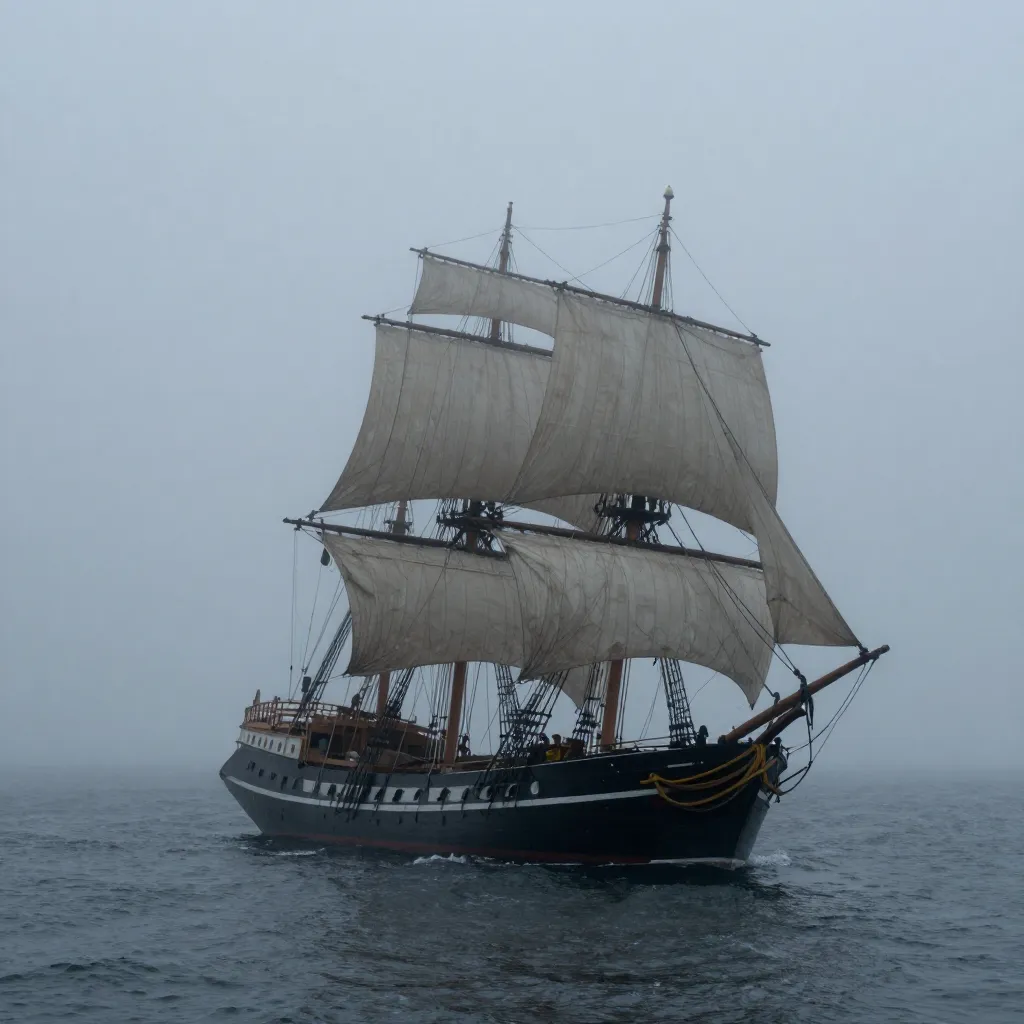
The Mary Celeste as she may have appeared when found adrift in December 1872 — seaworthy, fully provisioned, and completely abandoned.
On December 5, 1872, roughly 400 miles east of the Azores Islands in the middle of the Atlantic Ocean, the crew of the Canadian brigantine Dei Gratia spotted a ship drifting erratically under partial sail. As they drew closer, they recognized her as the Mary Celeste, an American-registered merchant brigantine that had departed New York Harbor nearly a month earlier bound for Genoa, Italy, with a cargo of industrial alcohol. Captain David Morehouse of the Dei Gratia hailed the vessel repeatedly. There was no response. He sent a boarding party across. What they found has haunted the maritime imagination for over 150 years. The Mary Celeste was completely abandoned. The ship was seaworthy. The cargo of 1,701 barrels of denatured alcohol was virtually intact. Six months' worth of provisions remained in the galley. The crew's personal belongings were neatly stowed. A half-eaten meal sat in the captain's cabin. The ship's papers and the captain's logbook were still on board, the last entry dated November 25, 1872. The only lifeboat was gone. And every single person aboard — Captain Benjamin Briggs, his wife Sarah, their two-year-old daughter Sophia, and seven crew members — had vanished without a trace. No bodies were ever found. No distress signal was ever received. The lifeboat was never recovered. The Mary Celeste had become, in the words of one nineteenth-century commentator, "the most famous ghost ship in the world" — a title it holds to this day.
The mystery of the Mary Celeste is not just a maritime puzzle. It is a foundational myth of the sea — a story that has inspired novels, films, conspiracy theories, and more than a century of fevered speculation. It has been linked to everything from mutiny and murder to giant squids, waterspouts, and paranormal phenomena. The reality, as is so often the case, is both more mundane and more puzzling than the legends suggest. Modern research has narrowed the most likely explanations to a handful of plausible scenarios, but the absence of definitive evidence means that the case can never be closed. The Mary Celeste remains what it has always been: a perfect mystery — a ship in perfect condition, found empty in the middle of the ocean, with no one aboard to explain why.
The Discovery: A Ghost Ship in the Atlantic
The Dei Gratia, under Captain David Morehouse, had departed New York on November 15, 1872, eight days after the Mary Celeste, bound for Gibraltar with a cargo of petroleum. Both ships were following roughly the same transatlantic route. On the afternoon of December 5, the Dei Gratia's helmsman spotted a vessel about six miles distant, sailing erratically and yawing as if no one was at the helm. As the Dei Gratia approached, Captain Morehouse recognized the Mary Celeste — he knew Benjamin Briggs personally and was aware that both ships were headed eastward across the Atlantic.
Morehouse dispatched his first mate, Oliver Deveau, and two crewmen to board the Mary Celeste. What they found was deeply unsettling. The ship was under partial sail, with several sails torn or missing and others improperly set. The forecastle hatch had been blown off and was found lying on deck. About three and a half feet of water sloshed in the hold — more than normal but not enough to endanger a sound vessel. The ship's pump had been disassembled, suggesting someone had been trying to deal with the water. In the captain's cabin, the boarding party found the logbook, the ship's register, and other papers. The last log entry was dated November 25, 1872, placing the Mary Celeste near the island of Santa Maria in the Azores — meaning the ship had drifted unmanned for approximately ten days and 500 miles before being found. The captain's chronometer, compass, and sextant were present. The cargo was intact. The food and water supplies were ample. But the lifeboat was gone, and so was everyone on board.
🚢 Captain Benjamin Briggs: A Model Mariner
Benjamin Spooner Briggs was not a careless or inexperienced captain. He was 37 years old, a devout Christian from a respected Massachusetts seafaring family, and had commanded three previous vessels without incident. He was known in maritime circles as a competent, sober, and reliable master. For the Mary Celeste voyage, he had handpicked his crew of seven, including his nephew Albert Richardson as first mate. Briggs's decision to bring his wife Sarah and their two-year-old daughter Sophia on the voyage was not unusual for the era — captains frequently brought their families on long voyages, and Briggs had previously taken Sarah to sea. The Briggs family was by all accounts happy and financially secure. Benjamin had invested heavily in the Mary Celeste's cargo, personally owning a share of the alcohol shipment. He had every reason to want the voyage to succeed — and no known reason to abandon his ship voluntarily. The disappearance of a man this competent, together with his entire family and crew, is what elevated the Mary Celeste from a routine maritime incident to a legend that endures alongside the Flying Dutchman and the vanishing ships of the Bermuda Triangle.
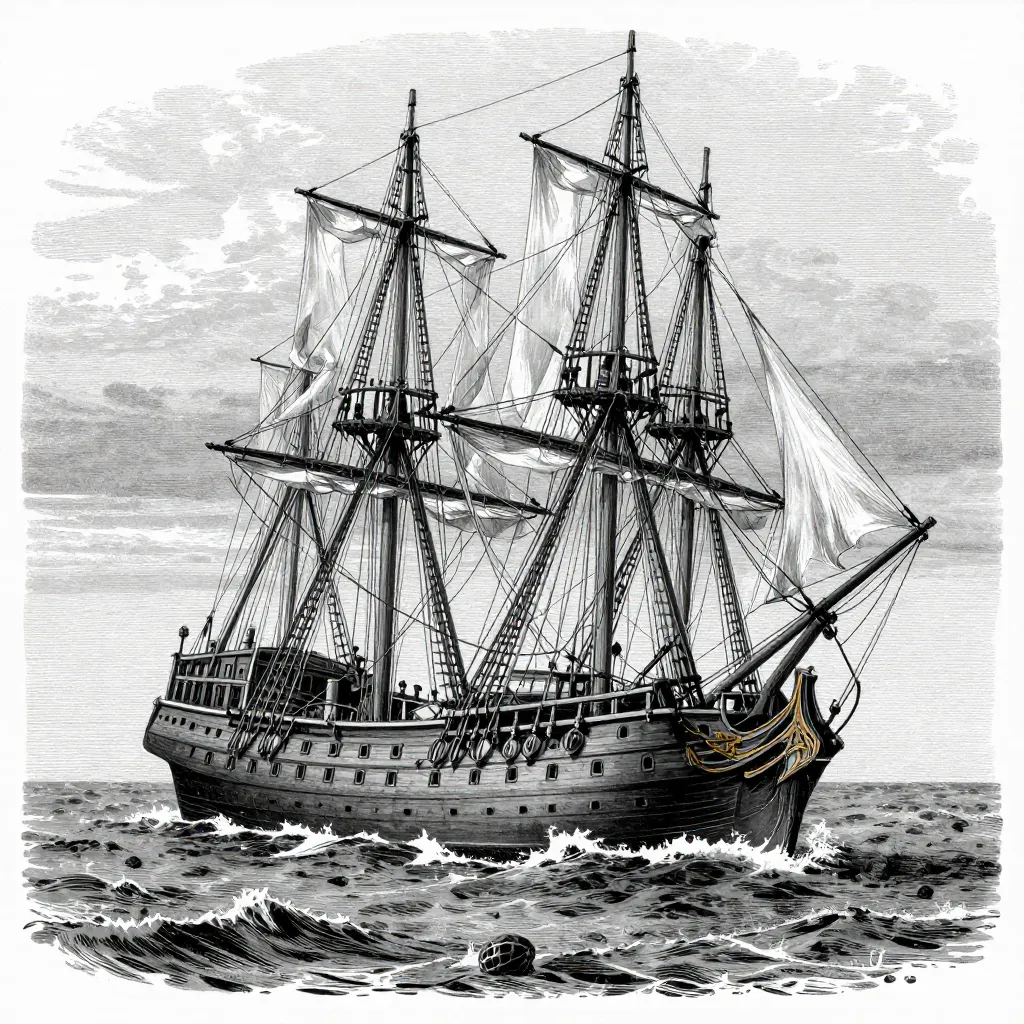
A 19th-century illustration depicts the Mary Celeste as she was found — abandoned, adrift, and eerily silent on the open Atlantic.
The Investigation: Suspicion and Salvage at Gibraltar
When the Dei Gratia arrived at Gibraltar on December 12, 1872, with the Mary Celeste in tow, the case immediately attracted official attention. Under maritime law, the crew of the Dei Gratia was entitled to a salvage award for recovering the derelict vessel and its cargo, but the circumstances of the abandonment were so unusual that a formal investigation was launched by the Virny Gatty Maritime Court of Gibraltar. The hearing was conducted by the Attorney General of Gibraltar, Frederick Solly-Flood, a man whose suspicions would shape the public narrative of the Mary Celeste for decades to come.
Solly-Flood was convinced that foul play was involved. He noted that the ship appeared to have been abandoned in haste, that certain items (including the captain's navigation instruments and the ship's flag) appeared to have been removed rather than lost, and that the Mary Celeste's cargo — denatured alcohol, a highly flammable substance — could have been the motive for a crime. He ordered a thorough inspection of the vessel, including the cargo hold, and had divers examine the hull below the waterline. The divers found no evidence of collision, grounding, or deliberate scuttling. The inspection of the cargo revealed that nine of the 1,701 barrels were empty, but the remaining barrels were intact and properly stowed. There was no evidence of fire, explosion, or violence. Despite Solly-Flood's suspicions, the investigation produced no evidence of criminal activity, and the salvage award was eventually paid to the Dei Gratia's crew — though at a reduced rate, reflecting the court's lingering unease.
The Most Plausible Theories
In the century and a half since the Mary Celeste was found, dozens of theories have been proposed to explain the disappearance. The most credible modern explanations include:
- Fear of alcohol explosion — The most widely supported theory, first proposed by a contemporary investigator and later developed by modern researchers. The nine empty barrels in the cargo hold were made of red oak, which is more porous than white oak and more likely to leak. If these barrels had been leaking denatured alcohol fumes into the hold, the crew may have smelled the vapor and feared an imminent explosion. Captain Briggs, traveling with his wife and young daughter, may have decided that the risk was too great and ordered an orderly evacuation to the lifeboat, intending to trail behind the ship at a safe distance until the danger passed. If the lifeboat's towline broke or the weather turned, the occupants could have been lost at sea while the Mary Celeste sailed on without them.
- Waterspout or seaquake — A sudden waterspout or undersea earthquake could have alarmed the crew and caused them to abandon ship in panic. A waterspout could explain the blown-off hatch and the water in the hold, though it would not explain why the crew failed to return to the vessel afterward.
- Piracy or mutiny — While popular in fictional retellings, these theories are poorly supported by the evidence. The cargo was untouched, the crew's valuables were still aboard, and there were no signs of violence on the ship. Pirates would have taken the valuable alcohol; mutineers would have used the ship rather than abandoning it.
- Insurance fraud — Some investigators suspected that Briggs or the ship's owners had deliberately staged the abandonment to collect insurance. However, the Mary Celeste was under-insured, and Briggs had invested his own money in the cargo — making fraud an unlikely motive.
📝 Arthur Conan Doyle and the Fiction That Became "Fact"
In 1884, twelve years after the real Mary Celeste was found, a young writer named Arthur Conan Doyle published a short story called "J. Habakuk Jephson's Statement" in the literary magazine Cornhill Magazine. The story, presented as a first-person account by a survivor of the Marie Celeste (Doyle slightly altered the name), described a ship found abandoned in the Atlantic after its crew had been murdered by a fanatical African tribesman seeking revenge for the slave trade. The story was so vivid and so convincing that many readers took it for fact, and elements of Doyle's fictional account — including the idea that the ship's chronometer was found running, that the crew's belongings were untouched, and that the ship showed signs of violence — became permanently entangled with the real historical record. Doyle himself later expressed amusement at how widely his fiction had been believed. The confusion he caused illustrates a broader truth about the Mary Celeste: the line between fact and legend was blurred almost from the beginning, and the mystery has been shaped as much by storytellers as by historians — much as the legends surrounding the Titanic or the Salem Witch Trials have been refracted through centuries of retelling.
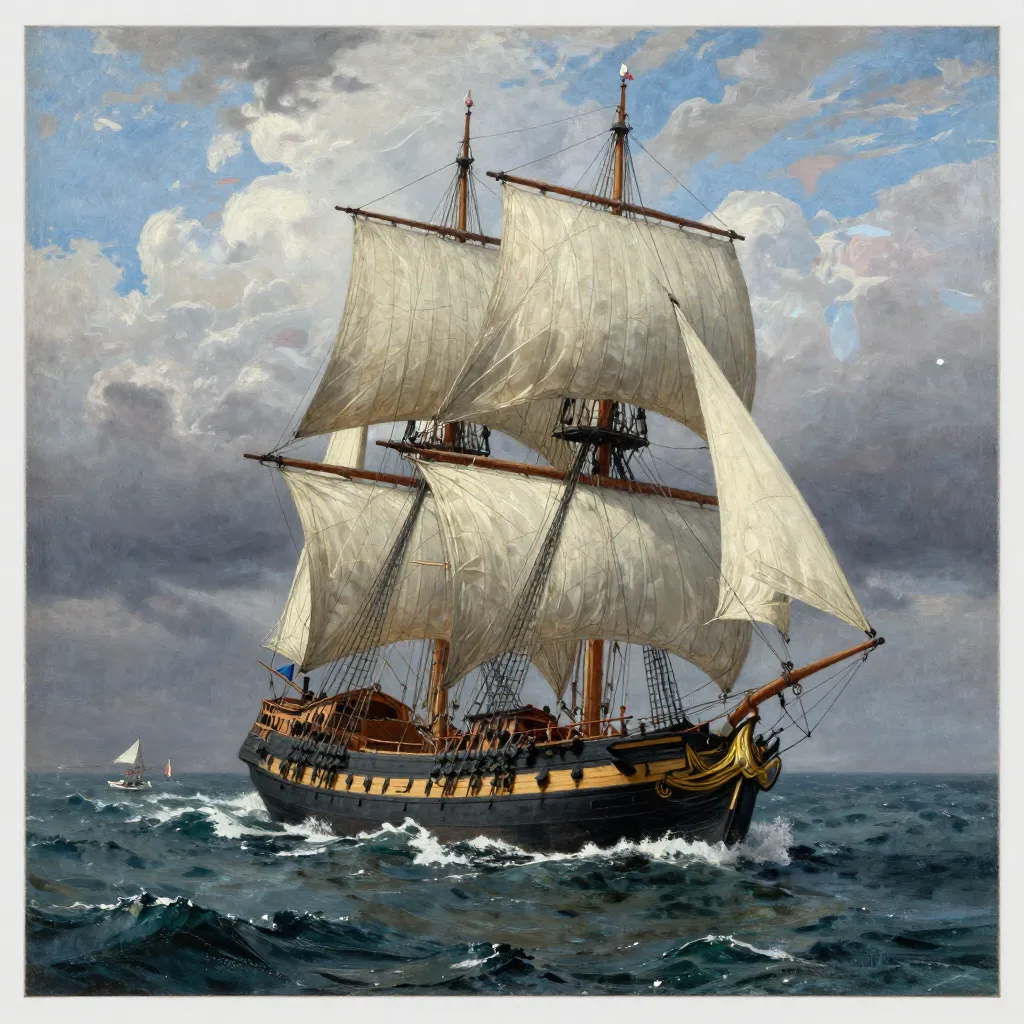
A brigantine like the Mary Celeste under full sail. The ship was built in 1861 and originally named the Amazon.
The Fate of the Ship and the Enduring Mystery
The Mary Celeste herself did not long survive her moment of fame. After the salvage hearing, the ship was returned to her owners and sold to a series of subsequent owners. Over the next thirteen years, she passed through at least seventeen different hands — a pattern of rapid resale that suggests the ship had acquired an undesirable reputation. Her later voyages were unremarkable and largely unsuccessful. In 1885, the Mary Celeste's last owner, gilman C. Parker, deliberately ran the ship aground on the Reef of Rochelais off the coast of Haiti as part of an insurance fraud scheme. The ship was wrecked beyond repair. Parker was prosecuted for fraud but was eventually acquitted — the judge concluding that the ship was not worth the insurance value claimed. The Mary Celeste, already famous as the ghost ship of the Atlantic, ended her life as a deliberate wreck on a Caribbean reef — an ignominious fate for a vessel whose name had become synonymous with maritime mystery.
The fate of Captain Briggs, his family, and his crew remains unknown. No trace of the lifeboat, the crew, or their belongings has ever been found. The ten people who vanished from the Mary Celeste joined the ranks of the lost at sea — a category that, in the nineteenth century, included thousands of sailors every year. What makes the Mary Celeste unique is not that people disappeared at sea, but that the ship they left behind was found in such perfect condition. If the vessel had sunk, or burned, or been found ransacked, the case would have attracted little attention. It is the normality of the abandoned ship — the half-eaten meal, the neatly stowed belongings, the intact cargo — that has made the Mary Celeste an enduring puzzle, comparable to the Flannan Isle lighthouse keepers who vanished from a fully functioning lighthouse, or the Lost Colony of Roanoke that disappeared from an intact settlement.
🚩 Other Ghost Ships of History
The Mary Celeste is the most famous ghost ship, but she is far from the only one. Maritime history is filled with vessels found abandoned under mysterious circumstances. In 1947, the Holmesdale was found adrift in the Pacific with no one aboard and no sign of her crew. In 1955, the Joyita, a fishing boat carrying 25 people, was found drifting in the South Pacific, partially submerged but with no one on board. In 2006, the Beln-2, a catamaran, was found off the coast of Australia with the engine running, the GPS operating, food on the table, and life jackets still stowed — but no crew. In 2007, the Kaz II, a yacht found drifting off the Great Barrier Reef, earned the nickname "the Mary Celeste of the 21st century" when investigators discovered the same eerie scene: engine running, sails up, laptop computer turned on, and no people. These cases share a common pattern — a vessel in good condition, abandoned without explanation, with no trace of the occupants. Like the enigmatic Dead Sea Scrolls that revealed a hidden world, or the endlessly rebuilt rooms of the Winchester Mystery House that concealed their own logic, the ghost ships of history remind us that the sea keeps its secrets well — and that some disappearances can never be explained.
The Greatest Mystery the Sea Has Never Told
The Mary Celeste is not the most tragic maritime disaster in history, nor the most important. What makes her story endure is its elegant incompleteness. A ship found floating in the Atlantic, seaworthy and well-provisioned, with no one aboard. A captain's logbook that ends in the middle of a routine entry. A missing lifeboat that suggests an orderly departure. Nine empty barrels of alcohol in the hold that suggest a reason for fear. And beyond these facts — nothing. No bodies, no witnesses, no distress signals, no confession. The most likely explanation remains the simplest: that Captain Briggs smelled alcohol fumes, feared an explosion, and ordered his family and crew into the lifeboat to wait at a safe distance while the danger passed. The towline broke, or the weather turned, or the lifeboat was swamped, and ten people were lost in the vastness of the Atlantic Ocean while their ship sailed on without them. It is a scenario that is plausible, comprehensible, and deeply sad — a story of a careful man who made a reasonable decision that cost him everything. But "most likely" is not the same as "certain," and the Mary Celeste has never offered certainty. She offers only questions, carved into the silence of a ship that was found full of everything except the people who mattered. She remains the greatest ghost ship in history — not because the answer is unknowable, but because the question is so perfectly, hauntingly, beautifully unanswerable.
Frequently Asked Questions
What was the Mary Celeste?
The Mary Celeste was an American-registered merchant brigantine, originally built in Spencer's Island, Nova Scotia, in 1861 under the name Amazon. She was a two-masted sailing vessel of approximately 282 gross tons. On November 7, 1872, under the command of Captain Benjamin Briggs, she departed New York Harbor bound for Genoa, Italy, carrying a cargo of 1,701 barrels of denatured industrial alcohol. She was found abandoned at sea on December 5, 1872, approximately 400 miles east of the Azores.
Who was on board the Mary Celeste?
The Mary Celeste carried ten people: Captain Benjamin Briggs (37), his wife Sarah Briggs, their two-year-old daughter Sophia Briggs, and a crew of seven men including first mate Albert Richardson (Briggs's nephew). All ten vanished. No trace of any of them has ever been found.
Was the Mary Celeste ever found?
The ship was found abandoned but intact by the crew of the Dei Gratia on December 5, 1872. The vessel was towed to Gibraltar, where a maritime court investigated the abandonment. The ship was subsequently returned to her owners and sold to a series of new owners. In 1885, the last owner deliberately wrecked the Mary Celeste on a reef off Haiti as part of an insurance fraud scheme. The crew and passengers were never found.
What is the most likely explanation for the Mary Celeste mystery?
The most widely supported theory among modern historians is that the crew abandoned ship due to fear of an alcohol explosion. Nine of the 1,701 barrels of denatured alcohol in the cargo hold were found empty, suggesting that some barrels had leaked. The resulting fumes may have caused Captain Briggs to fear that the cargo was about to ignite. He may have ordered an orderly evacuation to the lifeboat, planning to trail behind the ship at a safe distance until the danger passed. If the lifeboat's towline parted or weather conditions worsened, the lifeboat and its occupants could have been lost at sea while the Mary Celeste continued to drift eastward on its own.
📖 Recommended Reading
Want to learn more? Check out The Ghost of the Mary Celeste by Valerie Martin on Amazon for a deeper dive into this fascinating topic. (As an Amazon Associate, we earn from qualifying purchases.)
References & Further Reading
- Wikipedia: Mary Celeste — Comprehensive article covering the ship's history, abandonment, investigation, and legacy
- Wikipedia: J. Habakuk Jephson's Statement — Arthur Conan Doyle's fictional account that shaped public perception of the mystery
- Wikipedia: David Morehouse — The captain of the Dei Gratia who discovered the abandoned Mary Celeste
- Wikipedia: Ghost Ship — Overview of abandoned vessels found at sea throughout maritime history
- All That's Interesting: Mary Celeste, The Ghost Ship Found Abandoned in the Atlantic — Detailed narrative account with contemporary illustrations and photographs
- Wikipedia: Brigantine — Technical description of the vessel type used by the Mary Celeste
Editorial note: reconstructions are continuously revised as imaging and inscription studies improve. See our Editorial Policy.