The Fall of the Minoans: How Earth's Biggest Eruption Toppled a Civilization
In the glittering Aegean world of the second millennium BCE, one civilization stood above all others. The Minoans — named by modern archaeologists after the legendary King Minos of Crete — built Europe’s first advanced urban society. They constructed vast palaces with running water and flush toilets, painted radiant frescoes of acrobats leaping over charging bulls, sailed the Mediterranean in ships laden with olive oil, wine, and saffron, and developed not one but two writing systems. Their island of Crete was a hub of trade and culture, a maritime empire whose influence stretched from the Levant to the Iberian Peninsula. And then, somewhere around 1450 BCE, it all fell apart. Palaces burned. Trade networks collapsed. The writing on the tablets changed from undeciphered Linear A to the Greek-language Linear B. The Minoan world was swallowed by the Mycenaean one, and one of the most spectacular civilizations of the ancient Mediterranean simply vanished — leaving behind ruins, legends, and a mystery that has consumed archaeologists for over a century.
The collapse of Minoan civilization is not a single event but a cascade of catastrophes — volcanic, seismic, political, and possibly climatic — that unfolded over roughly a century and a half. At its heart lies one of the most violent geological events in human history: the Minoan eruption of Thera (modern Santorini), a volcanic explosion so enormous that it ejected between 28 and 41 cubic kilometers of rock into the atmosphere, generated tsunamis that crashed across the Aegean, and may have darkened skies as far away as China and Egypt. But was Thera alone enough to destroy a civilization? Or was the eruption merely the first blow in a series of disasters — earthquakes, Mycenaean invasions, agricultural failure, and internal political decay — that together brought down Europe’s first great society?
The Minoan civilization emerged on Crete around 3100 BCE and reached its cultural zenith between 2000 and 1600 BCE, during what archaeologists call the Protopalatial and Neopalatial periods. The island’s fertile plains, mild climate, and strategic position in the center of the eastern Mediterranean made it a natural crossroads for trade between Egypt, the Levant, Anatolia, and mainland Greece. The Minoans exploited this position to build what was essentially a thalassocracy — a sea empire — controlling maritime trade routes throughout the Aegean and beyond. At the heart of Minoan society were the palace centers: vast architectural complexes that served as administrative hubs, religious centers, storage facilities, and ceremonial spaces. The largest and most famous was Knossos, excavated by the British archaeologist Sir Arthur Evans beginning in 1900. Knossos covered approximately 20,000 square meters and contained hundreds of rooms connected by a labyrinthine network of corridors — a layout that may have inspired the ancient Greek myth of the Labyrinth and the man-eating Minotaur. Other major palaces included Phaistos in southern Crete, Malia on the northern coast, and Zakros on the eastern tip of the island.
The Minoans were extraordinary engineers. The palace at Knossos featured a plumbing system that would not be equaled in Europe for over three thousand years: terracotta pipes carried clean water into the complex, and a network of stone drains carried wastewater out. Some rooms had what appear to be flush toilets. The palaces were multistory buildings with light wells, staircases, and painted columns that tapered downward — a distinctive Minoan architectural feature. The Minoans developed Linear A, a still-undeciphered writing system used for administrative records, and later Linear B, which was adapted from Linear A to write an early form of Greek. Their art — bull-leapers, dolphins, saffron gatherers, blue monkeys — is among the most vibrant and naturalistic of any ancient culture, conveying a sense of joy and movement that feels startlingly modern. Among the most iconic images are the bull-leaping frescoes discovered at Knossos, depicting young athletes grasping a charging bull by the horns and vaulting over its back. Whether these frescoes represent an actual sport, a religious ritual, or a mythological narrative is debated, but the bull occupied a central place in Minoan religion and culture. The connection between the Minoan bull cult and the later Greek myth of Theseus and the Minotaur is one of the most tantalizing links between archaeology and mythology in the ancient world.
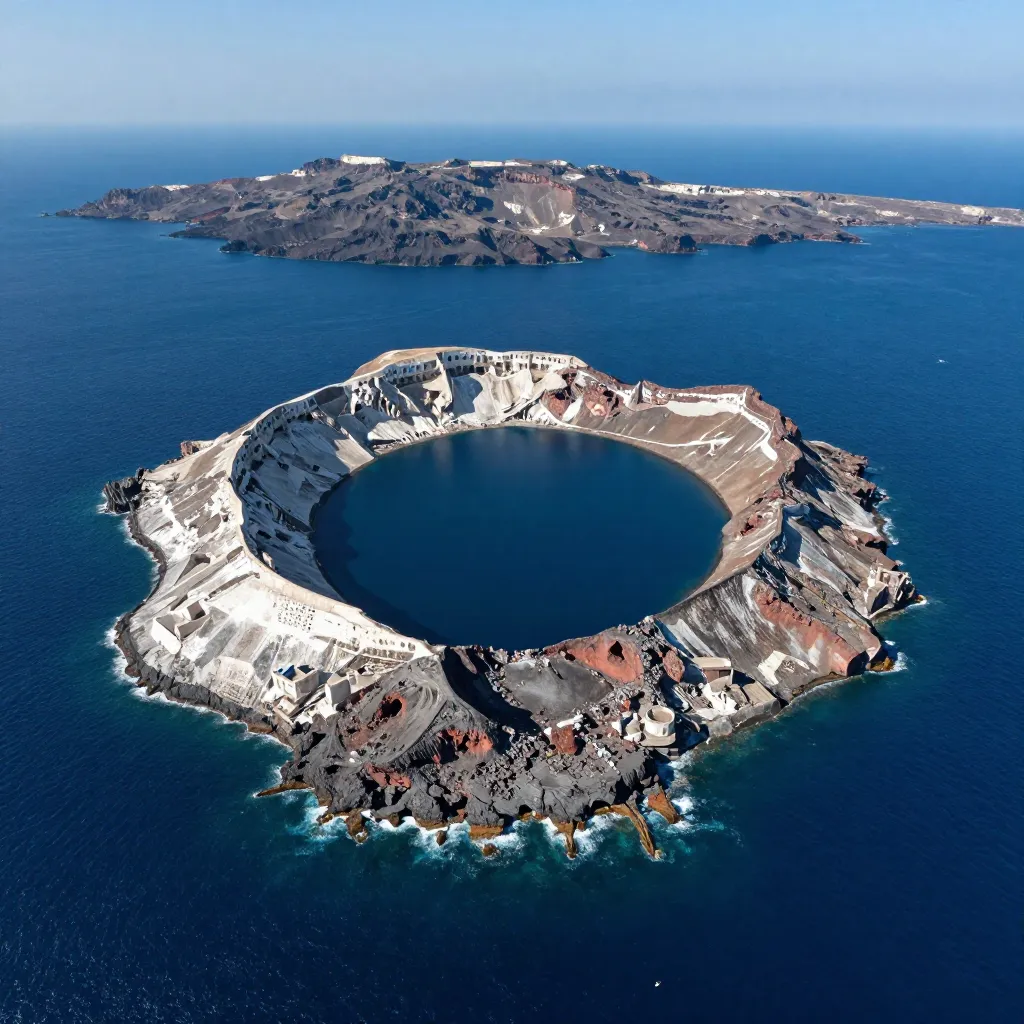
Sometime around 1600 BCE — the exact date remains one of the most contested questions in Aegean archaeology — the volcano on the island of Thera erupted with a violence that is difficult to comprehend. With a Volcanic Explosivity Index of 7, the Minoan eruption was one of the largest volcanic events in the last 10,000 years. It ejected between 28 and 41 cubic kilometers of dense rock equivalent into the atmosphere — roughly four times the volume of the 1883 Krakatoa eruption. The eruption column may have reached 36 kilometers into the stratosphere. Pyroclastic flows — incandescent avalanches of superheated gas, ash, and rock at temperatures exceeding 300 degrees Celsius — swept across Thera at hurricane speeds, burying the Minoan town of Akrotiri under meters of volcanic debris. The eruption devastated the island completely, collapsing its central caldera and leaving only a crescent-shaped ring of land surrounding a deep, volcanic bay.
But the destruction did not end with the ash. The eruption generated massive tsunamis that radiated outward across the Aegean. Crete, lying just 110 kilometers to the south, would have been struck by waves estimated at between 7 and 15 meters high — sufficient to destroy coastal settlements, devastate the Minoan fleet, and inundate low-lying agricultural land with saltwater. Computer models developed by marine geologists suggest that the collapse of the Thera caldera into the sea would have produced waves reaching Crete’s northern coast within 30 to 45 minutes of the eruption. Recent geological studies have identified tsunami deposits at several coastal sites on Crete, including deposits of marine sand, shells, and volcanic pumice found well inland — physical evidence that the waves were real and that they reached far enough to cause serious damage. The destruction of the Minoan merchant fleet would have been particularly catastrophic: the Minoan economy was built on maritime trade, and the loss of ships, harbors, and coastal warehouses would have severed the commercial arteries that kept the civilization alive.
The town of Akrotiri on Thera, buried and preserved by the eruption, is one of the most extraordinary archaeological sites in the world. Often called the “Minoan Pompeii,” Akrotiri was a prosperous settlement with multi-story buildings, elaborate frescoes, and an advanced drainage system. The ash preserved buildings up to three stories tall, with furniture, pottery, and food stores still in place. Remarkably, no human remains have been found at Akrotiri, suggesting that the population was evacuated before the final catastrophic phase of the eruption — a testament to either early warning signs or a series of precursor earthquakes that gave residents time to flee. The destruction of Thera and the collapse of Minoan civilization have long been proposed as the historical basis for Plato’s legend of Atlantis. In his dialogues Timaeus and Critias, written around 360 BCE, Plato described a great island civilization that was destroyed in “a single day and night of misfortune” by earthquakes and floods. The parallels with Thera are suggestive: a powerful island civilization, destroyed by a catastrophic eruption and inundation. The Greek archaeologist Spyridon Marinatos first proposed the Thera-Atlantis connection in the 1930s. However, the theory faces significant objections: Plato placed Atlantis beyond the Pillars of Hercules, not in the Aegean; he described it as existing 9,000 years before his time, not 1,200. Most scholars consider the Atlantis connection speculative but acknowledge that the Thera eruption may have contributed elements to Plato’s philosophical allegory.
The most important fact about the end of Minoan civilization is that it did not end with the Thera eruption. The eruption occurred around 1600 BCE, but the final destruction of the Minoan palaces and the takeover of Crete by the Mycenaeans did not occur until roughly 1450 BCE — a gap of approximately 150 years. During that century and a half, the Minoans rebuilt damaged palaces, continued trading, and maintained their cultural identity. The eruption was not a single hammer blow that obliterated Minoan civilization overnight. It was, at most, the first of several crises that collectively weakened the civilization until it could no longer resist external pressure. The eruption was followed by massive seismic activity, with multiple earthquakes striking Crete in the decades after the eruption, damaging palaces and infrastructure. Ash fall, saltwater inundation from tsunamis, and potential climate cooling would have reduced crop yields, weakened the economy, and strained the palace-based redistribution system.
Then came the Mycenaean encroachment. Mainland Greek warriors, speakers of an early form of Greek, gradually gained influence on Crete between approximately 1500 and 1450 BCE. The evidence is linguistic and administrative: Linear B tablets appear at Knossos, indicating that Greek-speaking administrators were running the palace. The Minoans’ own writing system, Linear A, has never been deciphered and represents a language that is not Greek and has no known living relatives. The appearance of Linear B at Knossos represents not just an administrative change but a cultural one: the Minoan world was being absorbed into the Mycenaean one. This was not necessarily a violent conquest. It may have been a gradual process of economic infiltration, political alliance, and elite adoption — more like a corporate merger than a military invasion. But the result was the same: by approximately 1450 BCE, the distinctive Minoan culture that had flourished for over 1,500 years had effectively ceased to exist as an independent civilization.
The fall of Minoan civilization is a case study in the vulnerability of complex societies to cascading disruptions. The Minoans built a civilization of extraordinary sophistication — palaces, writing, international trade, specialized artisanship, and a centralized administrative system that managed the production and distribution of food, oil, and manufactured goods across the island. But that very complexity created fragility. The palace system was the Minoan economy; when the palaces were damaged by earthquakes and tsunamis, the redistribution networks that fed the population broke down. The maritime trade routes were the Minoan lifeline; when the fleet was destroyed and harbors damaged, the flow of goods, raw materials, and wealth from abroad stopped. The centralized political authority was the Minoan glue; when crises eroded faith in the elite’s ability to manage disasters, the social contract that held the system together weakened. These patterns — overdependence on centralized systems, vulnerability of trade networks, erosion of institutional authority during prolonged crises — are not unique to the Bronze Age. They are recurring themes in the collapse of complex societies throughout history. The Minoans built the first great civilization in Europe. The earth, eventually, took it back.
References & Further Reading
📚 Recommended Reading: Fire in the Sea: The Santorini Volcano by Walter L. Friedrich (on Amazon) — As an Amazon Associate, we earn from qualifying purchases.
Editorial note: reconstructions are continuously revised as imaging and inscription studies improve. See our Editorial Policy.