Pompeii: The City Frozen in Ash for 1,700 Years That Changed How We See Ancient Rome
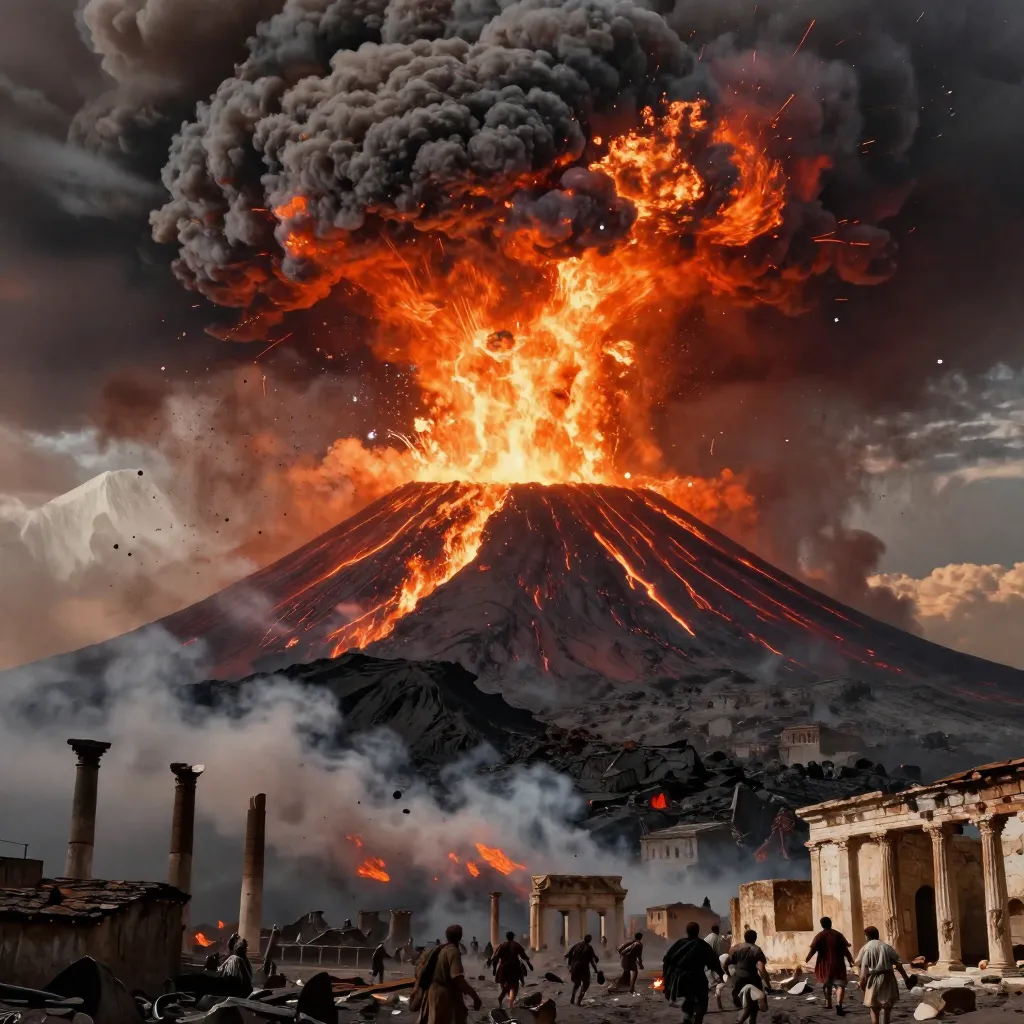
On a summer morning in the year 79 CE, the residents of Pompeii went about their business with no idea that the mountain looming over their city was about to destroy them. Bakeries loaded bread into their ovens. A landlord painted a fresco on his garden wall. Merchants haggled in the forum. Children played in the streets. Somewhere in the city, a graffiti artist scratched an insult about a neighbor into the plaster of a doorway. All of these details would be preserved with extraordinary fidelity, because within 24 hours, Mount Vesuvius would bury Pompeii under millions of tons of volcanic ash, pumice, and superheated gas, freezing the city at the exact moment of its death.
The eruption of Vesuvius is one of the best-documented catastrophes of the ancient world, thanks to a remarkable stroke of historical luck: a 17-year-old Roman named Pliny the Younger witnessed the event from across the Bay of Naples and later wrote two detailed letters to the historian Tacitus describing what he saw. His account, combined with nearly three centuries of archaeological excavation, has given us an intimate portrait of a Roman city in its final hours that no other ancient site can match. Yet for all that we have learned, Pompeii continues to yield new secrets. In 2018, a charcoal inscription discovered on a renovated house wall pushed the date of the eruption from the traditional August 24 to October 17, overturning centuries of assumption. In 2023, researchers used artificial intelligence to begin reading carbonized scrolls from the nearby Villa of the Papyri, texts that had been unreadable for nearly 2,000 years. And every year, new excavations reveal details that force us to revise our understanding of how the city died and how its people lived.
Mount Vesuvius had been dormant for centuries before 79 CE, so long that residents did not even recognize it as a volcano. The Greek geographer Strabo, writing a century earlier, had described its shape as resembling an amphitheater, its crater worn flat by ancient eruptions. But the mountain was not dead. A massive magma chamber was building pressure beneath it, and in the years before the eruption, a series of earthquakes rattled the region, including a major one in 62 CE that caused significant damage to Pompeii. The eruption began sometime around midday. A column of pumice, ash, and superheated gas rocketed 33 kilometers (21 miles) into the atmosphere, expanding outward at the top like an umbrella pine tree — the shape that Pliny the Younger described and that modern volcanologists now use to classify this type of eruption as Plinian. For the next several hours, pumice and ash rained down on Pompeii, accumulating at a rate of about 15 centimeters per hour. By evening, the city was buried under nearly 3 meters of pumice.
Many residents had already fled. Those who remained, whether by choice or because they were unable to leave, sheltered in their homes as the pumice accumulated. Roofs began to collapse under the weight. Then, in the early hours of the following morning, the eruption entered its lethal second phase. The column of ash that had been billowing upward collapsed under its own weight, sending a pyroclastic surge — a superheated avalanche of gas, ash, and rock fragments — racing down the slopes of Vesuvius at speeds exceeding 300 kilometers per hour (185 mph) and temperatures approaching 300 degrees Celsius (570 degrees Fahrenheit). When the surge hit Pompeii, anyone still alive died almost instantly. The ash that followed sealed the bodies in place, creating perfect molds that would preserve the shapes of the dead for 1,700 years. The eruption ejected molten rock and ash at a rate of 1.5 million tons per second, releasing thermal energy equivalent to 100,000 times the Hiroshima atomic bomb. The total death toll is estimated at 1,500 to 3,500 in Pompeii alone, with potentially up to 16,000 across the entire affected region.
Our most detailed account of the eruption comes from Pliny the Younger (c. 61–113 CE), who was staying with his mother and uncle at the Roman naval base of Misenum, approximately 30 kilometers across the Bay of Naples from Vesuvius. His uncle, Pliny the Elder, was the commander of the Roman fleet and one of antiquity’s greatest naturalists. When the elder Pliny saw the strange cloud rising over the mountain, he ordered ships prepared and sailed directly toward the eruption to investigate and to rescue friends — a decision that would cost him his life. The younger Pliny’s two letters to the historian Tacitus, written roughly 25 years after the event, provide a vivid and surprisingly scientific account. He described the earthquake that shook the ground, the ash cloud shaped like an umbrella pine, the buildings swaying, the sea retreating from the shore, and the darkness that fell over the region. His descriptions were so precise that modern volcanologists named the Plinian eruption type after his account.
Pompeii and the nearby coastal town of Herculaneum were both destroyed by the same eruption, but their destruction followed very different patterns. Pompeii, located about 8 kilometers southeast of the crater, was buried primarily in pumice and ash that fell from the sky during the first phase. Many of its buildings survived with walls and even upper stories intact, protected by the insulating blanket of volcanic material. Herculaneum, located much closer to Vesuvius and directly in the path of the pyroclastic flows, was buried under 20 meters (65 feet) of superheated pyroclastic material, a much denser and hotter deposit than the pumice that covered Pompeii. The intense heat carbonized organic materials, including wooden beams, furniture, and papyrus scrolls, preserving them in a form that would not have survived in Pompeii’s cooler burial environment. For centuries, it was believed that most of Herculaneum’s residents had escaped. That assumption changed dramatically in the 1980s, when archaeologists excavating the ancient waterfront discovered over 300 skeletons huddled in boat chambers along the beach. These people had fled to the shore, hoping to escape by sea, only to be killed instantly when the pyroclastic surge swept through the chambers at temperatures exceeding 500 degrees Celsius.
The most haunting artifacts from Pompeii are not objects but people. When the pyroclastic surge killed the remaining inhabitants, their bodies fell where they stood. As the ash hardened around them and the organic tissue decomposed over centuries, the bodies left behind perfect hollow cavities in the compacted ash, preserving the exact posture and even the folds of clothing from the moment of death. In 1863, the Italian archaeologist Giuseppe Fiorelli had an insight that would transform archaeology. Noticing that excavators occasionally broke through into empty spaces containing skeletal remains, he realized these voids were molds of the bodies. He began pouring liquid plaster into the cavities and letting it set. When the surrounding ash was carefully chipped away, the result was astonishing: detailed plaster replicas of the victims, capturing their final poses with extraordinary precision, down to facial expressions, jewelry, and the texture of their garments. The most famous of these casts is the Garden of the Fugitives, where 13 adults and children were found huddled together in a corner of a vineyard, their faces turned toward the city walls as if hoping to find an escape.
What makes Pompeii uniquely valuable to archaeologists is not the drama of its destruction but the completeness of its preservation. The ash that killed the city also protected it. When excavators began systematic digging in the 18th century, they found a Roman town that had been sealed like a time capsule, with everyday objects still in the positions where their owners had last used them. In the bakeries, 81 loaves of bread were found still sitting in ovens, carbonized but recognizable, stamped with the baker’s name. In the thermopolia — the fast-food restaurants of ancient Rome — serving counters with built-in dolia held traces of the last meals served: stewed meats, fish, and chickpeas. Graffiti covered walls throughout the city, offering an unfiltered window into Roman private life: insults, boasts, love declarations, political slogans, advertisements for gladiatorial games, and explicit sexual commentary that scandalized Victorian-era visitors. The city had at least 89 thermopolia, roughly one per block, showing how many residents ate out rather than cooking at home. Political graffiti reveals hotly contested elections with slogans like “the fruit sellers urge you to vote for Holconius Priscus for aedile.”
In the 1750s, workers tunneling beneath Herculaneum stumbled upon an extraordinary structure: a vast suburban villa overlooking the sea, filled with bronze statues, mosaics, and a library of approximately 1,785 carbonized papyrus scrolls. The Villa of the Papyri, believed to have belonged to Julius Caesar’s father-in-law Lucius Calpurnius Piso Caesoninus, contained the only intact library to survive from the ancient world. The scrolls were carbonized by the pyroclastic surge, rolled into lumps of charred papyrus so fragile that any attempt to unroll them destroyed the text. For over two centuries, scholars managed to unroll and read only a fraction of the collection, mostly works of Epicurean philosophy by the Greek philosopher Philodemus. But in recent years, a revolution has occurred. Using X-ray phase-contrast tomography and machine learning algorithms, researchers have begun reading the scrolls without unrolling them. In 2023, the Vesuvius Challenge, a competition offering prizes for AI-driven scroll reading, produced its first breakthrough when a team used machine learning to detect Greek letters inside an intact scroll. The recovered text appears to discuss music, food, and pleasure, consistent with Epicurean philosophy. If even a fraction of the villa’s library contains unknown works by authors like Sophocles, Livy, or Sappho, it could fundamentally reshape our understanding of the ancient world.
Pompeii lay buried and forgotten for nearly 1,700 years. In 1592, workers digging an underground channel to divert the Sarno River encountered ancient walls and inscriptions, but no one connected them to the lost city. The first deliberate excavations began in 1748, under the direction of the Spanish military engineer Rocque Joaquin de Alcubierre, who was searching for antiquities to decorate the palace of the King of Naples. The early excavations were essentially treasure hunts: workers tunneled through the ash, stripped portable valuables, and reburied what remained. The transformation of Pompeii from a looting site into a scientific project is largely credited to Fiorelli, who became director of excavations in 1860 and introduced systematic methods: excavating from the top down rather than tunneling, preserving buildings in place, documenting everything, and numbering each structure. Only about two-thirds of Pompeii has been excavated. The remaining third, roughly 22 hectares, remains buried under volcanic deposits, and there is active debate about whether it should be excavated at all.
Pompeii is the rare catastrophe that became a gift to history. The eruption that killed thousands also preserved their world with a completeness that no deliberate act of preservation could have achieved. We know what the Pompeians ate for breakfast, how they decorated their bedrooms, what jokes they scratched on their walls, and how they died. No other ancient site offers this level of intimacy with ordinary life. But Pompeii is also a reminder of how fragile civilization is. A thriving city of 15,000 people was erased in a single afternoon. The mountain that destroyed it is still there, still active, and still capable of producing a catastrophic eruption. The last major eruption of Vesuvius occurred in 1944. Today, over 3 million people live in the volcano’s danger zone. The story of Pompeii is not just about the past. It is about the future, and about the uncomfortable truth that the ground beneath our feet is never as stable as it seems.
References & Further Reading
Wikipedia: Pompeii — History, excavation, and daily life in the ancient city
Britannica: Pompeii — Archaeological site, eruption, and significance
Pompeii Sites: The Casts — Official archaeological park documentation on the plaster body casts
Wikipedia: Villa of the Papyri — The Herculaneum library and its carbonized scrolls
Wikipedia: Giuseppe Fiorelli — The archaeologist who developed the plaster cast technique
📚 Recommended Reading: Pompeii: The Life of a Roman Town by Mary Beard (on Amazon) — As an Amazon Associate, we earn from qualifying purchases.
Editorial note: reconstructions are continuously revised as imaging and inscription studies improve. See our Editorial Policy.