The Lost Tomb of Alexander the Great: The Greatest Archaeological Mystery of the Ancient World
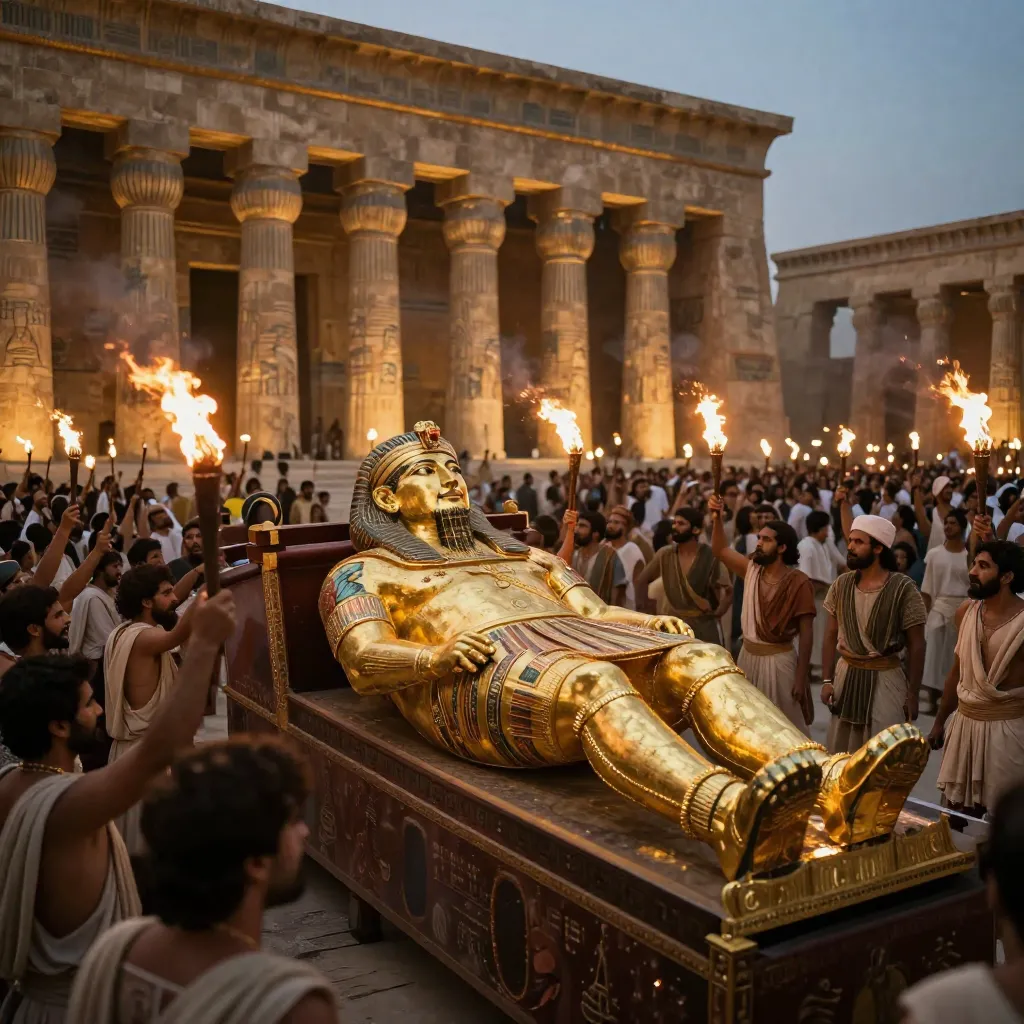
The lost tomb of Alexander the Great remains one of archaeology's greatest unsolved mysteries
In 323 BCE, the most successful military commander in human history lay dying in the palace of Nebuchadnezzar II in Babylon. Alexander the Great — the king who had conquered the Persian Empire, marched his armies to the edge of India, and never lost a single battle — was just thirty-two years old. The cause of his death remains debated: fever, poisoning, typhoid, or perhaps a combination of exhaustion and illness after years of relentless campaigning. His last words, when asked to whom he left his empire, were said to be: “To the strongest.” What followed was a struggle not only for his empire but for his body — a struggle that would span centuries, involve some of the most powerful figures in antiquity, and end in one of the greatest vanishing acts in archaeological history. The tomb of Alexander the Great, once one of the most famous landmarks in the ancient world, visited by Roman emperors and described by historians in glowing detail, has simply disappeared. No one alive today knows where Alexander rests.
The story of Alexander’s tomb is a saga of political ambition, religious transformation, and the fragility of even the grandest monuments. It begins with a funeral carriage of staggering opulence, passes through the streets of two of antiquity’s greatest cities, and ends in an absence — a blank space in the historical record where one of the most visited tombs in the ancient world should be. The search for Alexander’s tomb has been called the “Holy Grail of archaeology,” and over a hundred official expeditions have attempted to locate it since the nineteenth century. All have failed. The tomb remains where it has been for over sixteen centuries: lost.
Alexander’s death triggered an immediate power struggle among his generals, known as the Diadochi (Successors). With no clear heir — Alexander’s wife Roxana was pregnant, but the child would not be born for months — his empire was carved up within years. The regent Perdiccas took control of the funeral arrangements, ordering the construction of an elaborate carriage to transport the body to the royal necropolis at Aegae (modern Vergina) in Macedonia, where the Argead kings were traditionally buried. According to the historian Diodorus Siculus, the carriage was a marvel of craftsmanship: covered in gold and adorned with paintings and sculptures depicting Alexander’s conquests, it was drawn by sixty-four mules and designed to be a mobile monument to the dead king’s glory.
But the body never reached Macedonia. Ptolemy I Soter, one of Alexander’s most trusted generals, who had seized control of Egypt, intercepted the funeral procession in Syria around 321 BCE and diverted it to Egypt. The hijacking of Alexander’s body was not an act of devotion — it was a calculated political maneuver. In the ancient world, possession of a great king’s remains conferred enormous symbolic authority. By controlling Alexander’s body, Ptolemy anchored his claim to rule Egypt to the legacy of the conqueror himself. It was a masterstroke of political theater that would define the Ptolemaic dynasty for nearly three centuries.
Ancient sources report that Alexander’s body was embalmed in the Egyptian manner in Babylon, a process that took months and required specialized knowledge. Diodorus Siculus wrote that the body was placed in a coffin of “hammered gold” that fit closely around it, and that the honey and embalming spices were so effective that when Ptolemy’s men opened the coffin in Egypt, Alexander’s features were still recognizable years after his death. The choice of Egyptian mummification was deliberate — it associated Alexander with the pharaonic tradition and reinforced Ptolemy’s claim that Alexander, and by extension the Ptolemies, were legitimate rulers of Egypt. The preservation was reportedly so remarkable that the Roman emperor Augustus, visiting the tomb nearly three centuries later, was said to have been shown Alexander’s face and to have placed a golden crown upon the body.
Ptolemy initially buried Alexander in Memphis, the ancient capital of Egypt, possibly in or near the temple of Nectanebo II, the last native Egyptian pharaoh, whose cult site at Saqqara has been proposed as the temporary resting place. In the nineteenth century, archaeologists discovered a temple of Nectanebo II near the Serapeum of Saqqara, and some researchers have suggested this was the original tomb. Memphis was Ptolemy’s initial seat of power, and it made strategic sense to keep Alexander close. But as the new city of Alexandria rose on the Mediterranean coast — a city named after the conqueror himself — Ptolemy’s successors recognized that Alexander’s permanent tomb belonged in the city that bore his name. Around 280 BCE, Ptolemy II Philadelphus transferred the body to Alexandria, where it was installed in a monumental tomb known as the Soma (“the Body”), a mausoleum and cult center that became one of the most famous landmarks of the ancient world.
For over five centuries, Alexander’s tomb in Alexandria was one of the most important pilgrimage sites in the Mediterranean world. It was not merely a grave — it was a political shrine, a place where the powerful came to associate themselves with the greatest conqueror the world had ever known. Julius Caesar visited in 47 BCE after his campaign in Alexandria during the Alexandrian War. According to accounts, Caesar stood before Alexander’s sarcophagus and wept — moved, perhaps, by the realization that Alexander had conquered the known world by the age at which Caesar had achieved comparatively little. Cleopatra VII, the last Ptolemaic ruler of Egypt, also visited the tomb and reportedly took gold from it to finance her political ambitions. The Roman emperor Augustus (then Octavian) visited after his defeat of Antony and Cleopatra in 30 BCE. According to the historian Cassius Dio, Augustus was taken to the tomb, laid a crown of flowers on Alexander’s body, and was asked if he also wished to see the tombs of the Ptolemies. Augustus reportedly replied: “I wished to see a king, not dead men.” The story — whether true or apocryphal — perfectly captures the symbolic power Alexander’s remains held over the Roman imagination.
The emperor Caligula reportedly visited and took Alexander’s breastplate from the tomb. Septimius Severus visited around 200 CE and, according to some accounts, sealed the tomb to prevent further looting. His son Caracalla visited around 215 CE and was said to have been so devoted to Alexander that he imitated his mannerisms, adopted Macedonian military dress, and even attempted to emulate his conquests. These visits are among the last reliable historical attestations of the tomb’s existence.
After Caracalla’s visit around 215 CE, the historical record regarding Alexander’s tomb goes silent. Over the following century and a half, Alexandria experienced a series of catastrophes that may have destroyed the tomb or rendered it inaccessible. The city was wracked by political violence, religious conflict between pagans and Christians, earthquakes, and tsunamis. The Theodosian Decrees of the late fourth century CE ordered the closure of all pagan temples and shrines throughout the Roman Empire. Alexander’s tomb, as a pagan cult center, would have been a prime target for destruction or appropriation. Some scholars have suggested that the tomb was destroyed during the anti-pagan riots of the late fourth century, when the patriarch Theophilus of Alexandria led campaigns against pagan temples. Others propose that it was damaged by earthquakes or gradually buried beneath the rising ground level of the city, which has subsided significantly over the centuries due to seismic activity and the weight of subsequent construction.
Whatever the cause, by the time the Arab conquest of Egypt occurred in 641 CE, the location of Alexander’s tomb was apparently already lost. The parallel with Cleopatra’s tomb is striking — another Ptolemaic ruler whose final resting place has never been found despite centuries of searching, both lost somewhere beneath the same ancient city.
Since the nineteenth century, over one hundred official archaeological expeditions have attempted to locate Alexander’s tomb in Alexandria. The city presents extraordinary challenges for archaeologists: the modern metropolis of Alexandria sits directly atop the ancient one, and centuries of construction, demolition, and landfill have created a dense urban environment where large-scale excavation is nearly impossible. The ancient royal quarter, where the Soma was likely located, lies beneath the modern city center, much of it now submerged beneath the harbor due to coastal subsidence.
Several theories persist. The most widely held holds that Alexander’s original mausoleum in central Alexandria lies buried beneath the modern city, potentially under the Nebi Daniel mosque area or the Shatby district, where underground chambers have been detected by ground-penetrating radar. A second theory argues that coastal subsidence has submerged parts of the ancient royal quarter beneath the Eastern Harbor, and that the tomb may now lie underwater. A third, championed by researchers including Dr. Christian de Vartavan, proposes that Alexander’s body may never have been moved from the original Memphite tomb at the Nectanebo II temple at Saqqara. Still others believe the tomb was simply destroyed during late antique Christian riots, its materials recycled into other buildings, leaving nothing to find. None of these efforts has produced definitive results. The Egyptian government has restricted excavation in many areas, and the sheer density of the modern city makes systematic exploration nearly impossible.
Alexander the Great spent his life conquering the physical world. He defeated the Persian Empire, marched through Central Asia, and reached the Indus River. He founded cities that bear his name from Egypt to Afghanistan. He was declared a god in his own lifetime. But he could not conquer time. The tomb that was built to guarantee his eternal memory — a monument so grand that Roman emperors traveled across the Mediterranean to stand before it — has been swallowed by the very city that bears his name. The irony is almost too perfect: the man who made the world his monument has no monument of his own. Somewhere beneath the streets of modern Alexandria, or beneath the waters of its harbor, or in a forgotten chamber at Saqqara, the man who conquered the world may still lie waiting — in a tomb that the world has forgotten how to find. “To the strongest,” Alexander whispered with his dying breath. But time, in the end, has proven stronger than them all.
References & Further Reading
Britannica: Alexander the Great — Comprehensive biography of the Macedonian conqueror and his legacy
Britannica: Alexandria — History of the Egyptian city from its founding through late antiquity
📚 Recommended Reading: Alexander the Great by Robin Lane Fox (on Amazon) — As an Amazon Associate, we earn from qualifying purchases.
Editorial note: reconstructions are continuously revised as imaging and inscription studies improve. See our Editorial Policy.