The Tunguska Event: The Morning the Sky Exploded Over Siberia
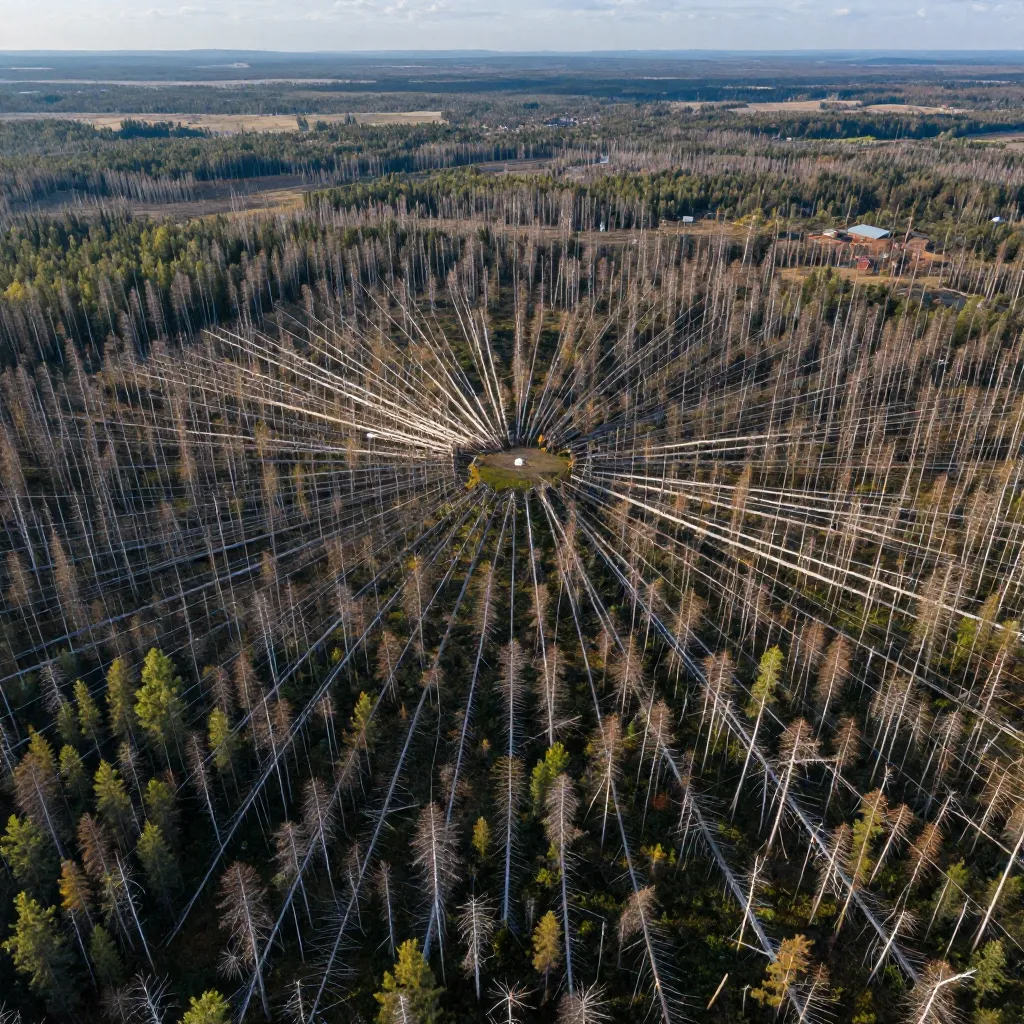
On the morning of June 30, 1908, at approximately 7:17 AM local time, the sky over a remote stretch of Siberian forest near the Podkamennaya Tunguska River split open. What appeared first as a blinding column of light — brighter than the sun, described by some witnesses as a “second sun” — streaked across the sky and then exploded with a force estimated at between 10 and 50 megatons of TNT. That is roughly 1,000 times the power of the atomic bomb dropped on Hiroshima. The blast flattened approximately 80 million trees over an area of 830 square miles (2,150 square kilometers) — a zone of destruction larger than the area of many major cities. Reindeer herds were incinerated. Indigenous Evenki people and Russian settlers dozens of miles away were thrown from their porches and chairs by the shock wave. The sound was heard hundreds of miles away. Seismic stations across Eurasia recorded the tremors. Barometric pressure waves circled the Earth twice. And yet, when the first scientific expedition finally reached the site nineteen years later, they found something that made no sense: no crater. Something had unleashed the most destructive explosion in recorded human history — and it had left almost no physical trace. The Tunguska Event remains, more than a century later, one of the most fascinating and unsettling mysteries in the history of science.
What makes Tunguska so compelling is not just the scale of the destruction but the strange, almost supernatural aftermath. For days following the explosion, the skies over Europe and Asia glowed with an eerie silver light. In London, 3,000 miles from the blast, people could read newspapers at midnight. The “glowing clouds” — now understood to be noctilucent clouds formed from ice particles blasted into the upper atmosphere — were beautiful and deeply unsettling, a visible reminder that something extraordinary had happened in the Siberian wilderness. The Tunguska Event became a magnet for theories, ranging from the scientific to the absurd: a meteor, a comet, a black hole passing through the Earth, an antimatter collision, an experiment by Nikola Tesla gone wrong, even a nuclear-powered alien spacecraft. The truth, as it emerged over decades of research, is remarkable enough on its own — and deeply relevant to the survival of modern civilization.
The Tunguska Event occurred in one of the most remote inhabited regions on Earth — the dense taiga forest of central Siberia, hundreds of miles from the nearest city. This remoteness is both the reason the blast killed few people (estimates suggest up to three possible deaths) and the reason it took nearly two decades for scientists to investigate. The eyewitness accounts that survive are extraordinary. S. Semenov, a farmer sitting on his porch in the trading post of Vanavara, approximately 40 miles from ground zero, described seeing “a blindingly bright white-blue light” that seemed to split the sky in two. The heat was so intense that he felt his shirt was about to catch fire. Then came a thunderous crash that threw him from his chair. “I lost my senses for a moment,” he later recalled, “but then my wife ran out and led me into the house. After that, such noise came, as if rocks were falling or cannons were firing, the Earth shook.”
Other witnesses described the fireball from different angles and distances. Some saw a pillar of fire reaching from the ground to the sky. Others described a “second sun” that briefly outshone the real one. Indigenous Evenki people in the forest closer to the blast reported being physically thrown by the shock wave, their reindeer herds scattered or killed. Hundreds of miles away in Irkutsk, the Magnetic and Meteorological Observatory recorded seismic tremors and dramatic atmospheric pressure waves. Barographs as far away as London and Washington D.C. recorded the pressure pulse. The Earth, quite literally, rang like a bell.
Because of the extreme remoteness of the Tunguska region and the political upheavals of early twentieth-century Russia (World War I, the Russian Revolution, and the Russian Civil War), no scientific expedition reached the blast site until 1927 — nineteen years after the event. The man who finally got there was Leonid Kulik, a Russian mineralogist and geologist who had become fascinated by accounts of the explosion. Kulik convinced the Soviet government to fund an expedition by arguing that the blast might have been caused by a giant meteorite, and that the iron from such a meteorite could be valuable to Soviet industry.
What Kulik found when he reached the site was overwhelming. A vast zone of flattened trees — millions of them — radiated outward from a central point in a distinctive “butterfly” pattern. The trees had been knocked down like matchsticks, their tops pointing away from the epicenter. Near the center, the trees had been stripped of their branches and bark and stood like a forest of telephone poles — a phenomenon known as a “telegraph forest” that is characteristic of a powerful airburst. The destruction extended for dozens of miles in every direction. Kulik expected to find a massive impact crater at the center. He searched for years. He drained a lake. He dug trenches. He found nothing. No crater. No meteorite fragments. No iron. No nickel. No physical evidence of what had caused the destruction. The absence of a crater was deeply puzzling. How could something powerful enough to flatten 80 million trees over 830 square miles leave no hole in the ground?
The answer, which emerged over decades of scientific research, is that the Tunguska object never hit the ground. Instead, it exploded in the atmosphere — an event known as an airburst. Modern scientists have concluded that a stony meteoroid or comet nucleus approximately 50 to 200 meters (160 to 660 feet) in diameter entered Earth’s atmosphere at a speed of about 54,000 kilometers per hour (33,500 mph). The intense friction and pressure of atmospheric entry caused the object to heat catastrophically and disintegrate at an altitude of approximately 5 to 10 kilometers (3 to 6 miles) above the surface. The resulting explosion released energy equivalent to 10 to 30 megatons of TNT — comparable to a large thermonuclear weapon. Because the explosion occurred several miles above the ground, it produced a devastating downward shock wave that flattened the forest below but left no impact crater. The object itself was almost entirely vaporized by the immense heat of the explosion, which explains the absence of meteorite fragments.
While the airburst hypothesis is widely accepted, the question of what exploded — a stony asteroid or an icy comet — remains one of the most debated questions in planetary science. The asteroid hypothesis holds that the Tunguska object was a rocky meteoroid, probably a carbonaceous chondrite or ordinary chondrite, approximately 50 to 80 meters in diameter. Computer models show that a stony asteroid of this size, traveling at typical near-Earth asteroid velocities, would produce an airburst of the observed magnitude. Asteroids in this size range are relatively common, and impacts of Tunguska-scale are estimated to occur approximately once every 300 to 1,000 years. The comet hypothesis proposes that the object was the nucleus of a small comet, composed primarily of ice and dust. Proponents point to the absence of significant meteorite debris (a comet would vaporize more completely than a stony asteroid), the reported “glowing skies” (consistent with ice particles in the upper atmosphere), and the reported observation of a luminous trail in the sky for days before the explosion. Italian expeditions in the 1970s and 2000s found evidence in lake sediments near the blast site that they interpreted as consistent with a cometary origin, though this interpretation has been challenged.
The Tunguska Event is not just a historical curiosity — it is a preview of something that will happen again. In 2013, a roughly 20-meter asteroid exploded over Chelyabinsk, Russia, with a force of approximately 500 kilotons of TNT (about 1/30th of Tunguska). The event injured approximately 1,500 people (mostly from broken glass), was captured on dozens of dashboard cameras, and provided invaluable data about how small asteroids break up in the atmosphere. The Chelyabinsk meteor had not been detected before impact — a wake-up call for planetary defense. In September 2022, NASA deliberately crashed the Double Asteroid Redirection Test (DART) spacecraft into the asteroid Dimorphos, successfully changing its orbit. This was the first demonstration that humanity can alter an asteroid’s trajectory — a crucial first step toward planetary defense. If a Tunguska-sized object were detected on a collision course with Earth, the DART technology could potentially be used to deflect it.
If a Tunguska-sized airburst occurred over a modern city, the results would be devastating. The explosion would be equivalent to a large thermonuclear weapon detonating several miles above the ground — without the radioactive fallout. The blast wave would shatter windows across hundreds of square miles, collapse buildings, and generate hurricane-force winds. The thermal radiation would cause severe burns and ignite fires across a wide area. The Chelyabinsk meteor — only about 1/30th the power of Tunguska — injured 1,500 people and damaged over 7,200 buildings across six cities. A Tunguska-scale event over a populated area could kill millions. NASA and other space agencies are actively searching for near-Earth objects through programs like the Planetary Defense Coordination Office. The challenge is detection: objects in the 50 to 200 meter size range are difficult to spot, and we have catalogued only a fraction of those that cross Earth’s orbit.
Over the decades, the Tunguska Event has also attracted dozens of alternative explanations, some scientific, some outlandish. One theory proposed that Nikola Tesla’s Wardenclyffe Tower accidentally caused the explosion during experiments with wireless energy transmission. There is no evidence that Tesla’s tower could generate anything close to the Tunguska blast, and Tesla himself never made such a claim. Physicists proposed that a tiny primordial black hole could have passed through the Earth, entering in Siberia and exiting in the North Atlantic — but the theory predicts a second exit blast, which was never detected. A chunk of antimatter colliding with the atmosphere would produce the observed destruction and explain the absence of a crater, but antimatter annihilation produces specific gamma-ray signatures that were not detected. Soviet science fiction writer Alexander Kazantsev proposed in 1946 that a nuclear-powered alien spacecraft exploded over Tunguska. All of these theories have been thoroughly investigated and rejected by the scientific community, which overwhelmingly supports the airburst hypothesis. The persistence of alternative theories says more about human fascination with the unknown than about the evidence.
The Tunguska Event is the closest thing Earth has experienced to a cosmic close call in modern history. On a warm June morning in 1908, a rock from space — or a ball of ice and dust — entered the atmosphere at 33,500 miles per hour and detonated with the force of a hydrogen bomb over the Siberian wilderness. If it had arrived four hours and 47 minutes later, the Earth’s rotation would have placed the city of St. Petersburg directly under the blast. The consequences do not bear thinking about. The event was a reminder — a shot across the bow from the cosmos — that we live on a planet drifting through a shooting gallery, and that the “empty” space above our heads is not empty at all. It is full of rocks and ice and debris left over from the formation of the solar system, and occasionally, one of those objects finds its way to Earth. The sky is not empty. The next Tunguska is out there. We just don’t know when it will arrive.
References & Further Reading
📚 Recommended Reading: The Tunguska Event by John Baxter (on Amazon) — As an Amazon Associate, we earn from qualifying purchases.
Editorial note: scientific models of the Tunguska Event are continuously refined as new data and simulations become available. See our Editorial Policy.