Mothman: The Winged Creature That Terrorized a West Virginia Town for 13 Months
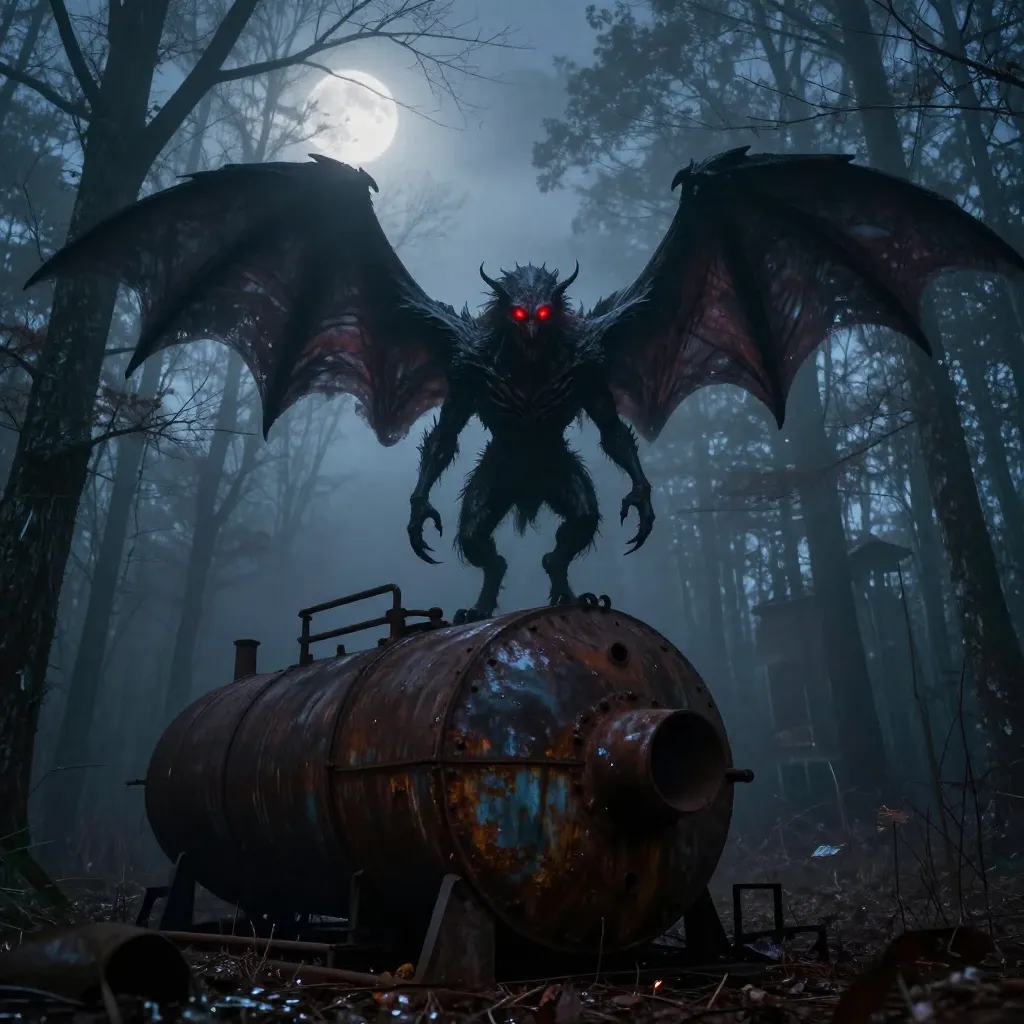
On the evening of November 15, 1966, two young couples were driving through the abandoned TNT plant area outside Point Pleasant, West Virginia, a small town perched on the banks of the Ohio River. Roger and Linda Scarberry and Steve and Mary Mallette were not looking for monsters. They were simply cruising, as young people in rural America did on a Tuesday night, when they noticed something standing in the shadows near the old munitions igloos. It was seven feet tall. It had wings folded against its back. And its eyes — large, hypnotic, and glowing an impossible red — stared directly at them.
The creature pursued their car as they fled, keeping pace at speeds exceeding 100 miles per hour. It did not run. It glided. When they reached the Point Pleasant city limits, it simply turned and vanished into the darkness. The four shaken witnesses reported the encounter to the local sheriff, and by the next morning, the story was on the front page of the Point Pleasant Register under the headline: “Couples See Man-Sized Bird... Creature... Something.” Over the next thirteen months, more than one hundred people in the Point Pleasant area would report seeing the same impossible being. And then, on December 15, 1967, the Silver Bridge collapsed into the Ohio River, killing forty-six people. The sightings stopped. Whatever the Mothman was — or whatever the people of Point Pleasant believed it to be — it had left behind one of the strangest chapters in the history of American folklore.
The first Mothman sighting was not, technically, the first. On November 12, 1966, three days before the Scarberry-Mallette encounter, a group of gravediggers in Clendenin, West Virginia, about sixty miles from Point Pleasant, reported seeing a massive figure fly over their heads while they worked in a cemetery. They described it as a “brown human being” moving from tree to tree. This report received little attention. The November 15 sighting, however, detonated like a bomb. Roger Scarberry, Linda Scarberry, Steve Mallette, and Mary Mallette told Deputy Sheriff Millard Halstead that the creature had grayish-brown skin, stood between six and seven feet tall, and possessed a wingspan estimated at ten feet. Its most disturbing feature was its eyes — large, round, and emitting a hypnotic red glow that witnesses described as intensely unsettling, almost as if the creature were looking through them rather than at them.
Over the following weeks, sightings multiplied. On November 16, 1966, just one day after the first report, a woman named Marcella Bennett was visiting friends near the TNT plant when she saw a large, gray creature rise from the ground and glide toward her. She was so terrified she dropped her infant daughter. On November 25, a young boy reported seeing a creature with glowing red eyes outside his home. On November 27, a woman driving near the TNT plant said a winged creature followed her car for miles. By the end of November, the national media had descended on Point Pleasant, and “Mothman” — a name apparently coined by a newspaper copy editor — had entered the American lexicon. The West Virginia Ordnance Works, known locally as the “TNT plant,” was a World War II munitions manufacturing facility covering over 8,000 acres near Point Pleasant. During the war, it produced trinitrotoluene for the military. After the war, the plant was decommissioned and largely abandoned, leaving behind a sprawling complex of concrete igloos — earth-covered bunkers once used to store explosives — surrounded by dense forest, marshland, and contaminated groundwater. The site was dark, isolated, and deeply unsettling even before anyone reported seeing a monster there. It became ground zero for the Mothman legend, and most of the earliest sightings occurred within or near its perimeter.
The Mothman sightings did not occur in isolation. During the same thirteen-month period, Point Pleasant and the surrounding region experienced a wave of anomalous phenomena that included UFO sightings, encounters with mysterious government agents, strange phone calls, electrical disturbances, and reports of a bizarre entity known as Indrid Cold, the “Grinning Man.” On November 2, 1966, two weeks before the first major Mothman sighting, an appliance salesman named Woody Derenberger was driving on Interstate 77 near Parkersburg, West Virginia, when a strange vehicle pulled alongside his car. The vehicle was described as dark and unusual in design. Its driver stepped out — a tall man with a dark complexion and a wide, fixed grin. The man introduced himself as Indrid Cold and communicated with Derenberger telepathically, warning him of an impending disaster.
Derenberger’s report attracted the attention of journalist and paranormal investigator John A. Keel, a New York-based writer who had been investigating UFO sightings and paranormal phenomena since the early 1960s. Keel became the primary chronicler of the Point Pleasant events, visiting the town repeatedly between 1966 and 1967 and conducting over one hundred interviews with witnesses. He documented not only the Mothman sightings but an entire ecosystem of weirdness: lights in the sky, phone calls from unknown numbers that emitted strange electronic sounds, visitors claiming to be government agents who warned witnesses to stop talking, and an oppressive atmosphere of dread that settled over the town like fog. Several witnesses reported being visited by individuals who identified themselves as government agents but who behaved in ways that were, to put it mildly, unusual — olive complexions, ill-fitting suits, stilted robotic language, and an uncanny knowledge of details witnesses had not shared with anyone. These “Men in Black” visitations paralleled similar reports from UFO encounters of the 1940s through 1960s, leading Keel to argue that the Mothman, the UFOs, and the Men in Black were all manifestations of the same phenomenon.
Keel’s 1975 book, The Mothman Prophecies, argued that the events in Point Pleasant were not random but part of a larger pattern of paranormal activity — a “window area” where the barrier between dimensions had grown thin. Unlike many of his contemporaries, who believed UFOs were extraterrestrial spacecraft, Keel developed the “ultraterrestrial hypothesis” — the idea that the entities responsible for UFO sightings, cryptid encounters, and paranormal phenomena were not visitors from other planets but beings from other dimensions who had always coexisted with humanity, appearing in different forms at different times — as fairies in medieval Europe, as airships in the 1890s, as flying saucers in the 1940s, and as Mothman in the 1960s. Whether or not one accepts Keel’s theories, his documentation of the Point Pleasant events remains the most thorough record of the Mothman phenomenon.
On December 15, 1967, at approximately 5:00 p.m., during the evening rush hour, the Silver Bridge — which carried U.S. Route 35 over the Ohio River between Point Pleasant, West Virginia, and Kanauga, Ohio — collapsed without warning. The bridge was packed with vehicles. In seconds, the entire structure plunged into the freezing river. Forty-six people died. Nine were injured. Thirty-one of the thirty-seven vehicles on the bridge fell with it — twenty-four into the water, seven onto the Ohio shore. Many of the victims were never recovered. The official investigation, conducted by the National Transportation Safety Board (NTSB), determined that the collapse was caused by a cleavage fracture in the lower limb of the eye of eyebar 330 — a single component in the bridge’s eyebar-chain suspension system. The Silver Bridge, built in 1928, used a design in which the suspension chains were composed of linked metal bars with circular “eyes” at each end, connected by pins. The design was strong but had no redundancy: if a single eyebar failed, the entire chain would separate. The NTSB found that the fracture was caused by stress corrosion cracking and corrosion fatigue — the slow, invisible growth of a crack under repeated stress over decades. The failure was undetectable with 1928 inspection technology, and catastrophic when it occurred.
The Mothman sightings stopped after the bridge collapse. For those who believed the creature was a harbinger of disaster — a death omen — the timing was conclusive. Keel himself had documented witness reports that the creature seemed to appear near the bridge in the weeks before the collapse, as if patrolling. Skeptics pointed out the logical fallacy: people had been seeing the Mothman for thirteen months in a small town where nearly every landmark was within walking distance of the bridge. Any pattern could be imposed retroactively. But the connection between the Mothman and the Silver Bridge had already become folklore, inseparable from the legend.
The most widely accepted skeptical explanation for the Mothman is that witnesses saw sandhill cranes — large birds that stand up to four feet tall with seven-foot wingspans and distinctive red facial markings that could appear to “glow” at night. Other possibilities include barred owls or great horned owls, whose reflective eyeshine can appear to glow red in headlights, misidentified herons, or a combination of misidentification and mass suggestion. The concentrated media coverage and the area’s isolation likely amplified the effect, causing witnesses to interpret ambiguous stimuli in light of the growing legend.
The idea that a strange creature appears before a disaster is not unique to Point Pleasant. In Japanese folklore, the mujina — a shape-shifting creature — was said to appear before earthquakes. In Irish mythology, the bean-sidhe (banshee) wails before a death in the family. The Flatwoods Monster of West Virginia (1952) and the Owlman of Cornwall, England (1976) share striking similarities with the Mothman: humanoid forms, glowing eyes, and appearances near small communities. Whether these parallels reflect a genuine cross-cultural phenomenon or simply the universal human tendency to associate the unknown with the ominous remains a matter of interpretation.
The Mothman is no longer just a mystery — it is an industry. Point Pleasant, West Virginia, population roughly 4,000, has built an entire tourism economy around a creature that may or may not have existed. The Mothman Museum draws thousands of visitors each year. A twelve-foot stainless steel statue of the creature stands in the town square. The annual Mothman Festival every September brings 10,000 visitors to a town that otherwise has no particular reason to attract tourists. The 2002 film The Mothman Prophecies, starring Richard Gere, introduced the legend to a global audience. But behind the merchandise and the movies lies a real tragedy: forty-six people died when the Silver Bridge collapsed, and their deaths have been overshadowed by the mythology of a monster. The people of Point Pleasant, who lived through thirteen months of genuine terror followed by a genuine catastrophe, deserve to be remembered as more than characters in a ghost story. Their fear was real. Their loss was real. And whatever flew through the West Virginia night in 1966 — crane, owl, or something else entirely — the shadow it cast over that small river town has never fully lifted.
References & Further Reading
Wikipedia: Mothman — History, analysis, and cultural impact of the Point Pleasant sightings
Wikipedia: Silver Bridge — Construction, collapse, wreckage analysis, and legacy
Wikipedia: Flatwoods Monster — Another West Virginia cryptid encounter with parallels to the Mothman
📚 Recommended Reading: The Mothman Prophecies by John A. Keel (on Amazon) — As an Amazon Associate, we earn from qualifying purchases.
Editorial note: the Mothman phenomenon remains one of the most debated cryptid sightings in American history, with extensive witness testimony but no physical evidence. See our Editorial Policy.