The Mary Celeste: History's Greatest Ghost Ship Mystery
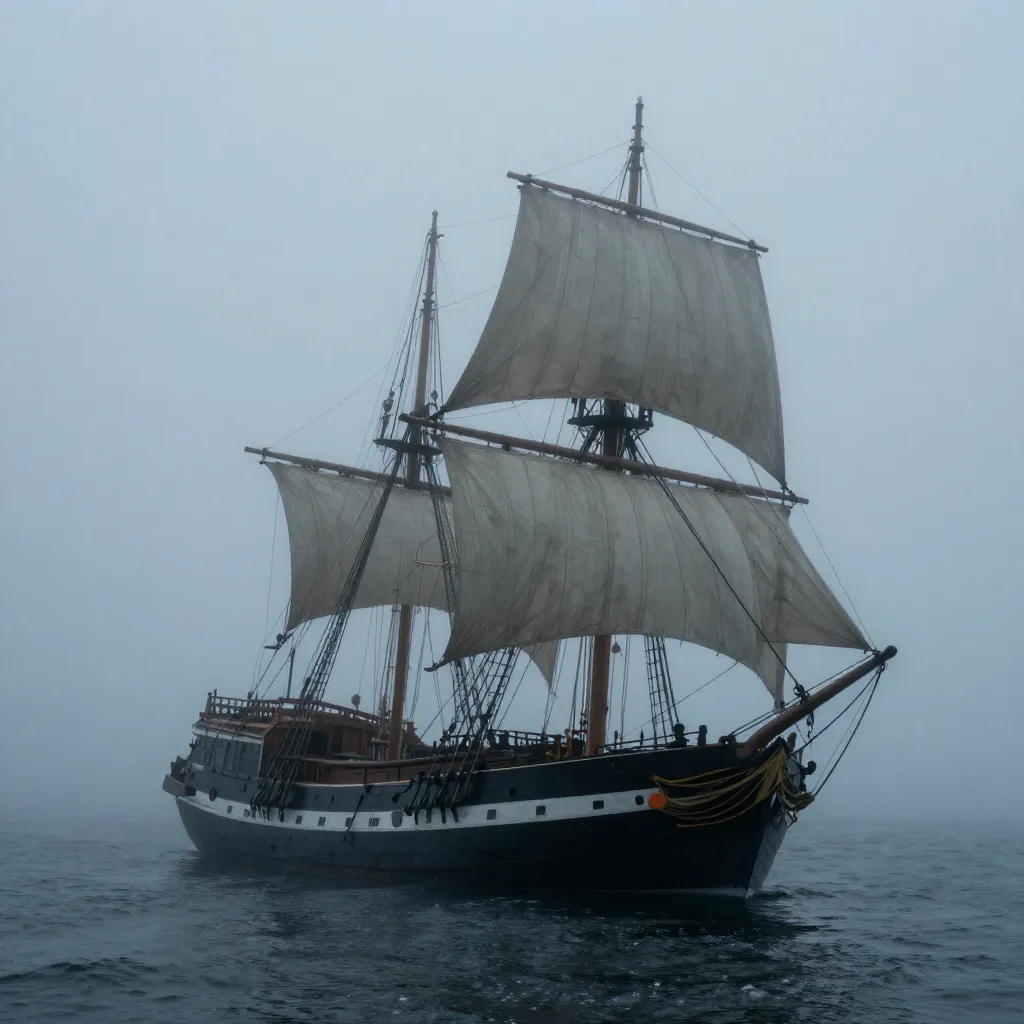
On December 5, 1872, roughly 400 miles east of the Azores in the vast, grey expanse of the North Atlantic Ocean, the crew of a small Canadian brigantine called the Dei Gratia spotted something that should not have been there: another ship, adrift, its sails partly set, yawing slowly in the choppy seas with no one at the helm. As the Dei Gratia drew closer, her captain, David Morehouse, felt a chill of recognition. The derelict vessel was the Mary Celeste — an American-registered brigantine that had departed New York Harbor eight days before the Dei Gratia on virtually the same route, bound for Genoa, Italy, with a cargo of industrial alcohol. Morehouse knew the Mary Celeste’s master, Captain Benjamin Spooner Briggs, personally. They had dined together in New York before their respective departures. Now, the Mary Celeste floated on the open sea with no one aboard — no captain, no crew, no passengers. The ship’s only lifeboat was gone. The captain’s logbook ended abruptly on November 25, ten days earlier. But the vessel itself was seaworthy. The cargo was largely intact. There was a six-month supply of food and water in the hold. There were no signs of violence, no blood, no evidence of pirate attack or mutiny. Ten people — including a two-year-old child — had simply vanished from the face of the ocean.
To understand the Mary Celeste mystery, it helps to understand the world in which it occurred. The 1870s were the twilight of the Age of Sail — a time when wooden sailing vessels still carried the bulk of the world’s cargo across the world’s oceans, even as steamships were beginning to supplant them. The North Atlantic was the busiest shipping lane on Earth, carrying goods, people, and raw materials between the industrializing nations of Europe and the rapidly expanding economies of the Americas. A brigantine like the Mary Celeste — a two-masted vessel with square sails on the foremast and fore-and-aft sails on the mainmast — was a common workhorse of this trade, neither glamorous nor remarkable. The transatlantic route from New York to the Mediterranean via the Azores was well-traveled and well-charted. Ships were lost at sea with some regularity, but they were usually lost completely — sunk by storms, wrecked on reefs, or consumed by fire. A ship found adrift and intact with its cargo untouched but its entire complement missing was something else entirely — an event that belonged not to the ordinary perils of the sea but to the realm of the inexplicable.
The Mary Celeste was not always the Mary Celeste. She was built in 1861 at Spencer’s Island, Nova Scotia, by shipbuilder Joshua Dewis, and originally named Amazon. She was a 103-foot brigantine with a beam of 25.7 feet and a gross tonnage of 282 tons after a major rebuild in 1872. From the beginning, the ship’s history was troubled. Her first captain died of pneumonia within days of taking command. On her maiden voyage, she collided with a fishing schooner in the Bay of Fundy and had to return to port for repairs. In 1867, she ran aground during a storm at Glace Bay, Nova Scotia, and was so badly damaged that she was abandoned as a wreck. Salvaged and sold to American owners, she was rebuilt, renamed Mary Celeste in 1869, and re-registered in New York. By the time she came under the command of Benjamin Briggs in 1872, she was an eleven-year-old vessel with a checkered past — sound enough, but carrying the residue of a decade of misfortune.
Briggs was the antithesis of the ship’s unlucky history. A 37-year-old native of Marion, Massachusetts, he came from a distinguished family of sailors and was widely regarded as one of the most competent, honest, and respected captains in the American merchant marine. He was a deeply religious man — the son of a minister — and by all accounts a cautious, conscientious seaman. For the voyage to Genoa, Briggs assembled a crew of seven: the first mate, Albert G. Richardson, the second mate, and five seamen of German, Danish, and American nationality. Unusually for a merchant voyage, Briggs was accompanied by his wife Sarah Elizabeth Briggs (née Cobb), age 33, and their two-year-old daughter Sophia Matilda. The presence of a woman and a toddler on a cargo brigantine was rare but not unprecedented — Briggs had brought his family to share the voyage, confident in his ship and his abilities. The cargo was 1,701 barrels of raw commercial alcohol (denatured ethanol), valued at approximately $36,000 — a substantial shipment. The Mary Celeste departed New York Harbor on November 7, 1872. Eight days later, on November 15, the Dei Gratia followed on roughly the same course. Briggs and Morehouse had agreed to compare notes if they encountered each other at sea. They never would.
When the Dei Gratia’s boarding party — composed of the first mate Oliver Deveau and two seamen — climbed aboard the Mary Celeste on December 5, 1872, they found a vessel that was simultaneously untouched and profoundly disturbed. The ship was under partial sail, wallowing in the swells with no one to tend the helm. The sails were partly set — some were properly furled, others were loosely hanging, and a few had been blown away by the wind. Below decks, the scene was disordered but not chaotic: the crew’s belongings were still in their quarters, their clothing and personal items undisturbed. The captain’s cabin was in similar condition — Sarah Briggs’ sewing machine was present, and Sophia’s toys were in their places. The ship’s charts had been tossed about, suggesting a period of rough weather. The ship’s logbook was found in the mate’s cabin — the last entry dated 5:00 AM, November 25, 1872, recording the ship’s position approximately 100 miles west of Santa Maria Island in the Azores. But the ship’s official papers were missing. The navigation instruments — sextant, chronometer — were gone. The ship’s only lifeboat had been launched and was missing. One of the ship’s two pumps had been disassembled, suggesting someone had been working on it. There was approximately 3.5 feet of water in the hold — more than expected but not enough to threaten the vessel. The ship’s clock was not functioning, and the compass had been damaged, its glass shattered and its housing displaced.
The cargo told a crucial story. Of the 1,701 barrels of alcohol, the vast majority were intact and in place. However, nine barrels were found to be empty. This detail would become central to the most widely accepted modern theory of the abandonment. The alcohol was denatured ethanol — a highly volatile, flammable substance. If nine barrels had leaked or been breached, the cargo hold could have filled with explosive vapor. But critically, there were no signs of fire or explosion — no scorched wood, no blistered paint, no charred ropes. Whatever had happened to the Mary Celeste, it had not burned. And whatever had caused the ten people aboard to abandon a seaworthy vessel in the middle of the Atlantic Ocean, it had been so compelling — so terrifying — that they had left behind their clothing, their belongings, their charts, their food supply, and six months’ worth of water, choosing to take their chances in a small open boat on the open sea rather than remain aboard.
The Dei Gratia’s crew sailed the Mary Celeste approximately 800 miles to Gibraltar, where a British Vice Admiralty Court convened a salvage hearing in December 1872. The presiding officer was Frederick Solly-Flood, the Attorney General of Gibraltar — a man whose suspicion and aggressive questioning would shape the early narrative of the mystery. Solly-Flood was convinced from the outset that foul play was involved. He suspected that the crew had murdered the Briggs family and abandoned the ship, or that the Dei Gratia’s crew had themselves intercepted the Mary Celeste and killed everyone aboard in order to claim the salvage reward. He ordered thorough inspections of both vessels and subjected the Dei Gratia’s crew to intensive interrogation. But despite his suspicions, Solly-Flood could find no evidence of violence — no blood, no weapons, no signs of struggle. The Mary Celeste showed no evidence of pirate attack, no damage consistent with boarding by force. The cargo was intact, which ruled out theft. Eventually, the court concluded that the abandonment was unexplained and awarded the Dei Gratia crew a salvage payment of approximately £1,700 — roughly one-fifth of the total value of the ship and cargo. The relatively small award reflected the court’s lingering suspicions.
In 1884, twelve years after the Mary Celeste was found, a young, not-yet-famous writer named Arthur Conan Doyle published a short story called “J. Habakuk Jephson’s Statement” in the British magazine Cornhill Magazine. The story was a fictionalized account of the Mary Celeste mystery, narrated by a survivor who claimed the ship had been attacked by a vengeful former slave. Doyle changed key details — the ship’s name to “Marie Celeste,” the number of crew, the circumstances of abandonment — and presented the account in a realistic, documentarian style that led many readers to believe it was a true story. The story was a sensation, reprinted in newspapers on both sides of the Atlantic, and it permanently distorted the public’s understanding of the case. Many of the “facts” that people associate with the Mary Celeste — blood on the deck, half-eaten meals still warm on the table, the ship in perfect condition — originated with Doyle’s fiction, not with the historical record. The story launched Doyle’s career and cemented the Mary Celeste as one of the most famous mysteries in maritime history — but at the cost of introducing layers of mythology that researchers have been trying to peel away ever since.
The most widely accepted modern explanation for the abandonment was developed by Dr. Anne MacGregor, a documentarian who conducted an extensive reinvestigation of the case in 2007 for a Smithsonian Channel documentary. MacGregor drew on modern maritime safety knowledge, newly discovered historical documents, and a careful re-examination of the physical evidence to construct a scenario that accounts for nearly all of the known facts. Her theory centers on the nine empty barrels of alcohol. Industrial alcohol — denatured ethanol — is extremely volatile, and in 1872 it was transported in wooden barrels, not the sealed metal drums that would be used today. If nine barrels had leaked or burst during the rough weather the Mary Celeste encountered in the first two weeks of the voyage, the cargo hold could have filled with highly explosive alcohol vapor. Captain Briggs — a cautious, religious man who had never carried alcohol before — may have been alarmed by the smell of vapor and feared an imminent explosion.
The key to MacGregor’s theory is the disassembled pump. The Mary Celeste had two pumps for removing water from the hold. One had been taken apart — presumably for repair or clearing — suggesting that someone had been attempting to deal with the water in the hold. To access the hold, they would have opened the cargo hatches, releasing a powerful wave of alcohol vapor. In an enclosed space, ethanol vapor at the right concentration is extremely explosive — a single spark from a pipe, a lantern, or even a metal tool striking metal could have triggered a catastrophic blast. MacGregor proposed that Briggs, confronted with the overwhelming smell of alcohol vapor and the genuine risk of explosion, made the decision to abandon the ship temporarily — ordering everyone into the lifeboat and towing it behind the Mary Celeste at the end of a rope, intending to wait at a safe distance until the vapor dissipated and it was safe to return. The plan was rational, cautious, and entirely consistent with Briggs’ character. But something went wrong. Perhaps the rope broke. Perhaps a sudden squall separated the lifeboat from the ship. Perhaps the wind caught the Mary Celeste’s partly set sails and she began to move faster than the lifeboat could follow. Whatever happened, the ten people in the lifeboat were left adrift in the mid-Atlantic while the Mary Celeste sailed on without them — a ghost ship that would be discovered ten days later, intact, cargo largely preserved, and permanently, hauntingly empty.
The story of the Mary Celeste did not end with the abandonment. After the salvage hearing, the ship was returned to her owners and continued to sail under a succession of captains and owners for another thirteen years. But the vessel’s luck had not improved. She changed hands repeatedly, her value diminished by the notoriety of the ghost ship legend, and her subsequent voyages were marked by further misfortune. Finally, in 1885, the Mary Celeste was deliberately wrecked on a reef near Haiti in what was almost certainly an insurance fraud scheme by her then-owner. The ship was partially burned before being run aground, and the insurance claim was filed. Investigators suspected fraud but were unable to prove it definitively. The Mary Celeste — the most famous ghost ship in history — met her end not at the hands of mystery but at the hands of greed, her bones scattered on a Caribbean reef, her name forever synonymous with the unexplained.
The Mary Celeste remains the most famous ghost ship in history, and for good reason: the specifics of the case are almost unmatched in maritime annals. A seaworthy vessel found adrift with its cargo intact, its food supply untouched, and no signs of violence — yet with every single person aboard vanished as completely as if they had stepped off the edge of the world. Dr. Anne MacGregor’s alcohol fume theory provides the most compelling explanation, and it is consistent with the physical evidence: the nine empty barrels, the disassembled pump, the missing lifeboat, the abandoned navigation instruments. Captain Briggs’ cautious, religious temperament makes the scenario of an orderly, temporary abandonment — followed by a tragic separation — psychologically plausible. But we will never know for certain. The rope, if there was one, has rotted away. The lifeboat, if there was one, has sunk beneath the waves. The ten people who sailed from New York on November 7, 1872, took their story with them to the bottom of the Atlantic, or to the silence of a grave without a marker. What remains is the mystery: a blank space on the map of human knowledge, a ship without a story, a question mark floating on the endless grey water.
References & Further Reading
Editorial note: The Mary Celeste mystery is documented through the Gibraltar Vice Admiralty Court salvage hearing records, contemporary newspaper accounts, and extensive historical research including Anne MacGregor’s 2007 reinvestigation. See our Editorial Policy.