The Mandela Effect: Why Millions of People Remember a History That Never Happened
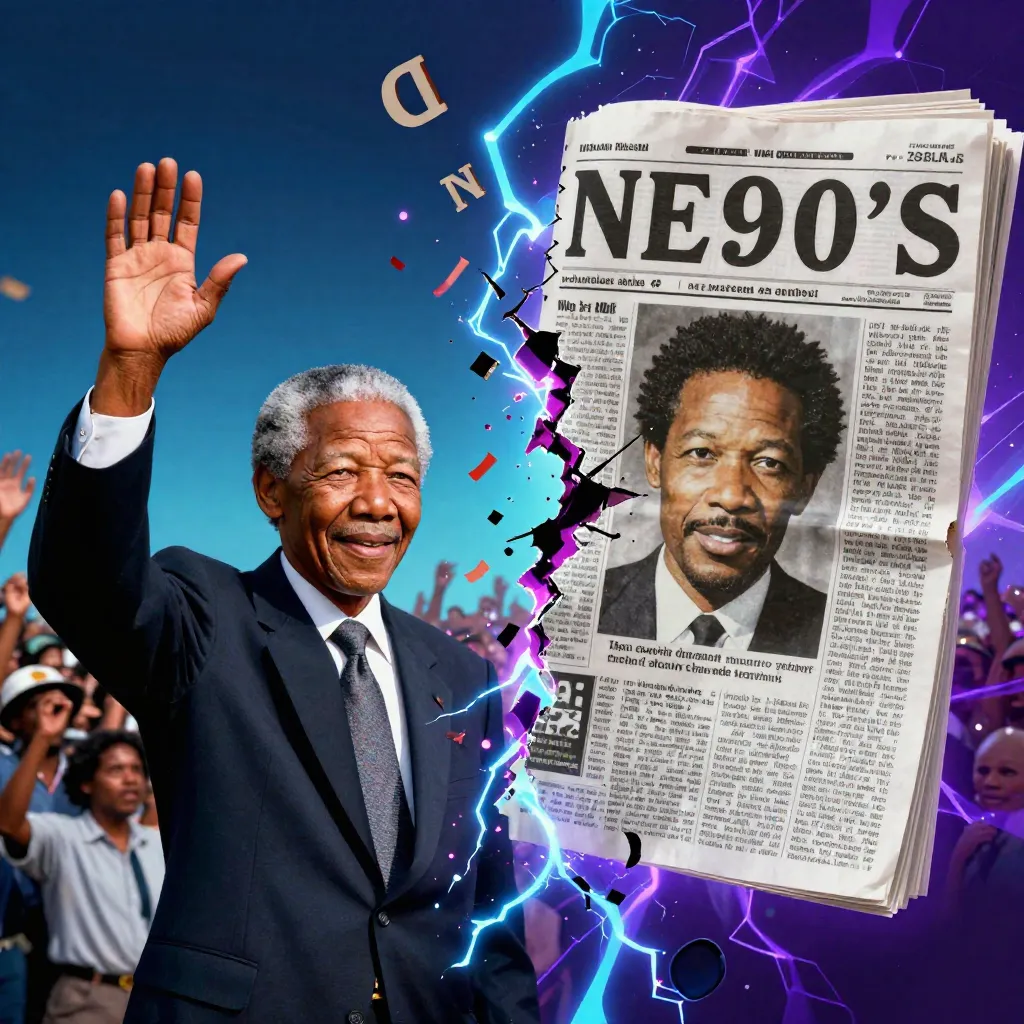
In 2009, a paranormal researcher named Fiona Broome was at a Dragon Con convention when she mentioned to a friend that she had vivid, detailed memories of Nelson Mandela dying in prison in the 1980s. She remembered the news coverage. She remembered the funeral. She remembered the mourning. She was certain. Her friend was equally certain — and equally wrong. Nelson Mandela did not die in prison. He was released from Victor Verster Prison in 1990, received the Nobel Peace Prize in 1993, was elected President of South Africa in 1994, and served until 1999. He died on December 5, 2013, at the age of 95. The funeral Broome remembered never happened — not in the 1980s, not the way she recalled. But Broome was not alone. When she wrote about her experience online, she discovered that thousands of people shared the same false memory. They, too, recalled news broadcasts, memorial services, and heartfelt tributes marking Mandela’s death decades before it occurred. Broome coined a term for this phenomenon: the Mandela Effect — a situation where a large group of people share a vivid, confident, and completely false memory of an event, detail, or fact.
What began as a curious anecdote about one man’s death has since become one of the most widely discussed psychological phenomena of the internet age. Millions of people around the world have discovered that their memories of movies, brand logos, historical events, geography, and even the color of common objects are demonstrably, provably wrong — and that millions of others share the same incorrect recollections. The Mandela Effect raises profound questions about the reliability of human memory, the nature of shared experience, and whether something far stranger than simple forgetting might be at work.
The Mandela Effect is best understood through its examples, and some of them are genuinely startling. These are not obscure trivia facts that a few people misremember. They are widely shared, deeply held false memories that have persisted even after being corrected — and in many cases, people who learn the truth report feeling a visceral sense of wrongness, as if the fabric of reality has been subtly altered. Perhaps the most famous example is the Berenstain Bears. The beloved children’s book series, created by Stan and Jan Berenstain, has been published under the name The Berenstain Bears since its inception. But an extraordinary number of people — possibly the majority of those who grew up with the books — remember the name as “Berenstein,” with an ‘-ein’ ending rather than ‘-ain’. The memory is often intensely specific: people recall the spelling on book covers, on library cards, on the title pages they read as children. The actual name has always been Berenstain, matching the authors’ real surname.
Then there is the most famous movie misquote in history. In The Empire Strikes Back (1980), Darth Vader reveals his identity to Luke Skywalker in one of cinema’s most iconic moments. The line most people remember is: “Luke, I am your father.” The actual line is: “No, I am your father.” Vader never says “Luke” in that scene. The misquote is so pervasive that it has appeared in official Star Wars merchandise, advertisements, and even other movies — a case where the false memory has been reinforced by the culture until it has effectively replaced the original. The phenomenon extends to other famous misquotations as well. In Disney’s Snow White (1937), the actual line is “Magic mirror on the wall,” not “Mirror, mirror on the wall” — the “mirror, mirror” version comes from the original Grimm fairy tale, not the film. Forrest Gump actually says “Life WAS like a box of chocolates,” not “is like.” Sherlock Holmes never speaks the phrase “Elementary, my dear Watson” in any of Arthur Conan Doyle’s original stories.
Visual Mandela Effects are equally widespread. Quick: picture the Monopoly Man, the mustachioed mascot of the classic board game. Does he wear a monocle? If you said yes, you are in the vast majority — and you are wrong. Rich Uncle Pennybags has never worn a monocle in any official rendition of the character. The confusion likely arises from a mental blending with other imagery: Mr. Peanut, the Planters mascot, wears a monocle and a top hat; the classic “monopoly man” archetype in popular culture frequently includes a monocle as shorthand for wealth. Your brain, presented with a top-hatted, mustachioed rich man, helpfully fills in the monocle because it “fits” — a process psychologists call confabulation, where the brain inserts plausible details into memories to create a coherent narrative. The same process explains why so many people remember Curious George having a tail (he never did — he’s an ape, not a monkey), why many recall Pikachu’s tail having a black tip (it’s entirely yellow), and why people picture Henry VIII holding a turkey leg in portraits (no such portrait exists). Many viewers also vividly remember the character Dolly having metal braces on her teeth in the 1979 James Bond film Moonraker, creating a comedic visual connection to the villain Jaws. She does not have braces in any frame of the film.
Some of the most disorienting Mandela Effects involve geography. Many people recall New Zealand being located to the northwest of Australia, when it is actually to the southeast. Others remember South America being directly south of North America, when it is actually shifted significantly to the east. Sri Lanka is remembered by some as being west of India rather than to its south. These geographic misrememberings are particularly striking because they involve spatial memory — the mental maps we carry in our heads — rather than verbal or visual details. They suggest that the Mandela Effect is not simply a matter of confusing similar-sounding words or conflating similar images, but something more fundamental about how the brain constructs and stores models of the world. The phenomenon also extends to the commercial world with surprising frequency. Many people remember the Ford logo with a curl or loop at the end of the ‘F’ that doesn’t exist. The Volkswagen logo is remembered by many as having a continuous horizontal line through the middle, when the actual logo has a gap. The Kit Kat logo is remembered with a hyphen (“Kit-Kat”) by many, though the official brand name has never included one. These commercial Mandela Effects are particularly interesting because they involve high-frequency exposure — most people have seen the Ford logo thousands of times, yet their memory of it is wrong.
The dominant scientific explanation for the Mandela Effect lies in the work of cognitive psychologists, particularly Dr. Elisabeth Loftus, a professor at the University of California, Irvine, who has spent decades studying the malleability of human memory. Loftus’s research has demonstrated that memory is not a recording device — it is a reconstructive process. Every time you recall an event, your brain assembles it from fragments, filling in gaps with assumptions, expectations, and information acquired after the fact. In her famous “Lost in the Mall” experiment (1995), Loftus and her colleague Jacqueline Pickerel demonstrated that approximately 25 percent of participants could be made to “remember” a completely fictional childhood event — being lost in a shopping mall as a child — simply through guided suggestion and follow-up interviews. The participants didn’t just agree that the event might have happened; they developed rich, detailed, confident memories of the experience, including specific sensory details and emotional responses, for an event that never occurred. This finding has been replicated numerous times and has profound implications for the Mandela Effect: if a single individual can be led to construct a vivid false memory through suggestion, then an entire culture can construct shared false memories through repetition, social reinforcement, and media exposure.
Psychologists have identified several specific mechanisms that produce Mandela Effects. Schemas are mental frameworks that help us organize information — your schema for “rich old man in a top hat” includes a monocle, so your brain helpfully adds one to the Monopoly Man. Source monitoring errors occur when you remember information accurately but attribute it to the wrong source — you recall hearing “Luke, I am your father” from a parody, a friend, or a meme, and your brain files it under “actual movie quote.” Social reinforcement amplifies the effect: when you discuss a false memory with others who share it, the shared confidence makes the memory feel more real. Confabulation fills gaps with plausible details — Henry VIII was famously a large, appetites-driven king, so your brain adds a turkey leg to his portrait because it “fits” the story. And leading questions can permanently alter memories: Loftus showed that asking witnesses “How fast were the cars going when they SMASHED into each other?” versus “hit each other” produced significantly different speed estimates and even caused witnesses to “remember” broken glass that wasn’t there. The brain prioritizes narrative coherence over photographic accuracy, preferring a coherent false memory to an incoherent true one.
Not everyone accepts the psychological explanation. For millions of people, the Mandela Effect feels too specific, too widely shared, and too “real” to be explained by faulty memory alone. The most popular paranormal theory is the parallel universes or multiverse hypothesis, in which the Mandela Effect occurs when an individual or group shifts from one universe to another — or when the “timelines” of multiple universes somehow intersect or merge. The false memories are not false at all; they are accurate memories of events that happened in a different reality, a reality in which Mandela died in prison, the Bears were Berenstein, and Vader said “Luke.” The theory draws on legitimate physics concepts — the many-worlds interpretation of quantum mechanics, proposed by physicist Hugh Everett III in 1957, suggests that every possible outcome of every event is realized in some branch of reality. But the leap from “the math permits parallel universes” to “you remember Berenstein Bears because you came from a universe where they were spelled that way” is not supported by evidence. One of the most elaborate theories involves CERN and its Large Hadron Collider, claiming that particle physics experiments altered the fabric of reality, causing subtle changes to the past that manifest as Mandela Effects. Another proposal is the simulation hypothesis — the idea, advanced by philosopher Nick Bostrom in 2003, that our reality may be a computer simulation, and that Mandela Effects are “glitches” in the code. While neither theory has any empirical support, both have been endorsed by millions of people online, demonstrating the extraordinary appeal of explanations that externalize the source of memory errors — placing the fault not in our brains but in reality itself.
The Mandela Effect is not a mystery of the external world. It is a mystery of the internal one — the vast, complex, and deeply unreliable apparatus of human memory. The evidence from decades of cognitive psychology is clear: memory is not a recording. It is a reconstruction, assembled fresh each time it is called upon, vulnerable to suggestion, distortion, and the quiet editing of a brain that values narrative coherence over factual accuracy. The false memories at the heart of the Mandela Effect are not evidence of parallel universes or simulation glitches. They are evidence of something equally extraordinary: that the minds of millions of people, operating independently across decades and continents, can converge on the same incorrect version of reality — and that once that version is established, it is almost impossible to dislodge. The question the Mandela Effect ultimately asks is not whether parallel universes exist. It is whether we can ever truly trust the evidence of our own minds — and the answer, science suggests, is far more unsettling than any multiverse theory.
References & Further Reading
Britannica: Mandela Effect — Definition, origins, examples, and potential causes
Wikipedia: False Memory — Scientific research on the malleability of memory and confabulation
Wikipedia: Elisabeth Loftus — Pioneering researcher on false memory and the misinformation effect
📚 Recommended Reading: The Mandela Effect by Fiona Broome (on Amazon) — As an Amazon Associate, we earn from qualifying purchases.
Editorial note: reconstructions are continuously revised as imaging and inscription studies improve. See our Editorial Policy.