The Franklin Expedition: Arctic Ice, Lost Ships, and the Inuit Who Knew Where They Were
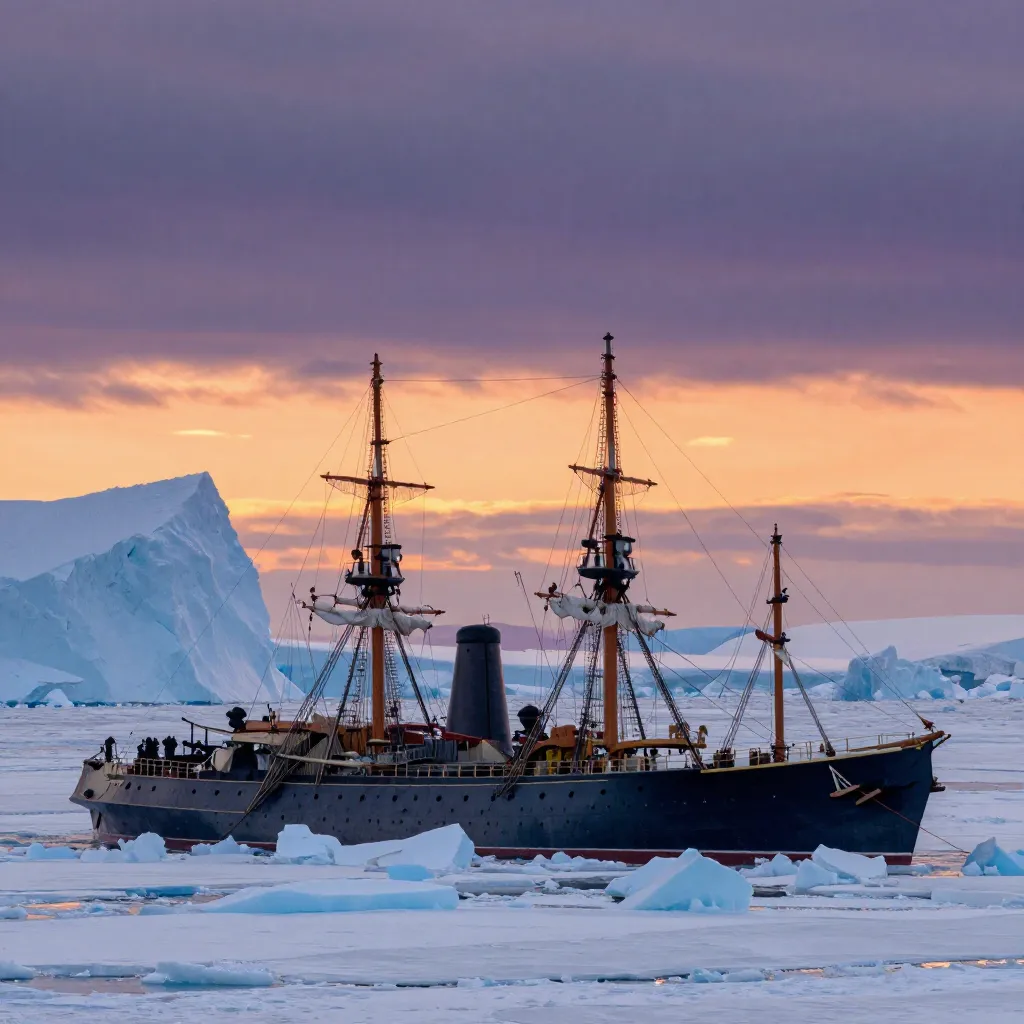
On May 19, 1845, two of the most advanced ships in the world — HMS Erebus and HMS Terror — sailed from Greenhithe, England, bound for the Northwest Passage, the fabled sea route connecting the Atlantic and Pacific Oceans through the frozen archipelago of the Canadian Arctic. Commanded by Sir John Franklin, a veteran Arctic explorer then fifty-nine years old, the expedition carried 129 officers and men, three years’ worth of provisions, early steam engines retrofitted from railway locomotives, and the confident expectations of an empire at the height of its power. The Royal Navy had been probing the Arctic for decades. The Northwest Passage was the last great prize of maritime exploration, and Franklin’s expedition — the best-equipped, best-supplied, and most technologically advanced ever sent into the ice — was expected to succeed where others had failed. Instead, it became the worst disaster in the history of Arctic exploration. Not a single man returned. The ships vanished. For a decade and a half, the fate of the Franklin expedition was the most compelling mystery in the English-speaking world — a mystery that was only truly beginning to be solved in the twenty-first century, when the wrecks of Erebus and Terror were finally found on the Arctic seabed, exactly where Inuit oral tradition had said they were all along.
The story of the Franklin expedition is a tragedy of hubris, a detective story spanning two centuries, and a powerful reminder that indigenous knowledge, long dismissed by European science, held truths that decades of official search parties could not uncover. It is also one of the most remarkable cold-case investigations in history — one that combined Inuit testimony, Victorian scandal, modern forensics, and underwater archaeology to piece together, bit by agonizing bit, what happened to 129 men in the most unforgiving environment on Earth.
Sir John Franklin was not the Admiralty’s first choice to lead the expedition. He was fifty-nine, overweight, and had not been to the Arctic in nearly twenty years. His previous overland expedition to map the Arctic coast of Canada (1819–1822) had ended in disaster — eleven of his twenty men had died of starvation, and Franklin himself had narrowly survived. But the first choice, Sir James Clark Ross, declined, and other candidates were unavailable. Franklin got the command, perhaps because his wife, the formidable Jane, Lady Franklin, lobbied tirelessly on his behalf.
The ships themselves were extraordinary. HMS Erebus and HMS Terror were both bomb vessels — heavily built warships designed to withstand the recoil of massive mortars — and had been extensively modified for Arctic service. Their hulls were reinforced with thick oak planking and iron sheathing. Each was fitted with a steam engine cannibalized from a railway locomotive, capable of propelling the ship at about four knots — a crucial advantage in tight ice. They carried hot-water heating systems piped throughout the interior, desalination apparatus for making fresh water from seawater, and an enormous library. The food supply was vast: over 120,000 pounds of flour, nearly 34,000 pounds of preserved meat, and — critically — 8,000 tins of canned food, sealed with solder containing a high proportion of lead.
The provisions were supplied by Stephen Goldner, a London food processor who won the Admiralty contract with the lowest bid. Goldner’s tins were large, hastily manufactured, and poorly soldered — the lead-based solder was applied so carelessly that it often dripped into the food itself. When the tins were examined decades later, many were found to have defective seals, allowing bacterial contamination. Modern forensic analysis of remains from the expedition, conducted by Owen Beattie of the University of Alberta beginning in 1981, revealed bone lead levels hundreds of times higher than normal — consistent with chronic lead poisoning from the canned provisions. Lead poisoning causes fatigue, confusion, impaired judgment, and eventually death — a devastating combination for men trying to survive in the Arctic. However, more recent research has questioned whether lead alone was sufficient to cause the expedition’s failure, noting that the crew of HMS Terror had been eating from similar tins during a previous Antarctic expedition (1839–1843) without apparent ill effects.
The expedition sailed first to the Orkney Islands, then across the Atlantic to Disko Bay on the west coast of Greenland, where it anchored in late June 1845. Here, five men were discharged to England as unfit, reducing the expedition’s complement to 129. On July 26, 1845, two whaling ships sighted Erebus and Terror moored to an iceberg in Baffin Bay, waiting for ice to clear in Lancaster Sound. The whaling captains spoke briefly with Franklin’s officers. Then the two ships sailed west into Lancaster Sound, the gateway to the Arctic archipelago. No European ever saw any member of the Franklin expedition alive again.
For three years after the last sighting, nothing was heard from the expedition. The Admiralty, unconcerned at first — Franklin carried three years’ provisions — began organizing search parties in 1847. Over the next decade, more than thirty expeditions would be sent to find Franklin and his men, making it the largest search-and-rescue operation in history.
The first solid clue came in August 1850, when searchers discovered the ruins of the expedition’s first wintering camp at Beechey Island, at the entrance to Wellington Channel. They found the graves of three crew members — John Torrington, John Hartnell, and William Braine — who had died during the first winter of 1845–1846. The bodies, preserved in the permafrost, would later be exhumed and examined in the 1980s, revealing high lead levels and signs of tuberculosis. But Beechey Island told searchers only where the expedition had been, not where it had gone or what had happened next.
The most important single document in the entire Franklin mystery was found on May 6, 1859, by a search party led by Francis Leopold McClintock, acting on instructions from Lady Franklin. In a cairn at Victory Point on the northwest coast of King William Island, McClintock’s second-in-command, William Hobson, discovered a standard Admiralty form with two messages written a year apart. The first, dated May 28, 1847, reported that Erebus and Terror had wintered in the ice off Beechey Island in 1845–1846, then sailed south through Wellington Channel. “Sir John Franklin commanding the Expedition. All Well.” The second message, written in the margins of the same form by Captain Fitzjames of Erebus on April 25, 1848, told a dramatically different story. Sir John Franklin had died on June 11, 1847 — just two weeks after the first message was written. By April 1848, a total of nine officers and fifteen men had perished. The ships had been beset in the ice since September 12, 1846 — trapped for nineteen months. The surviving officers had decided to abandon the ships and attempt to march south to the Great Fish River (now the Back River) on the Canadian mainland. The Victory Point note was the expedition’s last written testament.
In 1854, the Scottish explorer Dr. John Rae, surveying the Arctic coast for the Hudson’s Bay Company, encountered a group of Inuit near Pelly Bay who possessed a remarkable collection of objects: a silver fork bearing the Franklin family crest, a medal belonging to one of Franklin’s officers, buttons, telescopes, and other items clearly from the expedition. The Inuit told Rae a chilling story: they had encountered a large party of white men, perhaps forty in number, pulling a boat on a sledge south along the west coast of King William Island. Later, they had found the bodies of perhaps thirty men. Many had been mutilated — their flesh had been cut from their bones. The Inuit testimony was clear: the men had resorted to cannibalism in their final desperate days.
Rae reported his findings to the Admiralty and the London Times published the story. The reaction was explosive. Victorian England refused to believe that officers and gentlemen of the Royal Navy could have resorted to such barbarism. Charles Dickens, the most influential writer in the English language, wrote a furious two-part essay in his magazine Household Words denouncing Rae’s report and casting doubt on the reliability of Inuit testimony. Lady Franklin was equally appalled — not by the cannibalism itself, but by the suggestion that her husband’s men had died anything other than heroic deaths. Rae was effectively vilified for telling the truth. It would take over a century for forensic evidence to vindicate him completely.
The Inuit of the central Arctic — particularly the Netsilik Inuit of King William Island and the Inuinnait of the surrounding region — had detailed oral accounts of encounters with Franklin’s men and of the ships’ final locations, passed down through generations. For over a century, this knowledge was dismissed or ignored by European researchers. Inuit oral history described one ship being crushed in ice near O’Reilly Island and another drifting south to Terror Bay. When Parks Canada and the Inuit community of Gjoa Haven finally mounted a serious search based partly on Inuit testimony, the results were extraordinary. HMS Erebus was found in September 2014 in Wilmot and Crampton Bay, near O’Reilly Island, in just eleven meters of water. HMS Terror was found in September 2016 in Terror Bay, on the south coast of King William Island — precisely where Inuit accounts had placed it. The Inuit had known the answer for 160 years. Nobody had thought to ask them properly.
Underwater archaeological investigation of the wrecks, conducted in brief summer windows by Parks Canada’s team, has yielded extraordinary finds. Divers have entered the captain’s cabin of Erebus and recovered hundreds of artifacts: navigation instruments, ceramic tableware, personal items bearing officers’ initials, medicine bottles, and scientific equipment. The preservation is astonishing — leather boots, brass buttons, and even fragments of paper have survived in the cold Arctic water. On Terror, the closed hatches suggest the ship may have been deliberately sealed before abandonment, raising the tantalizing possibility that the interior may contain logbooks, maps, photographs, and written records that could finally answer the outstanding questions about the expedition’s fate.
Modern forensic science, applied to skeletal remains scattered across King William Island and to the Beechey Island burials, has painted a picture of cumulative, overlapping catastrophes. Lead poisoning from poorly soldered cans caused neurological damage and impaired judgment. Scurvy, despite the expedition carrying lemon juice, may have weakened the men as vitamin C was destroyed by cooking. Tuberculosis was found in the Beechey Island remains, and the crowded conditions aboard ship would have facilitated transmission. Some researchers have proposed that improperly sterilized canned food could have caused botulism, producing rapid paralysis and death. And the final killer was starvation and exposure — after abandoning the ships in April 1848, the surviving men faced a march of hundreds of miles across barren, frozen terrain with inadequate supplies and no knowledge of Inuit survival techniques.
John Rae was right about the cannibalism. In the 1990s and 2000s, skeletal biologists including Anne Keenleyside of Trent University examined bones from dozens of sites across King William Island and found conclusive evidence of cut marks, chop marks, and breakage patterns consistent with defleshing and marrow extraction — the unmistakable signatures of survival cannibalism. The evidence does not suggest ritual or recreational cannibalism, but the desperate, final act of starving men trying to stay alive. The Victorian establishment that had condemned Rae and dismissed Inuit testimony owed his memory a profound apology. In 2014, the Royal Geographical Society installed a plaque at Rae’s birthplace in Orkney, acknowledging his achievements. In the same year, the wrecks of the ships he had sought were found.
The Franklin expedition is a story about the limits of technology, the arrogance of empire, and the wisdom of people who were dismissed as primitives. Sir John Franklin and his men sailed into the Arctic with the best equipment the Industrial Revolution could produce, and the Arctic killed them all. For 160 years, the official searchers, the scientists, and the historians could not find the ships. The Inuit knew where they were. They had always known. The discovery of HMS Erebus and HMS Terror is one of the greatest archaeological triumphs of the twenty-first century, and it belongs as much to Inuit oral history as to sonar technology and underwater robotics. The ongoing investigation of the wrecks — still in its early stages, limited by the short Arctic diving season and the remote location — may one day yield written records that tell us, in the words of the men themselves, what really happened during those terrible final months. But even if the logs remain sealed forever, the broad outlines of the story are now clear: lead, ice, starvation, and a doomed march into oblivion. One hundred and twenty-nine men sailed into the ice. The ice kept them for 170 years. The Inuit never forgot.
References & Further Reading
Britannica: Franklin Expedition — Authoritative summary of the expedition and its legacy
Wikipedia: HMS Erebus (1826) — History of the bomb vessel later converted for Arctic exploration
History Hit: Terror in the Arctic — The Doomed Quest of HMS Terror and Erebus
📚 Recommended Reading: Ice Ghosts: The Epic Hunt for the Lost Franklin Expedition by Paul Watson (on Amazon) — As an Amazon Associate, we earn from qualifying purchases.
Editorial note: The Franklin expedition is documented through Admiralty records, Inuit oral testimony, the Victory Point note, Owen Beattie’s forensic investigations, and Parks Canada’s ongoing underwater archaeology. See our Editorial Policy.