El Dorado: The Legendary City of Gold That Drove Conquistadors Mad
In 1541, a Spanish conquistador named Gonzalo Pizarro — brother of the man who had conquered the Inca Empire and seized its mountains of gold — marched out of the city of Quito at the head of an army of 4,000 men, thousands of horses, dogs, and pigs, and a shimmering dream that would prove more deadly than any enemy. Somewhere in the vast, uncharted interior of South America, native informants had told him, there was a city made entirely of gold — a fabulous kingdom of incalculable wealth whose king covered himself in gold dust every morning and washed it off every night in a sacred lake. Pizarro and his men plunged into the Amazon rainforest, hacking their way through vegetation so thick that sunlight never reached the forest floor, crossing rivers teeming with piranhas, enduring disease, starvation, desertion, and attacks from indigenous warriors who wanted nothing to do with the armored strangers from across the sea. Within months, the expedition had disintegrated. Men died by the hundreds — from fever, from hunger, from poisoned arrows, from drowning, from sheer exhaustion. By the time the survivors stumbled out of the jungle, the dream of El Dorado — The Gilded One — had consumed thousands of lives and produced nothing but a continent-sized graveyard. Yet the legend would endure for another 80 years, driving some of the most extraordinary and disastrous expeditions in the history of exploration, and leaving behind a mystery that still resonates: was there ever a city of gold, or was the greatest treasure hunt in history built on nothing more than a misunderstood ritual?
The Spanish conquest of the Americas in the early 16th century had produced wealth beyond the imagining of Renaissance Europe. The fall of the Aztec Empire in 1521 yielded vast quantities of gold and silver. The conquest of the Inca Empire in 1533 produced even more — the ransom of the Inca emperor Atahualpa alone filled a room measuring 22 by 17 feet with gold objects. These staggering discoveries convinced the Spanish — and the other European powers who watched with envious eyes — that the New World contained almost limitless precious metals, if only one could find them. Reports filtered back from the interior of Colombia, Venezuela, and the Amazon basin, describing indigenous peoples who wore gold ornaments, performed rituals involving gold, and spoke of still greater treasures deeper in the unexplored wilderness. The stage was set for one of history’s most obsessive and destructive quests — a search that would reveal at least as much about the seekers as about the sought.
The truth behind the legend of El Dorado is both more fascinating and more humble than the myth. The original “El Dorado” — The Gilded Man — was not a city, a kingdom, or an empire. It was a person: the zipa, the king or chief of the Muisca people, one of the four most advanced civilizations of the pre-Columbian Americas (alongside the Aztec, Maya, and Inca). The Muisca lived in the highlands of present-day Colombia, in the fertile Altiplano Cundiboyacense surrounding the modern capital of Bogotá. They were a confederation of chiefdoms — not a single unified state, but a network of allied communities governed by two principal rulers (the zipa in the south and the zaque in the north). They were skilled goldsmiths, farmers, weavers, and astronomers who maintained a sophisticated calendar and a complex pantheon of gods.
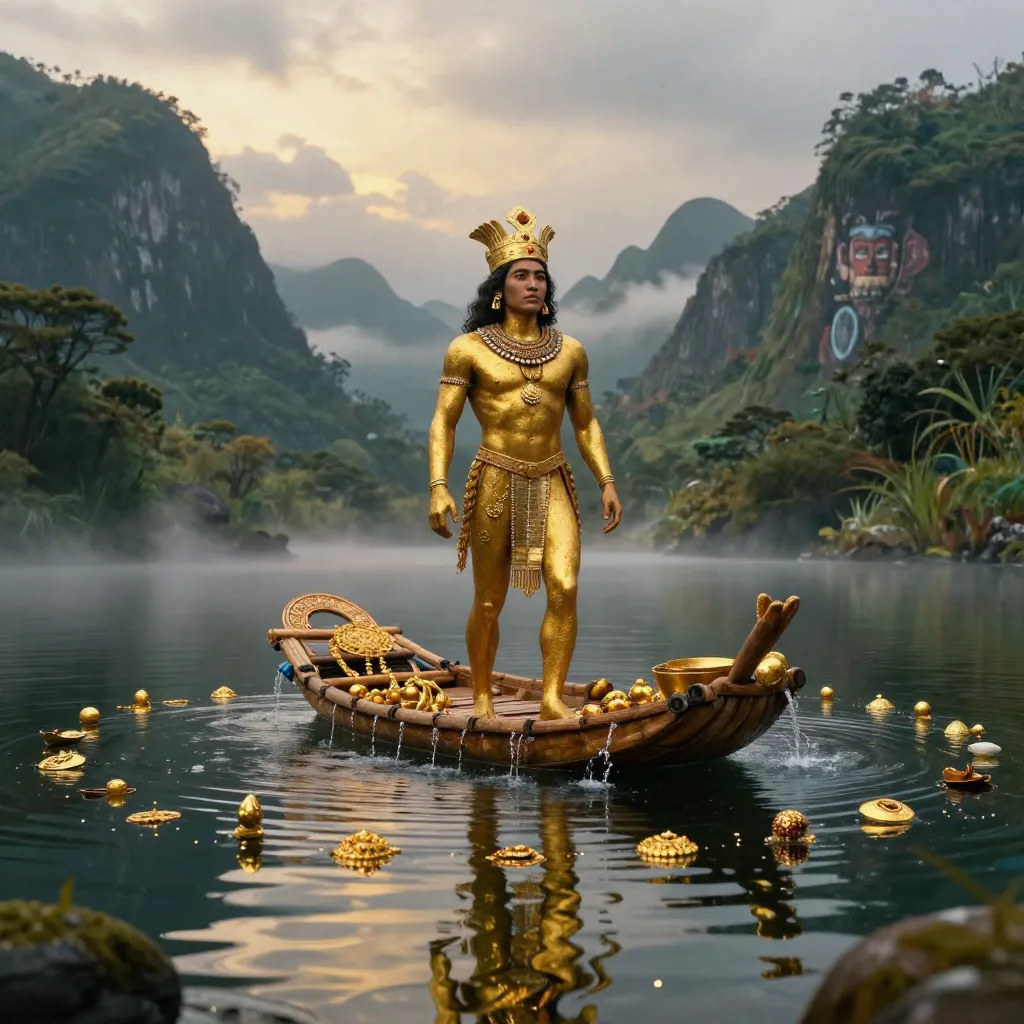
According to Spanish chronicles — filtered, as always, through the biases and misunderstandings of the conquerors — the Muisca performed a remarkable ceremony at Lake Guatavita, a circular crater lake nestled in the hills approximately 57 kilometers (35 miles) northeast of present-day Bogotá. When a new zipa was installed, the ritual required him to strip naked, cover his entire body with a fine layer of gold dust, and float out onto the surface of the sacred lake on a raft laden with gold and emeralds. Surrounded by priests and attendants in canoes, the gilded king would reach the center of the lake and dive into the cold water, washing the gold dust from his body as an offering to the gods. At the same time, his attendants would hurl gold ornaments, emeralds, and other precious objects into the lake. The ritual was a ceremony of investiture and offering — a symbolic union between the new ruler and the divine forces believed to inhabit the sacred waters. It was not a display of unlimited wealth; it was a religious act, performed with the reverence and awe appropriate to a people who believed that gold was the sweat of the sun god Súa and that the lake was a doorway to the spiritual world.
In 1969, two campesinos working in a cave near the town of Pasca, about 40 kilometers south of Bogotá, discovered a small but extraordinary gold object — the Muisca Raft (Balsa Muisca). Measuring just 19.5 × 10.2 × 10.1 centimeters (7.7 × 4.0 × 4.0 inches), the raft depicts the El Dorado ceremony in miniature: a central standing figure (the zipa, adorned with a headdress and nose ornament) surrounded by smaller attendants, all rendered in extraordinary detail through lost-wax casting in an alloy of gold, silver, and copper. The raft has been dated to between 1295 and 1410 CE — centuries before the Spanish arrived. It is now the centerpiece of the Gold Museum (Museo del Oro) in Bogotá, which houses over 55,000 pieces of pre-Columbian goldwork, the largest such collection in the world. The Muisca Raft has become a national emblem of Colombia and appears on Colombian postage stamps. It is, ironically, the closest thing to El Dorado that has ever actually been found — not a city of gold, but a small, exquisite model of a ritual that the Spanish wildly misunderstood.
The transformation of a Muisca ritual into one of history’s most enduring legends is a case study in how miscommunication, greed, and cultural incomprehension can create a myth powerful enough to reshape a continent. When the first Spanish explorers reached Muisca territory in the 1530s, they found a civilization that was rich in gold — but rich in the way that a deeply religious society is rich in sacred objects, not in the way that a mining empire is rich in bullion. The Muisca obtained gold through trade and panning from rivers, not from mines, and they used it primarily for religious and ceremonial purposes, not as currency. But the Spanish — whose entire conception of the New World was shaped by the staggering quantities of gold they had already extracted from Mexico and Peru — heard stories of a king covered in gold dust plunging into a lake filled with treasure, and their imaginations did the rest.
The first Spanish explorer to reach Muisca territory was Gonzalo Jiménez de Quesada, who led an expedition of approximately 800 men up the Magdalena River in 1537. After a grueling march through tropical lowlands, during which most of his men died of disease and starvation, Jiménez de Quesada reached the Muisca highlands and found a civilization that impressed him deeply. He seized a substantial quantity of gold — including objects taken from the Muisca temples and graves — but he did not find the legendary city of gold. Nevertheless, the stories he and his men brought back to the coast fueled the legend. Within a few years, “El Dorado” had evolved in the European imagination from a gilded man performing a ritual to an entire city made of gold, then to a kingdom, and finally to an empire of unimaginable wealth located somewhere in the vast, unexplored interior of South America — a place that existed in the fevered space between rumor and wishful thinking, always just beyond the next ridge of mountains, the next bend of the river, the next expedition.
Over the next 80 years (roughly 1530s to 1610s), a succession of European expeditions set out to find El Dorado, each more disastrous than the last. In 1541, Gonzalo Pizarro marched east from Quito with 4,000 soldiers and indigenous porters, plunging into the Amazon rainforest in search of the golden city. Conditions were catastrophic — the jungle swallowed men whole. Pizarro’s lieutenant, Francisco de Orellana, was sent ahead with a small party to find food and never returned. Instead, Orellana became the first European to navigate the entire length of the Amazon River, from its tributaries in the Andes to the Atlantic Ocean — a journey of over 6,000 kilometers (3,700 miles) that took nearly eight months. Orellana’s account of the journey, filled with descriptions of large indigenous settlements and hints of wealth, only fed the El Dorado legend further.
In Venezuela, the German explorer Philipp von Hutten, backed by the Welser banking family of Augsburg, spent years (1541–1545) searching the Venezuelan llanos for El Dorado. He reportedly found evidence of large indigenous communities but no golden city — and was eventually killed by a rival Spanish expedition led by Juan de Carvajal, demonstrating that the greatest danger in the search for El Dorado was often other Europeans. Nikolaus Federmann, another German explorer working for the Welser family, led a separate expedition across the Venezuelan plains in the same period, also without success.
The idea that Lake Guatavita contained vast quantities of sunken gold proved almost as irresistible as the legend of the city itself. In the 1540s, Spanish settlers attempted to drain the lake by cutting a notch in the crater rim, lowering the water level enough to recover some gold objects from the exposed shoreline — but not the treasure they expected. In the 1580s, a merchant named Antonio de Sepúlveda employed a large workforce to deepen the notch and recover more gold. He found some ornaments and emeralds, but the effort bankrupted him. Between 1898 and 1912, the Company Ltda. del Tesoro de Colombia (Colombian Treasure Company) actually managed to drain the lake by tunneling through the crater wall — but when the water receded, the exposed mud dried into a concrete-like hardness, making it impossible to extract whatever lay beneath. The company went bankrupt. In 1965, the Colombian government declared Lake Guatavita a protected archaeological site, prohibiting all further treasure hunting. Modern archaeological investigations, including a 2023 study published in Latin American Antiquity by the Gold Museum, suggest that while ritual offerings were made at the lake, the scale was far smaller than the legends implied — small-scale votive offerings rather than the mass deposit of gold that the Spanish imagined.
No figure embodies the tragic futility of the El Dorado quest more fully than Sir Walter Raleigh (1552–1618) — the English courtier, soldier, explorer, poet, and favorite of Queen Elizabeth I. Raleigh was captivated by the legend of El Dorado for decades, convinced that the golden city was located at the headwaters of the Caroní River in what is now Venezuela. In 1595, he mounted his first expedition, sailing up the Orinoco River with a small fleet and penetrating hundreds of miles into the South American interior. He found no gold, no city, and no empire — but he did produce a bestselling book, “The Discovery of Guiana” (1596), which described the Orinoco basin in vivid, tantalizing language and kept the El Dorado legend alive for another generation. Raleigh wrote that the golden city was real and that its discovery was merely a matter of time and resources — a claim that would prove fatal.
After Elizabeth’s death in 1603, Raleigh fell out of favor with her successor, King James I, who imprisoned him in the Tower of London on various charges. Raleigh persuaded James to release him for one final expedition to find El Dorado — promising gold, glory, and a new English colony in South America. In 1617, Raleigh set sail with a fleet of 14 ships and over 1,000 men. He sent his son, Watt Raleigh, up the Orinoco with a detachment of troops. The expedition was a disaster from the start. Watt Raleigh was killed in a battle with Spanish forces at the Venezuelan town of San Tomé. The surviving officers returned to their ships empty-handed. When Raleigh returned to England in disgrace, King James — who had ordered him not to provoke the Spanish — had him executed by beheading on October 29, 1618, ostensibly for crimes committed years earlier but in reality for the unforgivable sin of failing to find El Dorado. Raleigh’s execution marked the effective end of the great European quest for the golden city.
The quest for El Dorado consumed an estimated thousands of European and indigenous lives over approximately 80 years (1530s–1610s). Gonzalo Pizarro’s 1541 expedition set out with roughly 4,000 men; the vast majority died in the Amazon rainforest from disease, starvation, and indigenous attacks. Gonzalo Jiménez de Quesada’s 1537 expedition started with about 800 men; only 166 reached the Muisca highlands alive. Philipp von Hutten was killed not by the jungle but by rival Spaniards. Watt Raleigh was killed fighting the Spanish in Venezuela; his father was executed upon returning to England. The indigenous peoples of the affected regions — the Muisca, the peoples of the Orinoco, the inhabitants of the Amazon basin — suffered catastrophically from European diseases, enslavement, and violence, with population losses estimated at 80–90% in some areas within decades of first contact.
While the Spanish destroyed the Muisca civilization in their relentless search for gold, the Muisca’s actual legacy has survived in ways that the conquistadors could never have imagined. The Gold Museum (Museo del Oro) in Bogotá now houses the world’s largest collection of pre-Columbian goldwork — over 55,000 pieces, many of them Muisca in origin. These objects — pendants, nose ornaments, breastplates, tunjos (votive figurines), and the magnificent Muisca Raft — reveal a civilization of extraordinary artistic skill and deep spiritual sophistication. The Muisca used gold not as currency or as a measure of personal wealth, but as a sacred material — the “sweat of the sun” — employed in rituals that connected the human world to the divine. The gold objects were not meant to be hoarded; they were meant to be offered, worn, and deposited in lakes and caves as gifts to the gods.
The archaeological study of Lake Guatavita continues to yield insights. A 2023 study published in Latin American Antiquity by researchers from the Gold Museum documented the results of an archaeological survey around the lake, finding evidence of a shrine site where small-scale ritual offerings took place — but not the mass deposits of gold that the Spanish imagined. The study concluded that the fame of Lake Guatavita was amplified by Spanish chronicles that exaggerated the scale of the ceremonies, feeding the myth of El Dorado. The real Muisca world was impressive enough: a confederation of chiefdoms with a population estimated at between 500,000 and one million at the time of Spanish contact, practicing advanced agriculture, maintaining extensive trade networks, and producing goldwork of a beauty and technical sophistication that rivals anything produced in the ancient Mediterranean world. The irony is profound: the Spanish destroyed a real civilization in pursuit of an imaginary one, and the gold they sought was never as valuable as the culture they annihilated.
The story of El Dorado is, at its heart, a story about the power of a story. A ritual — a king covered in gold dust, diving into a sacred lake — was transformed by the alchemy of European greed into a city of impossible wealth, a kingdom of fabled splendor, an empire that existed only in the space between what people wanted to believe and what was actually there. For 80 years, the legend drove men to their deaths in the most inhospitable landscapes on Earth — the Amazon rainforest, the Venezuelan llanos, the Colombian highlands. It consumed the lives of thousands of Europeans and contributed to the destruction of indigenous civilizations whose true wealth — their art, their religion, their social organization, their knowledge — far exceeded the value of any golden city. The Muisca Raft in Bogotá, barely 20 centimeters long, is worth more than all the imaginary cities of gold combined: it is a real object, made by real hands, depicting a real ceremony, testifying to a real civilization that was destroyed by people who could not see the treasure right in front of them because they were too busy chasing a mirage. The term “El Dorado” has entered the language as a synonym for any illusory place of fabulous wealth — a fitting legacy for a legend that was, from beginning to end, the greatest treasure hunt that never found treasure.
References & Further Reading
Wikipedia: Lake Guatavita — The sacred crater lake where the El Dorado ritual was performed
📚 Recommended Reading: El Dorado, land of gold by Dennis Abrams (on Amazon) — As an Amazon Associate, we earn from qualifying purchases.
Editorial note: The El Dorado legend is documented through Spanish colonial chronicles, archaeological investigations at Lake Guatavita, the collections of the Gold Museum in Bogotá, and modern scholarship including the 2023 study in Latin American Antiquity. See our Editorial Policy.