Bigfoot: The Elusive Creature That Keeps Eyewitnesses Coming Forward
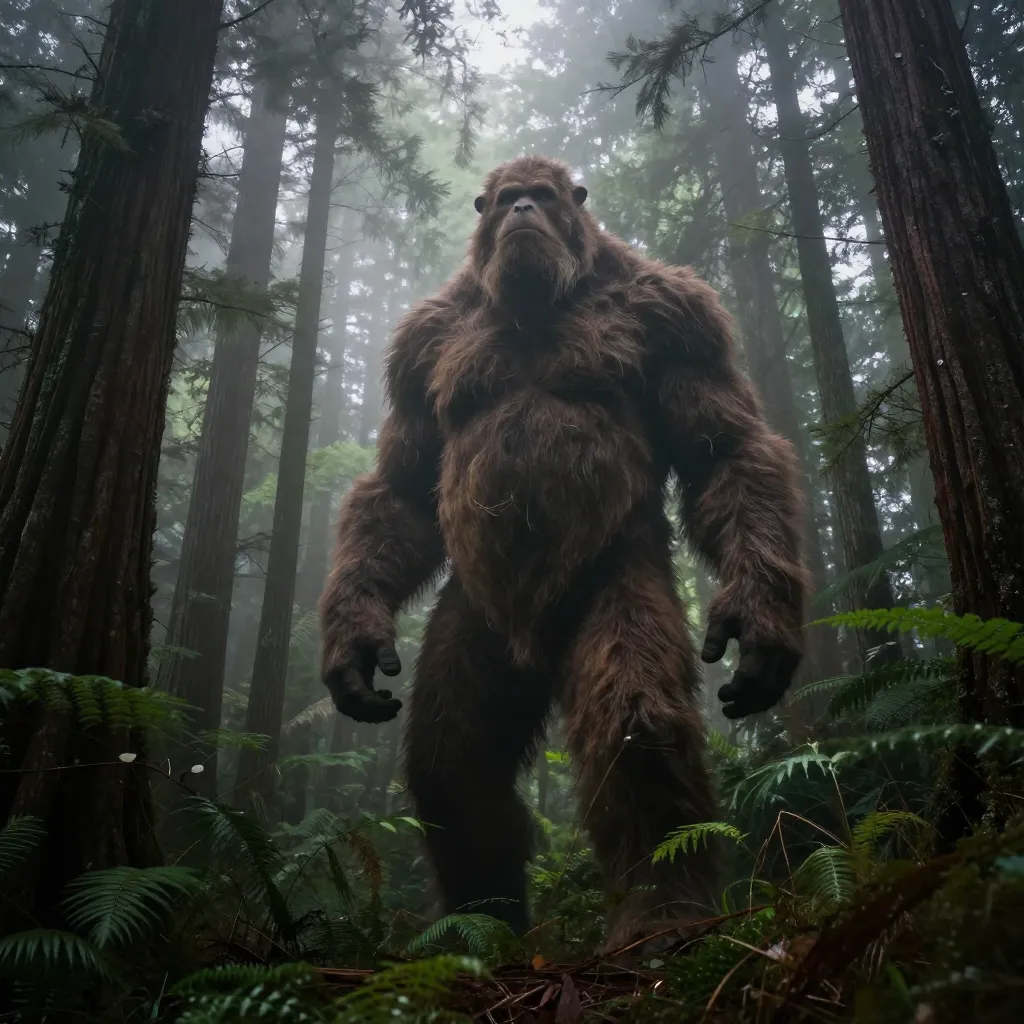
Bigfoot — the most famous and most debated cryptid on Earth, reportedly seen by thousands across North America
Deep in the old-growth forests of the Pacific Northwest — among the towering Douglas firs and western red cedars, in the misty valleys and steep ravines where sunlight barely reaches the forest floor — something may be watching. For centuries, perhaps millennia, people have reported encounters with a massive, hair-covered, bipedal creature standing between six and nine feet tall and weighing an estimated 500 to 800 pounds or more. It walks upright on two legs like a human, but it is covered in dark brown or black hair like an ape. It leaves enormous footprints — some measuring up to 24 inches (60 centimeters) in length. It screams in the night with a voice that sounds like nothing else in the animal kingdom. It has been seen in every state in the continental United States except Hawaii, and in every Canadian province. The Bigfoot Field Researchers Organization (BFRO) maintains a database of over 5,000 reported sightings. And yet, despite decades of searching, despite thousands of eyewitness accounts, despite footprint casts, audio recordings, photographs, and one of the most famous pieces of film in history — no one has ever produced a body, a bone, or a verified DNA sample. Bigfoot — also known as Sasquatch — remains the most famous, most debated, and most sought-after cryptid on Earth.
The creature’s domain is the vast, rugged wilderness of the Pacific Northwest — the dense, rain-soaked forests of Northern California, Oregon, Washington State, and British Columbia, where mountain ranges rise to over 14,000 feet and old-growth timber stretches across millions of acres. This is a landscape so immense and so remote that it is entirely plausible — theoretically — that a large, intelligent, reclusive animal could remain undetected by modern science. The region is home to black bears, cougars, elk, wolves, and other large mammals, and its rugged terrain includes vast roadless areas that have never been thoroughly surveyed. But Bigfoot sightings are not limited to the Pacific Northwest. Reports have come from the Appalachian Mountains of the eastern United States, the Ozarks, the Rocky Mountains, the swamps of Florida (where the creature is known as the Skunk Ape), the Ohio countryside (home of the Ohio Grassman), and the piney woods of Arkansas (where the Fouke Monster inspired the 1972 film The Legend of Boggy Creek). The breadth of the phenomenon — spanning the entire continent — is one of its most puzzling features.
The concept of a large, hairy, wild humanoid creature in the forests of North America is far older than the modern Bigfoot phenomenon. Indigenous peoples across the continent have traditions of such beings that predate European contact by centuries or more. The word “Sasquatch” itself derives from the Halkomelem word “sásq’ets”, used by the Coast Salish peoples of the Pacific Northwest, particularly the Sts’ailes (Chehalis) people of British Columbia, who have a long, deeply held tradition of belief in the creature. For the Sts’ailes, Sasquatch is not a myth but a real, spiritual being — a guardian of the forest, to be respected and avoided. Similar traditions exist among numerous other Indigenous nations across North America, each with their own names and stories. These accounts describe creatures that are typically portrayed as large, hairy, bipedal, and reclusive — broadly consistent with the modern Bigfoot description.
The modern Bigfoot phenomenon was born in 1958 at a remote logging camp near Bluff Creek, California, in Del Norte County. Jerry Crew, a bulldozer operator working for the Wallace Brothers Construction Company, discovered a series of enormous footprints in the mud near his work site — tracks measuring 16 inches (40 centimeters) long. Crew made plaster casts of the footprints and brought them to the attention of the Humboldt Times newspaper. Journalist Andrew Genzoli published the story on October 5, 1958, and in the article, he used the term “Bigfoot” — the first time the name appeared in print. The story was picked up by wire services and quickly spread across the country, capturing the public imagination. The logging company’s owner was Ray Wallace, who would become a central figure in the Bigfoot saga. After Wallace’s death in 2002, his family came forward to claim that Ray had created the Bluff Creek footprints using carved wooden feet strapped to his boots — a confession that skeptics seized upon as proof that the entire Bigfoot phenomenon was a hoax. But Bigfoot researchers countered that the Wallace confession, while undermining some footprint evidence, could not explain the thousands of other sightings, tracks, and encounters that had occurred across the continent both before and after 1958.
On October 20, 1967, Roger Patterson and Robert “Bob” Gimlin were riding horseback through the woods near Bluff Creek, California, when they encountered a large, hair-covered, bipedal creature crouching by a creek bank. Patterson, who had rented a Cine-Kodak K-100 16mm movie camera, leapt from his horse and filmed the creature as it stood up, walked away across a sandbar, and briefly glanced back over its right shoulder before disappearing into the trees. The resulting film — approximately 59.5 seconds of shaky but unmistakable footage — became the most analyzed piece of cryptozoological evidence in history. Frame 352, capturing the creature mid-stride with its head turned toward the camera, is one of the most iconic images of the 20th century. The creature in the film is estimated to be 6 to 7 feet (1.8-2.1 meters) tall, with a muscular build and what appears to be female anatomy. Patterson died of Hodgkin’s lymphoma in 1972, never recanting the film’s authenticity. Gimlin maintained the film was genuine for the rest of his life. Decades of analysis have produced no consensus: some experts argue the creature’s gait and musculature show genuine biological movement impossible to replicate with 1967 costume technology, while others contend it is simply a person in a well-made suit. The film has never been conclusively debunked — and has never been conclusively authenticated.
Long before Jerry Crew found footprints at Bluff Creek, the forests of the Pacific Northwest were already producing encounters that defied easy explanation. One of the earliest and most dramatic occurred in 1924 near Mount St. Helens, Washington, in an area that would become known as “Ape Canyon.” According to the account, a group of miners working a claim in the rugged canyon encountered several large, hair-covered “ape-men” — and after one of the miners shot at the creatures, the group’s cabin was besieged throughout the night by a barrage of rocks thrown by the creatures. The miners reported that the “ape-men” were enormous and that the rocks they threw were too heavy for a human to heave. The miners fled the canyon at dawn, and the story quickly spread through the local communities and into the press. The canyon was subsequently named “Ape Canyon” — a name it retains to this day. Skeptics have proposed that the miners encountered a group of human hermits or were simply embellishing a story, but the incident became one of the foundational legends of Bigfoot lore.
What makes Bigfoot compelling — and what separates it from many other cryptid legends — is the sheer volume and quality of the eyewitness testimony. The witnesses are not all attention-seekers or hoaxsters. They include law enforcement officers, military personnel, park rangers, hunters, loggers, biologists, and ordinary families who were simply in the wrong place at the right time. The BFRO database categorizes sightings by state, date, and witness credibility, and includes many reports from individuals with professional outdoor experience — people who know what bears look like, who are familiar with the local fauna, and who insist that what they saw was not a bear, not a person in a costume, and not any animal they could identify. Sightings typically describe a creature between 6 and 9 feet tall, covered in dark hair, walking upright on two legs, with a distinctive “non-human” gait and an overpowering, foul odor often described as a combination of wet dog, rotting meat, and sulfur. Many witnesses report a feeling of being watched or an eerie silence in the forest immediately before the encounter — as though every bird and animal in the vicinity has gone quiet.
While the overwhelming majority of the scientific community considers Bigfoot to be a combination of misidentification, hoaxes, and folklore, a small number of credentialed researchers have argued that the phenomenon deserves serious investigation. Dr. Grover Krantz (1931-2002), a professor of physical anthropology at Washington State University, was one of the earliest academic proponents. Krantz spent decades studying Bigfoot footprint casts and argued that the dermal ridges (fingerprint-like patterns on the soles of the feet) visible in some casts were anatomically consistent and could not have been faked. He proposed that Bigfoot might be a surviving population of Gigantopithecus blacki, an extinct giant ape that lived in Asia until approximately 100,000 years ago — though critics noted that no fossils of Gigantopithecus have ever been found in North America. Dr. Jeff Meldrum, a professor of anatomy and anthropology at Idaho State University, is the most prominent current academic researcher. Meldrum, author of Sasquatch: Legend Meets Science (2006), has examined hundreds of footprint casts and has argued that the biomechanical evidence is consistent with a real, large, bipedal primate. Perhaps most remarkably, Jane Goodall — the world’s most famous primatologist — stated in a 2002 NPR interview that she was “open-minded” about Bigfoot and that she had met “people whom I respect who have had encounters” that they could not explain.
Beyond the Patterson-Gimlin film, several pieces of physical evidence have kept the Bigfoot debate alive. Footprint casts number in the hundreds, with some showing dermal ridges and anatomical details that researchers like Krantz and Meldrum argue are impossible to fake. The Skookum Cast, discovered in 2000 in the Gifford Pinchot National Forest in Washington State during a BFRO expedition, is a large body impression found in a mud wallow that appears to show the imprint of a large primate’s hip, thigh, and forearm — with hair textures visible in the cast. Audio recordings of alleged Bigfoot vocalizations — typically described as deep, resonant howls, whoops, and screams unlike any known animal — have been analyzed by some researchers as consistent with a large, unknown primate. However, no verified DNA evidence, no body, no fossils, and no type specimen has ever been produced — the fundamental absence that keeps Bigfoot firmly outside the bounds of accepted science.
Any honest discussion of Bigfoot must confront the enormous shadow cast by hoaxes. The history of Bigfoot is riddled with deliberate frauds that have muddied the waters and given skeptics ample ammunition. The most damaging was the 2008 Georgia Bigfoot hoax, in which two men — Matt Whitton and Rick Dyer — claimed to have found a Bigfoot body in a freezer near the Appalachian town of Clayton, Georgia. They held a press conference, produced photographs of a dark, hairy form crammed into a freezer, and demanded money for the “discovery.” When the “body” was finally examined, it was revealed to be a rubber Bigfoot costume stuffed with animal organs. Dyer struck again in 2012, claiming to have shot and killed a Bigfoot near San Antonio, Texas. He toured the country exhibiting a “body” before admitting it was a costume. The Ray Wallace wooden-feet confession, the “Minnesota Iceman” of the 1960s (a carnival exhibit that was almost certainly a latex model), and countless faked YouTube videos have created a fog of deception that makes it extraordinarily difficult to separate genuine reports from manufactured ones.
The hoax industry has had a corrosive effect on Bigfoot research, but it has not killed the phenomenon — because the sightings keep coming. Every year, hundreds of new reports are filed with the BFRO and other organizations, many from credible witnesses who have nothing to gain and much to lose by going public. The persistence of sightings — across decades, across continents, across cultures — is one of the most puzzling aspects of the Bigfoot phenomenon. If Bigfoot were simply a hoax, it should have burned out decades ago. If it were simply misidentification of bears, it should be clustered in areas with high bear populations and rare elsewhere. Instead, sightings come from every type of terrain, every level of outdoor experience, and every demographic group.
Bigfoot has transcended cryptid status to become a genuine American cultural icon. The 1987 film Harry and the Hendersons portrayed Bigfoot as a gentle giant adopted by a suburban family. The Animal Planet television series Finding Bigfoot (2011-2017) ran for nine seasons. Bigfoot is the official state cryptid of Washington State. The town of Willow Creek, California bills itself as the “Bigfoot Capital of the World” and hosts an annual Bigfoot Daze festival. The creature has appeared on T-shirts, beer labels, road signs, and restaurant menus across the Pacific Northwest. Bigfoot has become big business — an irony that is not lost on researchers who worry that commercialization has further eroded the credibility of the phenomenon. But the commercial success of Bigfoot also speaks to something deeper: a cultural hunger for mystery, for the possibility that the modern, mapped, satellite-imaged world still contains secrets.
While “Bigfoot” and “Sasquatch” are the best-known names, the creature has numerous regional identities across North America. The Skunk Ape of Florida and the southeastern swamps is described as smaller than the Pacific Northwest Bigfoot (typically 5-7 feet tall) with a distinctive, overpowering odor reminiscent of rotten eggs or skunk spray. The Ohio Grassman of the Ohio countryside has been reported since the 1800s and is said to travel in family groups. The Fouke Monster of Fouke, Arkansas was the subject of numerous sightings in the 1970s that inspired the influential 1972 docudrama The Legend of Boggy Creek. The Momo (Missouri Monster) was reported in Louisiana, Missouri in 1972. Canada has its own variants, including the Saskatchewan Wildman and the Ontario “Old Yellow Top.” Each variant has its own local folklore, its own cluster of sightings, and its own passionate community of investigators — suggesting that the Bigfoot phenomenon is not a single, localized legend but a continent-wide tradition of encountering something large, hairy, and unexplained in the wild.
The Bigfoot phenomenon is, at its core, a story about the limits of human knowledge. We have mapped the ocean floor, photographed the surface of Mars, and decoded the human genome — and yet we cannot say with certainty whether a large, bipedal primate inhabits the forests of North America. The evidence, such as it is, remains tantalizing but insufficient: thousands of eyewitness accounts from credible witnesses, hundreds of footprint casts with alleged anatomical details, one extraordinary film that has resisted definitive debunking for nearly sixty years, and a handful of tantalizing physical artifacts like the Skookum Cast. Against this stands the complete absence of a body, a fossil, or verified DNA — the hard evidence that science demands and that has never been produced. The most likely explanation, from a scientific standpoint, is that the Bigfoot phenomenon is a complex mixture of misidentification, hoaxes, folklore, and the human tendency to see patterns where none exist. But the possibility — however remote — that something real is out there continues to draw researchers into the field and witnesses out of the woodwork. The forests of the Pacific Northwest are vast, dark, and largely unexplored. They hold their secrets well. And until someone produces a body or proves once and for all that Bigfoot is a myth, the search will continue — driven by the oldest, most powerful force in human inquiry: the desire to know what is hiding in the shadows.
References & Further Reading
Wikipedia: Skunk Ape — The Florida regional variant of Bigfoot reported in the southeastern swamps
📚 Recommended Reading: Bigfoot Sasquatch Evidence by Loren Coleman (on Amazon) — As an Amazon Associate, we earn from qualifying purchases.
Editorial note: Bigfoot/Sasquatch is documented through thousands of eyewitness reports, footprint casts, film evidence, and the work of both credentialed researchers and dedicated amateur investigators. See our Editorial Policy.