The Baghdad Battery: Did Ancient Civilizations Discover Electricity 1,500 Years Early?
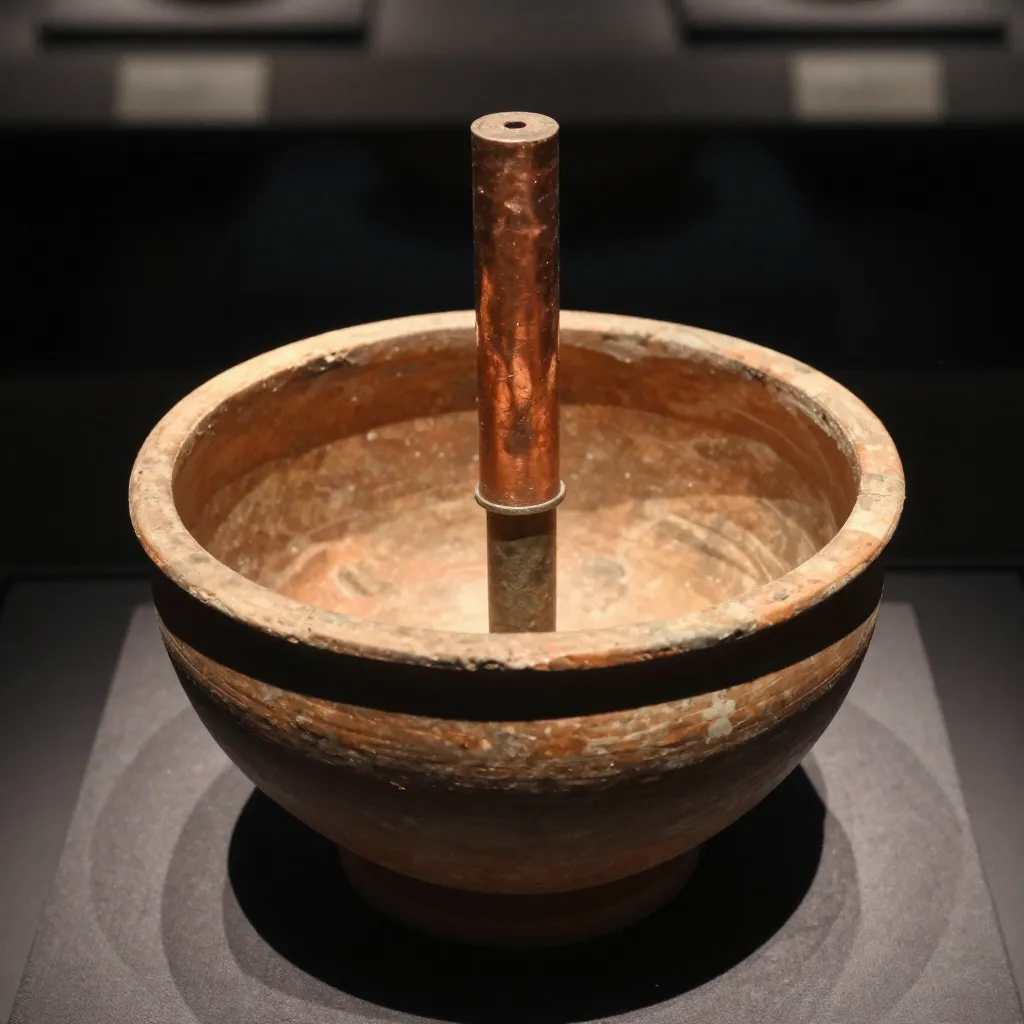
The Baghdad Battery: a 2,000-year-old clay jar that can generate electricity. Did ancient civilizations discover galvanic cells over a millennium before Volta?
In 1936, workers building a railway line near the village of Khujut Rabu, just outside modern Baghdad, stumbled upon an ancient grave that would spark one of the most heated debates in the history of archaeology. Among the pottery, beads, and burial goods excavated from the site was a small, unassuming terracotta jar — about 13 centimeters (5.5 inches) tall — that looked, at first glance, like nothing special. But when German archaeologist Wilhelm König examined the jar more closely, he found something extraordinary inside: a copper cylinder rolled into a tube, capped at the bottom with a copper disc and sealed with asphalt, with a narrow iron rod suspended down the center, held in place by another asphalt plug at the top. The iron rod did not touch the copper. König, who was the director of the laboratory of the National Museum of Iraq, recognized the configuration immediately. It was, in essence, a galvanic cell — a battery. If the jar were filled with an acidic liquid such as vinegar, grape juice, or lemon juice, a chemical reaction between the copper and iron would produce a small but measurable electrical current. The artifact was dated to the Parthian period (circa 250 BCE – 224 CE), which meant that if König was right, this humble clay jar predated Alessandro Volta’s invention of the modern battery in 1800 by more than 1,500 years.
The Baghdad Battery consists of three components fitted together with remarkable precision. The outer container is a terracotta jar approximately 13 centimeters tall and about 8 centimeters in diameter at its widest point. Inside the jar sits a copper cylinder made from a sheet of copper rolled into a tube approximately 9 centimeters long and 2.6 centimeters in diameter. The bottom of the copper tube is capped with a copper disc held in place by asphalt (bitumen). A narrow iron rod approximately 8 centimeters long is suspended down the center of the copper tube, held in place by an asphalt plug at the top. The iron rod does not touch the copper cylinder at any point — it is isolated by the asphalt seal and by empty space. What makes this configuration remarkable is that it perfectly matches the design of a basic galvanic cell. Two dissimilar metals immersed in an electrolyte — a liquid that conducts electricity, such as vinegar (acetic acid) or lemon juice (citric acid) — create a flow of electrons from the iron rod (the anode) to the copper cylinder (the cathode), producing a small electrical current.
König was not the first person to recognize this potential, but he was the first to publish a detailed analysis arguing that the artifact was designed as a battery. In his 1940 paper, he described the jar as the oldest known electric cell in existence and speculated that it might have been used for electroplating — the process of depositing a thin layer of metal onto a surface using electrical current. This was a provocative claim. The Parthian Empire, which controlled Mesopotamia during the period when the Baghdad Battery was created, was not generally credited with advanced knowledge of chemistry or physics. The idea that Parthian craftsmen might have understood galvanic electricity well enough to build working cells — and to apply them industrially — challenged the comfortable assumption that electrical knowledge began with the European Enlightenment.
If the Baghdad Battery was indeed used for electroplating, the most likely application would have been gilding — coating cheaper objects with a thin layer of gold or silver to make them appear more valuable. Archaeologists have found numerous silver objects from the Parthian and Sassanian periods that show a very thin layer of gold on their surfaces, and some researchers have suggested that electroplating could explain this phenomenon. Experiments have shown that a single Baghdad Battery replica can produce approximately 0.5 to 1 volt of electricity when filled with an acidic electrolyte — not enough to power a modern device, but sufficient for electroplating thin layers of metal. Theoretically, multiple cells could be connected in series to produce higher voltages, just as Volta stacked his cells to create the first true battery. The technology would have been simple enough to replicate: a potter makes a jar, a metalsmith hammers copper into a tube, and the resulting device is filled with common household acid. No deep understanding of electromagnetism is required — only empirical knowledge that the combination produces a useful effect.
Other proposed uses for the Baghdad Battery, if it was a battery at all, include electrotherapy — using mild electrical current to treat pain, a practice known from ancient Egyptian and Greek medical traditions — and religious or ritual purposes, where a mild electric shock administered to worshipers could have been interpreted as divine power. Some have speculated that the batteries might have been used to power small lamps inside temples, though no evidence of ancient electric lighting has ever been found.
The skeptical counterarguments, however, are substantial. The most important objection is that no wires, conductors, or associated electrical equipment have ever been found alongside the Baghdad Battery or anywhere else in the Parthian archaeological record. A battery is useless without a circuit — something to connect the anode to the cathode and complete the loop through whatever device is being powered. The absence of any such equipment suggests that the artifact may not have been electrical at all. Furthermore, the asphalt seals that hold the iron rod in place would make it difficult to refill or maintain the electrolyte, and the design does not include any obvious means of connecting a circuit to the iron rod, which is completely enclosed by the asphalt plug.
Several alternative explanations have been proposed for the Baghdad Battery’s construction. The most widely accepted among skeptics is that the jar was used for scroll storage. In the ancient Near East, sacred or important scrolls were sometimes stored in cylindrical containers to protect them from damage. The copper cylinder could have held a papyrus or parchment scroll, with the iron rod serving as a spindle or core around which the scroll was wrapped. The asphalt seals would have protected the contents from moisture and insects. This interpretation requires no exotic technology and fits comfortably within what is already known about Parthian burial and storage practices. Another theory suggests the jar was used for food storage or fermentation, with the copper cylinder acting as a container for a specific substance that reacted with the clay.
Experiments testing the battery hypothesis have produced mixed results. In the 1990s, researchers at the National Museum of Iraq built replicas of the Baghdad Battery and successfully generated electrical current using grape juice and vinegar as electrolytes. The replicas produced between 0.5 and 1.1 volts — enough to demonstrate that the design works as a galvanic cell. The Discovery Channel program MythBusters also tested the Baghdad Battery in episode 29, building ten replicas connected in series and using them to successfully electroplate a small object. However, the MythBusters team concluded that while the batteries could work, there was insufficient evidence to prove that they were intended to work as batteries.
One of the greatest obstacles to resolving the debate is that the original Baghdad Battery may be lost. During the 2003 invasion of Iraq, the National Museum of Iraq in Baghdad was subjected to catastrophic looting. Thousands of irreplaceable artifacts — including some of the oldest and most significant objects from Mesopotamian civilization — were stolen or destroyed. The Baghdad Battery was among the objects reported missing. While some looted items were later recovered, the current location of the original Baghdad Battery is uncertain. Without the ability to conduct new physical examinations, including metallurgical analysis, chemical residue testing, and advanced imaging, researchers are limited to working from photographs, descriptions, and the few replicas that were made before 2003.
The broader context of the Baghdad Battery debate touches on a recurring theme in the history of technology: the tendency to underestimate the capabilities of ancient peoples. The ancient world produced the Antikythera Mechanism, a geared astronomical computer of astonishing sophistication; Roman concrete that outperforms modern formulations; Damascus steel with properties that metallurgists still struggle to replicate; and Indian wootz steel, Greek flame projectors, and Chinese seismographs. Each of these discoveries challenged the assumption that technological progress is a straight line leading inexorably from primitive to modern. The Baghdad Battery, whether it was a battery or not, belongs to this tradition of artifacts that force us to question what we think we know.
In the end, the Baghdad Battery remains an enigma — an object that could have been an electrical device but might just as easily have been a perfectly ordinary storage container. The evidence is ambiguous, the original artifact may be lost, and the debate has been running for over eighty years without resolution. What makes the Baghdad Battery compelling is not the certainty that ancient Parthians discovered electricity, but the possibility that they might have. It is a reminder that the historical record is full of gaps, that ancient craftsmen were more ingenious than we typically credit, and that the line between primitive and advanced is often blurrier than we assume. Whether the jar from Khujut Rabu was the world’s first battery or simply the world’s most misunderstood storage container, it continues to generate something far more enduring than electrical current: questions.
References & Further Reading
Editorial note: reconstructions are continuously revised as imaging and inscription studies improve. See our Editorial Policy.